Best overall: a gravel-and-pipe French drain with rigid perforated pipe. Best for easier material handling: a prefabricated aggregate-free system. Best for curved routes: flexible corrugated pipe in a properly built gravel trench. This 2026 guide compares yard-drainage designs and explains when a French drain is the wrong fix.
- The best french drain for persistent yard seepage is a correctly graded gravel-and-pipe system with a lawful outlet.
- Prefabricated aggregate-free systems reduce gravel handling but still require correct sizing, filtration, and installation.
- French drains collect subsurface water; catch basins and grading address surface runoff more directly.
- Mainlineplumbingpros connects homeowners nationwide with vetted local licensed and insured plumbers for residential plumbing help.
Why this matters
A French drain collects water moving through soil and carries it toward an outlet. It does not make water disappear. Without a suitable discharge point, a buried trench becomes storage that eventually fills.
Before you buy materials in 2026, identify whether your problem is underground seepage, surface runoff, or a plumbing leak. Those problems need different repairs. Mainlineplumbingpros connects homeowners with vetted local licensed and insured plumbers when a suspected leak or residential plumbing problem needs investigation.
Choose the drainage route and outlet before choosing the pipe. A well-built system in the wrong place still misses the water you need to collect.
What makes the best French drain?
Use these criteria to judge a French drain proposal in 2026—not the appearance of the pipe or packaging.
- Correct water source: The design addresses water traveling through soil, rather than treating every puddle as a subsurface drainage problem.
- A lawful outlet: Collected water has somewhere permitted to go without flooding neighboring property or creating another wet area.
- Consistent fall: The route drains toward its outlet without dips that hold sediment and standing water.
- Suitable filtration: Soil, drainage aggregate, and filter fabric work together to limit fine sediment entering the drainage space.
- Service access: The layout includes practical access for inspection and cleaning instead of burying every connection permanently.
- Installation fit: Pipe strength, depth, surface loading, and manufacturer requirements match the actual yard conditions.
No pipe material compensates for a missing outlet. Treat that as a pass-or-fail requirement before comparing the remaining features.
French drain designs at a glance
These are construction approaches, not branded products. The interceptor option describes placement, so it can use either rigid pipe or an appropriate prefabricated assembly.
| Rank and design | Best for | Standout feature | Key limitation |
|---|---|---|---|
| 1. Rigid perforated pipe with gravel | Persistent yard seepage | A straight, controllable pipe grade | Requires gravel handling and careful trench preparation |
| 2. Prefabricated aggregate-free system | Easier material handling | Packaged drainage space around the pipe | Assembly suitability depends on installation conditions |
| 3. Flexible corrugated pipe with gravel | Curved routes without vehicle loading | Follows bends without numerous rigid fittings | Easier to install with unwanted dips |
| 4. Shallow interceptor French drain | Seepage moving downhill through soil | Collects water before it reaches the wet area | Misses water traveling below or around the trench |
1. Rigid perforated pipe: best for persistent yard seepage
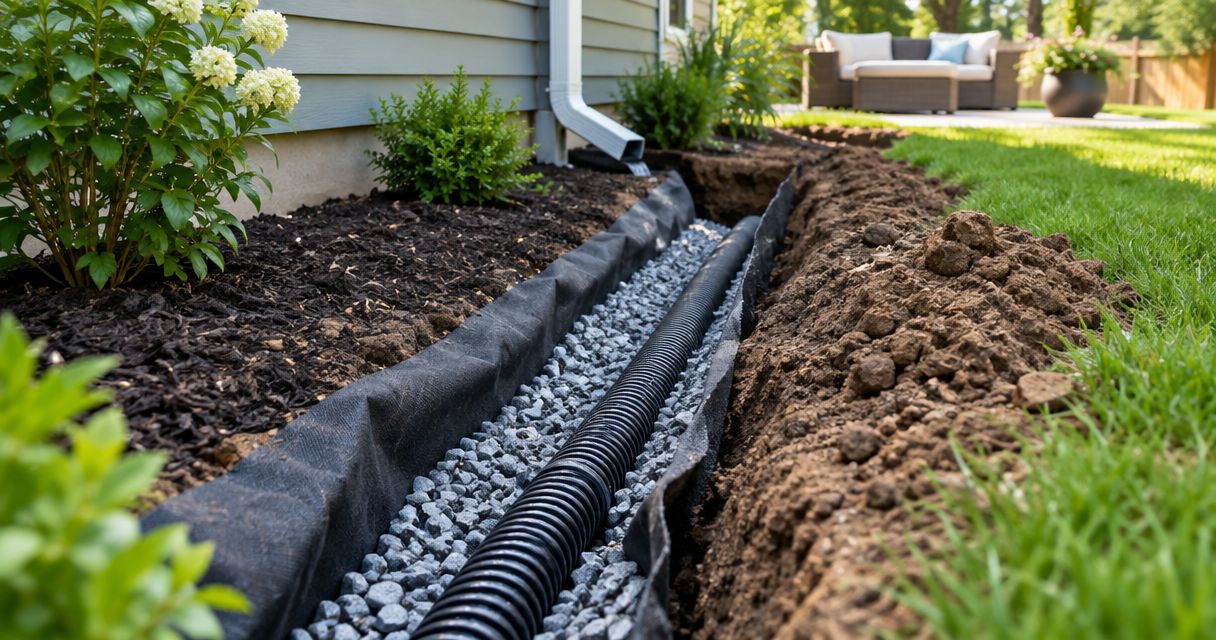
A gravel-and-pipe French drain uses perforated pipe surrounded by clean drainage aggregate. Water enters the trench through the soil, reaches the pipe, and travels toward the outlet. A suitable filter arrangement separates surrounding soil from the drainage material.
Rigid pipe is the default recommendation because its shape makes a straight grade easier to establish and inspect. That advantage disappears if the trench bottom settles or the installer leaves unsupported sections.
Rigid perforated pipe pros:
- Holds a defined alignment during installation.
- Supports planned cleanouts and accessible connections.
- Allows the installer to check grade along a straight route.
- Separates collection sections from solid discharge piping clearly.
Rigid perforated pipe cons:
- Requires excavation and substantial material handling.
- Needs fittings where the route changes direction.
- Still clogs when sediment control or maintenance access is neglected.
Best for: Homeowners with recurring subsurface wetness, a workable trench route, and a lawful gravity outlet.
Specify pipe rated for the installation conditions. A shallow pipe beneath a lawn and a pipe beneath a driveway face different loads; the material name alone does not establish suitability.
Verdict: Buy this design as the default for a properly assessed yard-seepage problem.
2. Aggregate-free systems: best for easier material handling
A prefabricated aggregate-free French drain replaces the conventional gravel envelope with a manufactured drainage assembly. These systems typically combine perforated pipe, lightweight drainage material, and a surrounding fabric layer. Follow the chosen assembly's installation instructions rather than applying a generic trench recipe.
The practical advantage is handling. You move packaged drainage sections instead of placing all the surrounding drainage gravel separately. You still need excavation, a suitable outlet, and a correctly supported route.
Aggregate-free system pros:
- Reduces separate gravel handling.
- Packages the drainage space and pipe together.
- Simplifies transporting drainage material through restricted access areas.
Aggregate-free system cons:
- Requires checking the assembly's permitted depth and loading conditions.
- Does not solve poor grading or an inadequate discharge location.
- Makes the product's installation requirements central to the design.
Best for: Homeowners whose main installation challenge is moving conventional aggregate through a narrow or difficult-access yard.
Do not assume every packaged system handles every soil or loading condition. Ask the installer to identify the actual assembly and explain why its instructions match your site.
Verdict: Buy when reduced material handling matters and the specified assembly fits the installation.
3. Flexible corrugated pipe: best for curved yard routes
Flexible perforated corrugated pipe bends around a route that would otherwise require multiple rigid fittings. In a French drain, it still needs a suitable surrounding drainage envelope and soil separation. The pipe alone is not the drainage system.
Flexibility helps with routing but makes careless installation easier. A pipe that follows every hollow in the trench bottom can retain water and sediment instead of draining consistently.
Flexible corrugated pipe pros:
- Follows gradual curves readily.
- Reduces the need for fittings along a winding route.
- Is easier to maneuver through some restricted work areas.
Flexible corrugated pipe cons:
- Can develop low spots without continuous support.
- Interior corrugations can make cleaning less straightforward than a smooth bore.
- Requires careful attention to loading limits and burial instructions.
Best for: Curved collection routes in non-vehicle areas where the installer can maintain a consistent grade.
Ask how the trench bottom will be prepared and checked before backfilling. Flexibility should solve a routing problem, not excuse an uneven trench.
Verdict: Buy for a genuinely curved route; skip it when flexibility serves no clear purpose.
4. Interceptor French drains: best for uphill soil seepage
An interceptor French drain sits across the path of water moving downhill through soil. Its job is to collect that water before it reaches a soggy lawn section or another vulnerable area. This is a placement strategy, not a separate pipe technology.
Location and depth determine whether it intercepts the actual water path. A shallow trench does little for water moving well below it, and an incomplete route lets water travel around the ends.
Interceptor French drain pros:
- Addresses seepage before it reaches the problem area.
- Can keep the collection trench away from the wettest destination.
- Works with an appropriate rigid or prefabricated collection system.
Interceptor French drain cons:
- Requires a credible assessment of the direction of underground flow.
- Does not replace surface grading for runoff crossing the lawn.
- Needs the same lawful outlet as every other French drain.
Best for: Yards where the observed problem is soil seepage arriving from higher ground.
Keep excavation away from retaining-wall footings and foundations unless a qualified professional has designed the work. Collecting water and protecting structural support are separate requirements.
Verdict: Hold until the water path and safe trench location are established.
When a French drain is the wrong choice
A puddle does not automatically call for perforated pipe. Watch what happens during rainfall and after the rain stops before choosing a system.
| What you observe | More appropriate first assessment | Limitation to understand |
|---|---|---|
| Water runs across the lawn during storms | Surface grading, swales, or catch basins | Surface improvements still need a discharge route |
| A downspout empties beside the house | Roof-water routing through suitable solid piping | Moving roof water elsewhere must not create another hazard |
| Soil stays wet during dry weather | Irrigation or water-supply leak investigation | A drain conceals symptoms without repairing a leak |
| Water appears inside the basement | Foundation drainage and water-entry assessment | Yard drainage alone does not establish the indoor cause |
Catch basins collect surface water directly, but their grates and sumps need cleaning. Swales move runoff across the landscape without a buried collection pipe, but they require suitable space and grading. Neither is automatically better than a French drain; each handles a different water path.
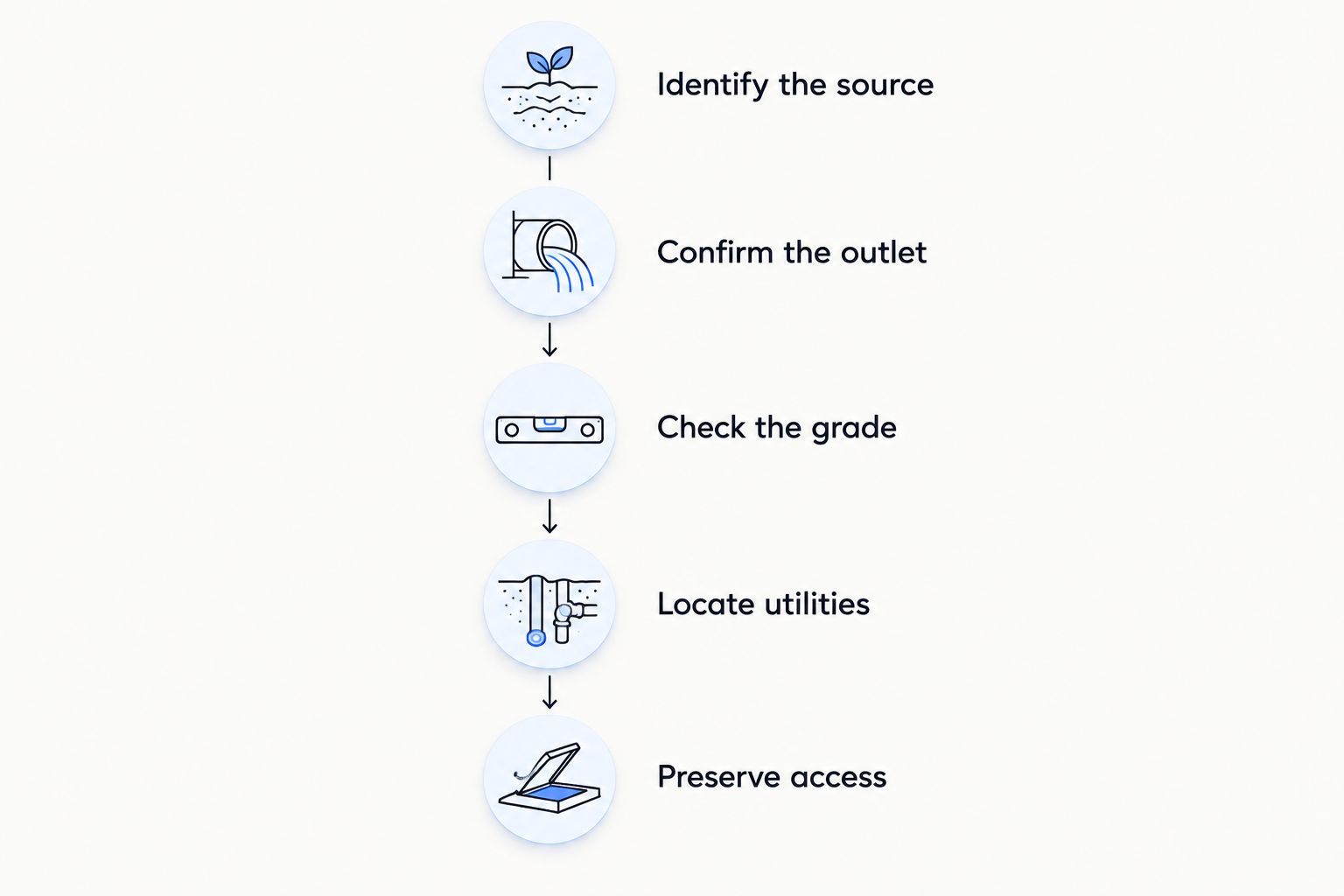
Plan the installation before digging
Identify the source
Observe rainfall from a safe location. Note where water first appears, where it travels, and which areas remain wet afterward. Check irrigation schedules and visible plumbing leaks rather than assuming every wet patch comes from groundwater.
Photographs taken during and after rain help you explain the problem. Mark the wet area and suspected flow direction without opening exploratory trenches near utilities or structures.
Confirm the outlet
Ask where the collected water will discharge and whether that destination is permitted locally. Do not connect yard drainage to a sanitary sewer without explicit authorization, and do not redirect water onto neighboring property.
If gravity discharge is unavailable, pumping requires a separate design assessment. A pump introduces power, maintenance, and discharge requirements; it is not a substitute for choosing a destination.
Check the grade
Use surveyed elevations or an appropriate level, not an eyeballed slope. As an illustration, a 1% slope drops 1 foot over 100 feet. That arithmetic helps you understand the space required; it is not a universal installation specification.
The actual design must account for the starting depth, pipe, outlet elevation, and local requirements. Ask for the planned elevations before approving excavation.
Locate utilities
Contact 811 before digging in the United States and follow the local marking and waiting requirements. Ask about private lines, too: irrigation, landscape lighting, and privately installed utilities are not automatically covered by every locating service.
Do not enter an unsupported trench. Keep children and pets away from excavations, and leave work near structural footings to qualified professionals.
Preserve access
Agree on inspection and cleaning access before backfilling. Photograph the installed route and connections, then keep those records with your home-maintenance information.
How we ranked these designs
This 2026 ranking prioritizes dependable collection, grade control, installation fit, and maintenance access. Rigid perforated pipe takes the default position because a defined alignment supports those goals. Aggregate-free assemblies and flexible pipe earn narrower recommendations for handling and routing needs.
No site inspection or product performance test underlies this comparison. The ranking explains construction choices; it does not establish which design fits an unassessed property.
Which French drain should you choose?
Choose rigid perforated pipe in a correctly filtered gravel trench when subsurface seepage is confirmed and gravity discharge is feasible. Choose an aggregate-free assembly when handling constraints justify it, and flexible pipe when a curved route genuinely requires it.
For 2026 installation proposals, request the same essentials from every contractor: the water source, trench route, outlet, pipe specification, filtration approach, and cleaning access. A proposal that names only a pipe leaves the important design decisions unanswered.
Mainlineplumbingpros is best suited to homeowners seeking a connection to vetted local plumbers rather than a retail French drain kit. For French drain installation specifically, confirm the local professional handles exterior yard drainage before booking the work.
FAQ
What's the best French drain for a wet yard?
A gravel-and-pipe system with rigid perforated pipe is the default choice for confirmed subsurface seepage. It needs suitable filtration, consistent grading, and a lawful outlet; surface runoff often needs a different approach.
Is a gravel-free French drain better than a gravel drain?
A prefabricated aggregate-free system is better for reducing separate gravel handling, not automatically for every drainage problem. Choose it only when the assembly's installation requirements fit the soil, depth, loading, and route.
Can I install a French drain without an outlet?
A French drain needs a suitable discharge destination to keep removing water. A trench without an outlet eventually fills; infiltration systems require their own soil, location, and local-rule assessment.
Should I use rigid or flexible pipe for a French drain?
Choose rigid perforated pipe for a straight, controlled alignment and flexible pipe when a curved route justifies it. Both require proper support, filtration, and a consistent fall toward discharge.
Will a French drain stop water from entering my basement?
A French drain is not a guaranteed solution for basement water entry. Diagnose the entry path, roof runoff, grading, and foundation drainage before deciding whether yard drainage belongs in the repair.
How much slope does a French drain need?
The required slope depends on the design, pipe, outlet elevation, and applicable local requirements. A 1% slope means a drop of 1 foot over 100 feet, but that example is not a universal specification.
Can Mainlineplumbingpros help with a wet yard?
Mainlineplumbingpros connects homeowners nationwide with vetted local licensed and insured plumbers for residential plumbing needs. Request an assessment when a leak or plumbing issue is suspected, and confirm exterior drainage capability before arranging French drain work.
One last thing
Keep collection and discharge piping distinct. Perforated pipe collects water from the surrounding soil; solid pipe carries collected water toward its destination without intentionally releasing it along the route.
Ask the installer to show that transition on the plan. It is a simple question that reveals whether the proposal explains where water enters—and where it finally leaves.
Related guides
- Best sump pumps for basement flooding
- Best battery backup sump pumps
- Best smart water leak detectors for homes
Suspect a leaking pipe or need residential plumbing help? Book a local plumbing assessment. Describe when the wet area appears and confirm the professional's exterior-drainage scope before scheduling excavation.
Book a plumbing assessment
Connect with a vetted local licensed and insured plumber. Confirm yard-drainage capability before booking.