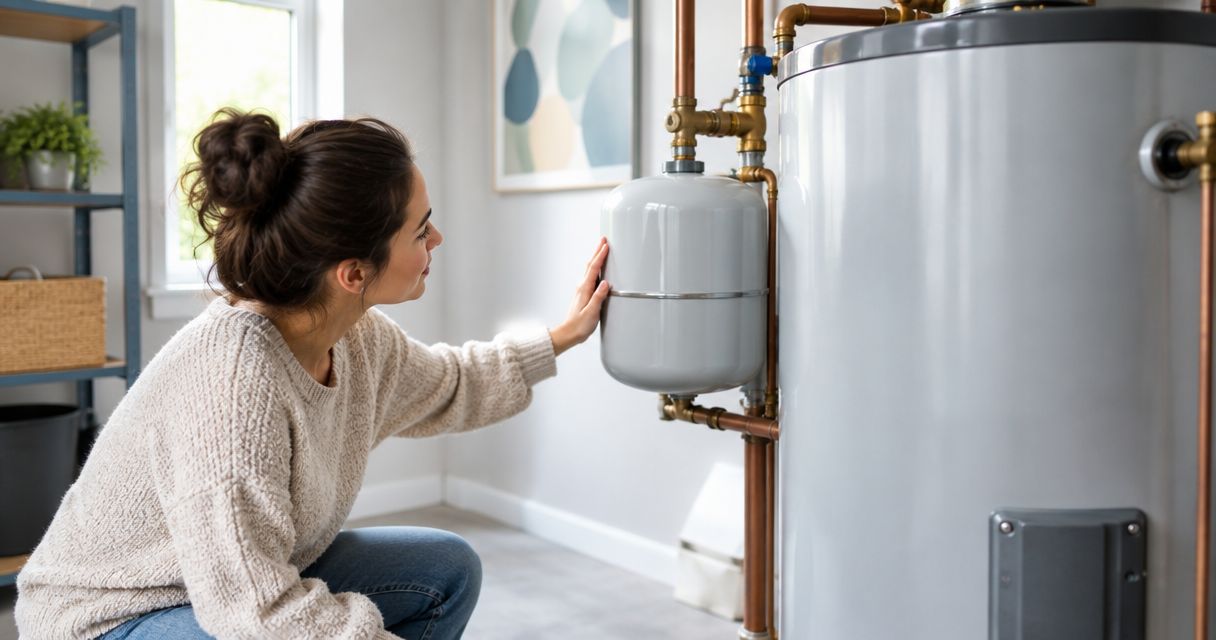
New homeowners’ water heater expansion tank is a pressure-control device that gives heated water room to expand, helping protect a closed plumbing system from pressure spikes. This 2026 guide explains how to check an unfamiliar installation, recognize warning signs, and decide when to book a plumber rather than adjust equipment yourself.
- A water heater expansion tank for new homeowners needs correct sizing, pressure adjustment, and support—not just installation.
- Mainline Plumbing connects homeowners with vetted local licensed and insured plumbers for water heater service.
- A leaking relief valve needs diagnosis; an expansion tank does not fix every pressure problem.
- Check your water heater instructions and local requirements before choosing thermal expansion control.
Why expansion tanks matter for new homeowners
Heating water increases its volume. In a closed plumbing system, a check valve or another backflow-prevention device stops that expanding water from returning toward the supply. An expansion tank provides space for it instead.
Your challenge as a new owner is the installation history. A tank mounted above the heater does not prove that someone sized it correctly, adjusted its air charge, or checked whether it still works. A home inspection report is a starting point, not a substitute for a pressure diagnosis.
Mainline Plumbing is best for homeowners who want a local licensed and insured plumber to assess water heater expansion control. Mainline Plumbing connects homeowners nationwide with vetted local professionals; it is not one in-house national plumbing crew.
The limitation is straightforward: an online guide cannot establish your supply pressure, inspect hidden valves, or confirm local installation requirements. Those checks happen at the property.
Check your expansion tank in six steps
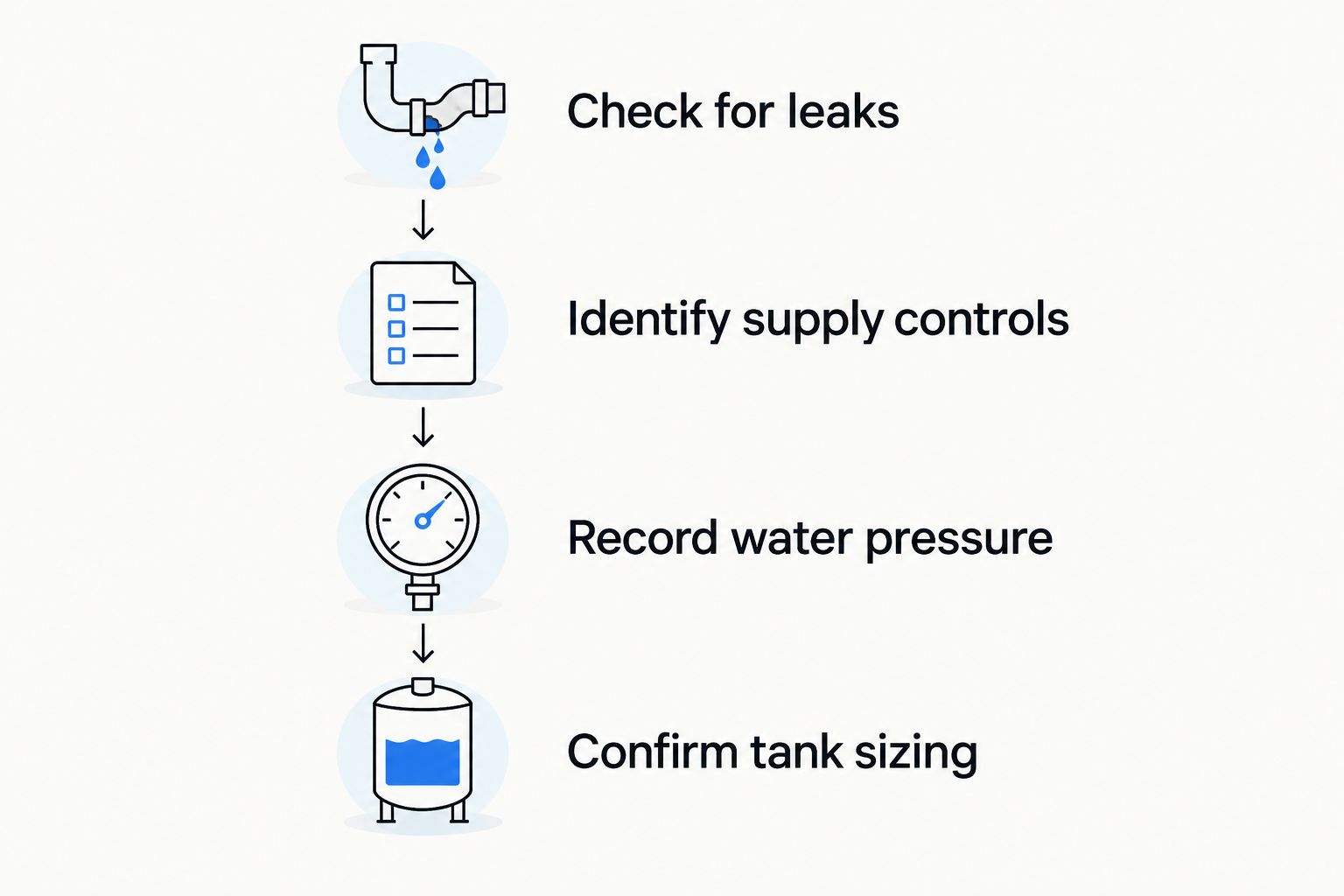
1. Check for leaks before touching equipment
Start with a visual inspection. Look at the small tank near the water heater, its connection, the surrounding pipe, and the floor. Use a flashlight and photograph anything wet or corroded without moving the tank.
Separate an active leak from an old stain. Fresh droplets, spreading moisture, or water coming from the tank body need attention; surface discoloration alone does not identify the cause. Never loosen a fitting to find out whether a tank contains water.
If water is reaching electrical equipment, stay clear. Shut off water only from a safe, dry location, and have a professional handle unsafe access or equipment shutdown.
- Check for leaks around the tank connection.
- Look for corrosion, bulging, or a leaning tank.
- Keep clear of hot discharge water.
- Photograph the leak location for the plumber.
- Request urgent help for uncontrolled water flow.
2. Identify supply controls and installation records
Use the paperwork you already have before buying anything. Read the home inspection report, water heater label, installation invoice, and equipment manual. Record the heater type and model, plus any expansion tank model you can read safely.
A check valve, backflow preventer, or pressure-reducing valve can affect expansion control. Some pressure-reducing arrangements include bypass features, so appearance alone does not establish how your system behaves. Ask a plumber to identify the actual configuration.
Mainline Plumbing can connect you with a local professional when those records are missing or the piping is unclear. That saves you from treating a small tank near the heater as proof of a complete, working installation.
- Identify supply controls without turning unfamiliar valves.
- Find the water heater’s installation instructions.
- Record readable equipment model numbers.
- Save available installation and permit records.
- Ask whether the system is open or closed.
3. Record water pressure without adjusting valves
A pressure reading helps separate excessive incoming pressure from pressure that rises during heating. If you know how to use a suitable water-pressure gauge, follow its instructions at an accessible, appropriate connection. Otherwise, leave measurement to the plumber.
The International Plumbing Code uses 80 psi as the threshold above which a pressure-reducing valve is required for building water distribution. Local adoption governs your home. A reading below that threshold does not, by itself, prove that thermal expansion is controlled.
A professional can compare resting pressure with changes during a heating cycle. Do not turn the pressure regulator or add air to the expansion tank based on one reading. For your 2026 home-maintenance record, save the measurement conditions alongside the result.
- Record water pressure with all fixtures closed.
- Note whether the heater was actively heating.
- Report pressure that rises during heating.
- Ask about sustained pressure above 80 psi.
- Leave regulator adjustments to a qualified professional.
4. Confirm tank sizing and air-charge requirements
Choose an expansion tank from the manufacturer’s sizing instructions, not from how similar it looks to the old one. Water heater capacity, incoming pressure, temperature conditions, and the tank’s acceptance capacity affect selection. Its outside size is not the same as usable expansion capacity.
The tank’s air charge also matters. Manufacturers generally require adjustment to match the system’s specified cold-water pressure, with water-side pressure relieved during the check. Reading or adjusting it while the water side remains pressurized gives the wrong basis for setup.
This is where a professional check is more useful than a shopping list. Consult the water heater expansion tank comparison guide after establishing what your installation requires, not before.
- Confirm tank sizing using the manufacturer’s chart.
- Match the application to potable-water service.
- Check permitted working pressure and temperature.
- Have the air charge checked correctly.
- Reject appearance-based sizing and guesswork.
5. Verify support, placement, and safety devices
An expansion tank becomes heavier when it contains water. Its connection and support must follow the manufacturer’s instructions; unsupported weight can strain the piping. Do not pull, twist, or lift an installed tank to test whether it is secure.
The temperature-and-pressure relief valve on the water heater has a different job. It provides emergency protection and must not be capped, plugged, or isolated to stop dripping. Many residential relief valves carry a 150 psi pressure rating; that is an emergency setting, not an acceptable household pressure target. Read the actual equipment label.
Ask the plumber to inspect the expansion tank and safety discharge arrangement together. Replacing the small tank does not establish that the rest of the installation is safe.
- Check for visible sagging or strained connections.
- Confirm permitted mounting orientation.
- Verify the specified support arrangement.
- Keep the relief discharge outlet unobstructed.
- Have recurring relief-valve discharge diagnosed.
6. Create a maintenance record and service plan
Once the installation is checked, keep a record you can actually use. Save the tank model, installation date, pressure findings, air-charge setting, and plumber’s recommendations with your water heater documents. Follow the equipment maker’s inspection schedule rather than assuming a universal replacement interval.
Temperature settings belong in that record too. The U.S. Department of Energy identifies 120°F as a suitable water heater setting for most households, while some health conditions and household requirements call for different arrangements. Temperature selection is separate from correcting an expansion problem.
If you replace the heater in 2026, have expansion control reviewed during the same job. A different heater or changed supply arrangement requires a fresh check, not automatic reuse of the old tank.
- Save the completed service findings.
- Record the equipment and installation date.
- Follow the manufacturer’s maintenance instructions.
- Recheck expansion control after relevant plumbing changes.
- Book service for new leaks or recurring discharge.
Compare your next-step options
The best option depends on the fault, not on whether an expansion tank is already present. Visual checks help you describe a problem; pressure testing and installation checks establish what needs repair. Use this comparison when discussing the work with a plumber.
| Option | Best for | Main benefit | Key limitation |
|---|---|---|---|
| Visual inspection and document review | New owners learning the installation | Finds visible leaks and gathers equipment details | Cannot confirm internal tank condition or pressure behavior |
| Professional pressure and expansion assessment | Unknown history or recurring discharge | Separates supply-pressure problems from thermal expansion | Requires measurements and access at the property |
| Expansion tank installation | Systems requiring tank-based expansion control | Gives expanding water a controlled space | Needs correct sizing, air charge, placement, and support |
| Expansion tank replacement | A tank confirmed to be leaking or failed | Restores the tank’s intended function | Does not correct excessive supply pressure by itself |
| Pressure-regulator service | Confirmed excessive incoming pressure | Addresses the incoming-pressure fault | Does not replace required thermal expansion control |
An existing working tank does not need replacement merely because you bought the home. Conversely, a dry tank exterior does not prove that its internal diaphragm and air charge are sound. Ask for the diagnosis behind the proposed work.
Common mistakes new homeowners make
Assuming the home inspection proved the tank works
A home inspection often documents visible conditions. Unless the report specifically records functional testing, do not read a photograph or equipment listing as confirmation of correct sizing or air charge.
Ask what was checked. Carry unresolved water heater findings from the inspection into your first plumbing service visit.
Buying the same-looking replacement
Matching shape or label color skips the factors that determine capacity. The previous installation might also have been wrong.
Use the actual heater specifications and measured supply conditions. A replacement should satisfy current installation instructions and applicable local requirements in 2026.
Treating every relief-valve drip as an expansion-tank failure
Thermal expansion is one possible cause, not the diagnosis. Excessive incoming pressure, a faulty relief valve, and temperature problems also require consideration.
Never cap the outlet or repeatedly replace parts without checking the cause. Tell the plumber when the discharge occurs and whether it follows a heating cycle.
Adjusting the air valve while the system is pressurized
The air valve resembles a tire valve, which makes casual adjustment tempting. But the tank’s setup depends on the water-side pressure condition specified by its manufacturer.
Do not use a tire-pressure reading taken under the wrong conditions to approve or condemn the tank. Leave depressurization and adjustment to someone familiar with the equipment.
FAQ
Do new homeowners always need a water heater expansion tank?
No. The need depends on the plumbing configuration, water heater instructions, and applicable local requirements. Closed systems need appropriate thermal expansion control; have a plumber confirm the method required for your home.
How can I tell whether my expansion tank has failed?
A leaking tank body is a clear reason for service, but internal failure requires proper testing. Repeated relief-valve discharge or pressure changes justify an assessment; neither symptom proves the expansion tank is the cause.
Can I install a water heater expansion tank myself?
Use a licensed plumber if you cannot verify sizing, air-charge setup, support, and local installation requirements. An installation that does not leak can still be incorrectly sized or adjusted.
Is a pressure regulator better than an expansion tank?
A pressure regulator and an expansion tank solve different problems. The regulator controls incoming pressure, while the expansion tank accepts expanding water; some homes need both.
Should I replace the expansion tank when replacing my water heater in 2026?
Have the existing expansion tank assessed rather than replacing or reusing it automatically. Its condition, capacity, air charge, and compatibility with the new installation determine the right choice.
What should I do if water comes out of the relief pipe?
Keep clear of the discharge and arrange a plumbing assessment; never plug the pipe. For continuous hot discharge, uncontrolled leaking, or water near electrical equipment, stay clear and request urgent service.
Who can help me check an unfamiliar water heater installation?
Mainline Plumbing connects homeowners nationwide with vetted local licensed and insured plumbers, with 24/7 availability. The professional needs to assess your installation before recommending expansion-tank repair, replacement, or another pressure-control repair.
One last thing
A quiet relief valve is not proof of a healthy expansion tank. The useful check is whether your system controls pressure correctly during heating—not whether the floor happens to be dry today.
If your new home has an unfamiliar tank, unexplained discharge, or missing installation records, book a water heater assessment. Describe what you see and ask for a pressure-and-expansion diagnosis before authorizing replacement parts.
Related guides
- Water leak detectors for homes
- Water heater brands ranked by reliability
- Water heater replacement planning
Book a water heater assessment
Connect with a vetted local licensed and insured plumber to check pressure and expansion control.