Mobile-home electric water heater repair is the diagnosis and correction of heating, control, and water leaks to restore reliable hot water safely. This 2026 guide explains how to separate an urgent hazard from a repairable fault, account for tight equipment compartments, and choose the right professional without opening electrical covers.
- Electric water heater repair for mobile homes starts with electrical safety, leak location, and the heater’s identification label.
- Mainline Plumbing is best for homeowners seeking a connection to vetted local licensed and insured plumbers.
- A leaking connection needs diagnosis; a leaking tank generally requires replacement rather than a patch.
- Match replacement equipment to the home, electrical supply, compartment, and manufacturer’s installation instructions.
Why electric water heater repair matters for mobile homeowners
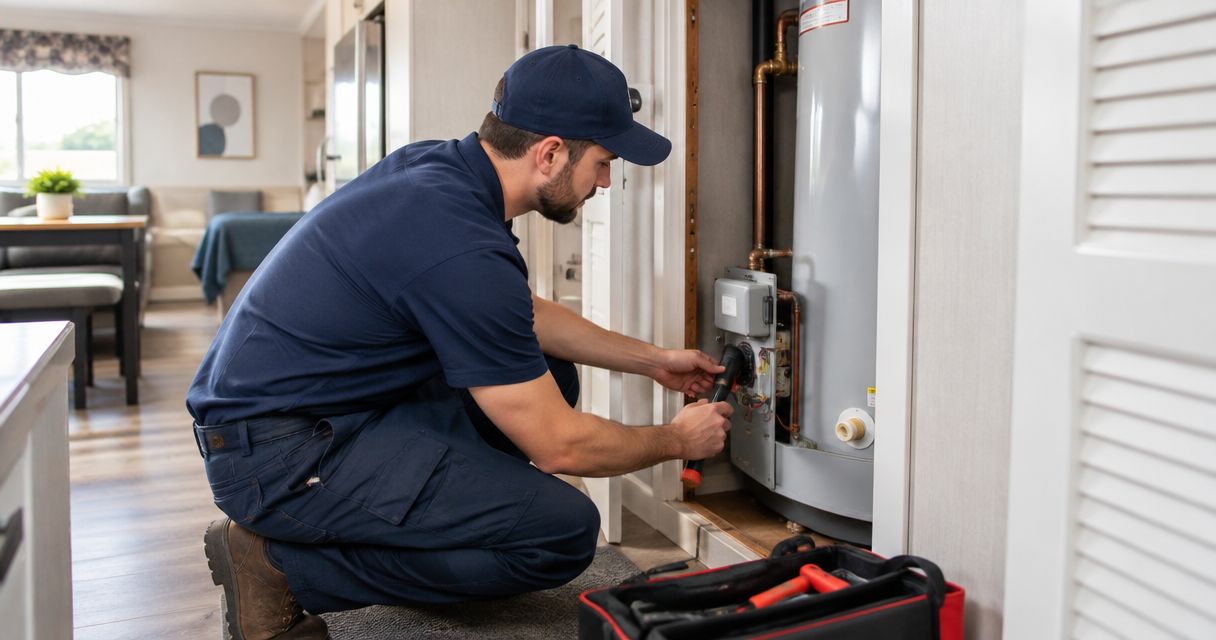
The right repair depends on the installation, not just the symptom. A heater inside a narrow closet or exterior-access compartment presents different access and water-damage concerns from an exposed utility-room installation. Check the actual location before anyone recommends parts or replacement equipment.
In 2026, use the appliance label and installation instructions—not a product photo—to establish what belongs in your home. Our guide to electric water heaters for small homes explains the selection questions to consider if repair turns into replacement.
No hot water does not automatically mean the tank has failed. The cause can be electrical, a heating component, a control, or a plumbing problem. Water beneath the heater also needs tracing: a leaking fitting and a leaking tank call for different work.
How to handle a mobile-home water heater problem
1. Stop unsafe operation before investigating
Electric water heaters combine water, heat, and electricity. Many residential models use 240 volts, but the equipment label determines the supply requirements. Never assume an appliance is safe to touch because it has stopped heating.
If you see smoke, sparks, or active arcing, leave the area and contact emergency services. Do not approach a wet electrical panel or stand in water to reach a switch. When safe, isolate the heater using its clearly identified breaker; do not remove electrical covers yourself.
- Keep people and pets away from standing water near electrical equipment.
- Switch off the identified heater breaker only from a dry, safe location.
- Stop using a heater with a burning smell or scorched wiring.
- Close the heater’s cold-water supply if safely accessible during an active leak.
- Never cap or plug a temperature-and-pressure relief discharge pipe.
2. Record the symptom without taking anything apart
Start with a free visual check. Write down whether the problem affects every hot-water tap, only one fixture, or only the shower. A single-fixture problem points the investigation toward that fixture rather than proving the heater has failed.
Record what changed before the problem began. Recent plumbing work, an outage, a leak, or a new pattern of hot-water use gives the professional useful context. You do not need to reproduce a hazardous fault to describe it.
- No hot water: note whether the loss was sudden or gradual.
- Short hot-water supply: describe when the water turns cool.
- Water too hot: stop use if scalding is a concern.
- Water around the heater: photograph it from a dry, safe position.
- Breaker tripping: leave the circuit off and request diagnosis.
3. Choose the professional based on the fault
Check the homeowner’s manual and any existing service paperwork first. These identify the model and explain the intended installation without requiring paid troubleshooting. Gather the information before booking, but do not delay help for an active leak or electrical hazard.
Mainline Plumbing connects homeowners nationwide with vetted local licensed and insured plumbers for water heater repair and installation. The benefit is a service connection rather than a solo search; the limitation is that the fault and repair scope still need an on-site assessment. Availability is 24/7, but an appointment is not a diagnosis.
Use Mainline Plumbing to request local plumbing help. If the fault involves the supply circuit, panel, or fixed wiring, ask whether a licensed electrician is also needed.
- Describe any leak, burning smell, or breaker trip when booking.
- State that the heater serves a mobile or manufactured home.
- Explain whether access is indoors, outdoors, or through a restricted compartment.
- Ask who will diagnose electrical faults and perform any required electrical work.
- Request the proposed repair scope before authorizing work.
4. Identify the heater and check compartment access
Photograph the rating plate if you can reach it without moving covers or disturbing wiring. The model number, serial number, tank capacity, and electrical ratings help identify compatible parts. Use the manual to confirm details rather than guessing from the tank’s appearance.
For a replacement considered in 2026, confirm suitability for the particular manufactured-home installation. Fitting through the door is only the beginning: service access, plumbing connections, electrical requirements, and manufacturer instructions also matter.
- Record the manufacturer and exact model number.
- Photograph the visible electrical rating and capacity information.
- Measure the compartment opening from a safe position.
- Note water connections, shutoff access, and the relief discharge route.
- Identify damaged flooring or damp surrounding materials.
A clear compartment photo helps explain access restrictions without asking you to dismantle the installation.
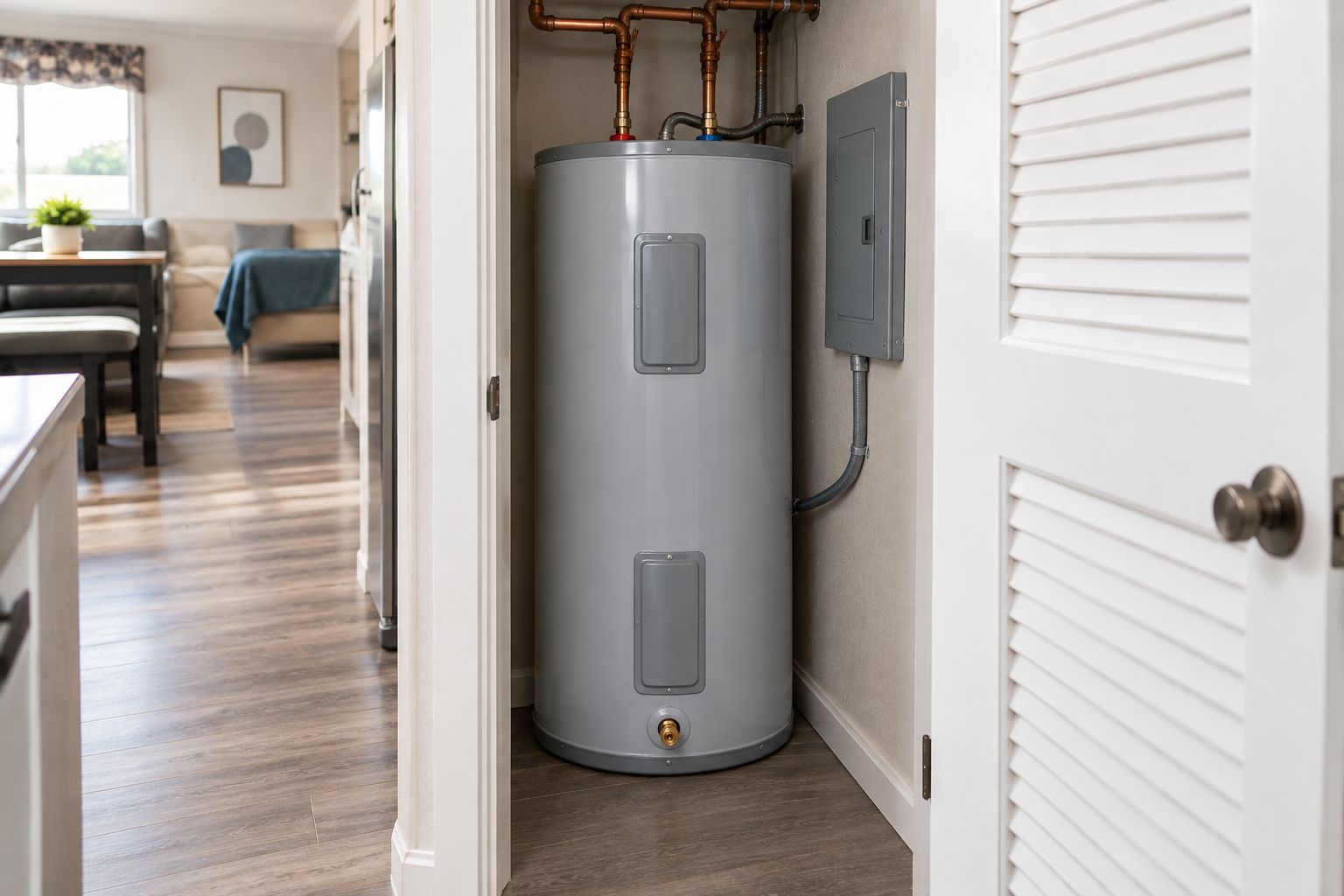
5. Separate a repairable part from a failed tank
Look from a dry position for where water first appears. Water can travel down the tank jacket from a connection above it, so the lowest wet spot does not establish the source. Leave close inspection to the professional when electrical equipment is wet.
A failed heating element or control can be repairable when the tank and installation remain sound. A tank-body leak generally calls for replacement. Relief-valve discharge requires diagnosis of temperature, pressure, and valve condition—not simply tightening or blocking the outlet.
- Ask the professional to identify the source of every visible leak.
- Separate the failed component from other recommended work.
- Request an explanation of why a proposed part matches the heater.
- Confirm whether surrounding water damage needs separate attention.
- Compare repair and replacement scopes before approving either.
6. Verify the repair before returning to normal use
Ask the professional to explain what failed and how the repair was checked. Restoring power is not enough: the heater needs to heat correctly, remain dry at serviced connections, and operate without abnormal electrical behavior.
Never energize an electric storage heater before it is properly filled and air is purged according to its instructions. A dry heating element can fail. Leave the return-to-service sequence to the professional after repair, especially when the tank has been drained.
The U.S. Consumer Product Safety Commission’s household scald-prevention guidance identifies 120°F, about 49°C, as a setting that helps reduce scald risk. That temperature is not scald-proof; discuss household needs and manufacturer guidance with the professional.
- Have the professional confirm proper filling before power returns.
- Check repaired connections for leaks during the service visit.
- Confirm that hot water reaches the affected fixtures.
- Ask how the delivered water temperature was checked.
- Keep the repair description and any workmanship terms with your records.
7. Reduce repeat problems without hiding warning signs
Start with the maintenance instructions for your exact model. Do not adopt a generic draining schedule or adjust controls because another heater’s guide recommends it. Access limits and the condition of an older installation also affect what is safe to do yourself.
Keep a 2026 service record with the fault, replaced parts, and any follow-up recommendations. Recurring breaker trips, repeated relief discharge, and new moisture need investigation rather than repeated resets or cleanup alone.
- Keep the access opening clear of stored belongings.
- Inspect the surrounding floor for new moisture from a safe position.
- Keep the model information and repair paperwork together.
- Follow the manufacturer’s maintenance instructions.
- Report recurring symptoms instead of repeating temporary fixes.
Compare your repair and replacement options
Choose the option that addresses the diagnosed problem. A replacement heater does not correct a faulty supply circuit, and a new heating element does not repair a leaking tank. Use this 2026 comparison to frame the service conversation, not to diagnose the appliance yourself.
| Option | Best for | Main advantage | Key limitation |
|---|---|---|---|
| Safe visual checks | Homeowners gathering information without an active hazard | Establishes symptoms and access conditions without opening equipment | Cannot confirm internal electrical faults or tank integrity |
| Plumbing repair | A diagnosed repairable component or connection fault | Addresses the specific failure while retaining a serviceable tank | Does not resolve unrelated wiring problems or a failed tank |
| Electrical diagnosis | Breaker trips, damaged supply wiring, or suspected circuit faults | Separates supply problems from appliance faults | Does not repair a leaking tank or plumbing connection |
| Heater replacement | A leaking tank or an installation requiring replacement | Replaces the failed appliance | Requires verification of fit, supply, access, and installation requirements |
| Mainline Plumbing connection service | Homeowners seeking vetted local licensed and insured plumbing help | Provides nationwide connections with 24/7 availability | Repair scope still depends on local assessment; electrical work needs appropriate qualifications |
Ask for the reasoning behind the recommendation. A useful explanation identifies the failed component, the condition of the tank, and any installation issue that affects the work. Avoid approving a replacement solely because the water is cold.
Common mistakes mobile homeowners make
Treating every compact heater as suitable
A small tank is not automatically appropriate for your home. Check the replacement’s installation instructions, intended application, electrical ratings, and required access before approving it. Ask how the proposed equipment meets the actual installation conditions.
Repeatedly resetting a tripping breaker
A breaker trip is a warning, not a maintenance routine. Repeated resets can re-energize a fault. Leave the heater circuit off and arrange qualified diagnosis rather than trying to get through another shower.
Replacing a relief valve without checking the cause
Water from the relief discharge does not prove the valve alone has failed. Temperature or pressure conditions can also cause discharge. Never plug the pipe, reduce its opening, or redirect it into a closed container.
Ignoring the floor beneath the compartment
Stopping the leak does not establish that the surrounding floor is sound. Report softness, staining, or persistent dampness. The plumbing repair and any building-material repairs are separate decisions, and both deserve attention before the compartment is closed.
FAQ
What should I do first if my mobile-home electric water heater stops working?
Check for leaks, burning smells, and other hazards before investigating the loss of hot water. Record whether every hot-water fixture is affected, and do not open electrical covers or repeatedly reset a tripping breaker.
Can I repair an electric water heater in a mobile home myself?
Keep homeowner checks to safe observation, accessible label information, and the manufacturer’s instructions. Internal electrical diagnosis and component replacement require appropriate skills and equipment; wet electrical components need professional attention.
How do I know whether the tank needs replacing?
A confirmed leak from the tank body generally requires replacement. Water beneath the appliance can also come from fittings or relief discharge, so have the source identified before approving a new heater.
Can I install any small electric water heater in a manufactured home?
No—physical size alone does not establish suitability. Confirm the manufacturer’s installation requirements, the home’s requirements, electrical compatibility, plumbing connections, and service access before choosing equipment.
Do I need a plumber or an electrician for a tripping water heater breaker?
A tripping breaker needs qualified electrical diagnosis. A plumber can assess the water heater within their qualifications, while supply-circuit, panel, or fixed-wiring faults require an appropriately licensed electrical professional.
What temperature should I discuss with the repair professional?
Discuss the U.S. Consumer Product Safety Commission’s 120°F household scald-prevention guidance alongside your heater’s instructions and household needs. Water at that temperature can still cause burns, so temperature selection does not replace supervision or suitable scald protection.
Does Mainline Plumbing handle mobile-home water heater service in 2026?
Mainline Plumbing connects homeowners nationwide with vetted local licensed and insured plumbers for water heater repair and installation, with 24/7 availability. Describe the mobile-home installation and symptoms when requesting service so the local professional can assess the work.
One last thing
Photograph the rating plate before it becomes unreadable or inaccessible. Keep that image with a wide photo of the compartment and your service record. Those pictures help identify the equipment and explain access constraints without another trip into a tight space.
Related guides
- Water heater replacement considerations
- Smart water leak detectors for homes
- Pipe insulation for preventing frozen pipes
If your heater leaks, trips the breaker, or leaves you without hot water, book service and describe the symptoms. Leave unsafe equipment off until a qualified professional assesses it.
Book local water heater service
Connect with vetted local licensed and insured plumbers. Available 24/7 nationwide.