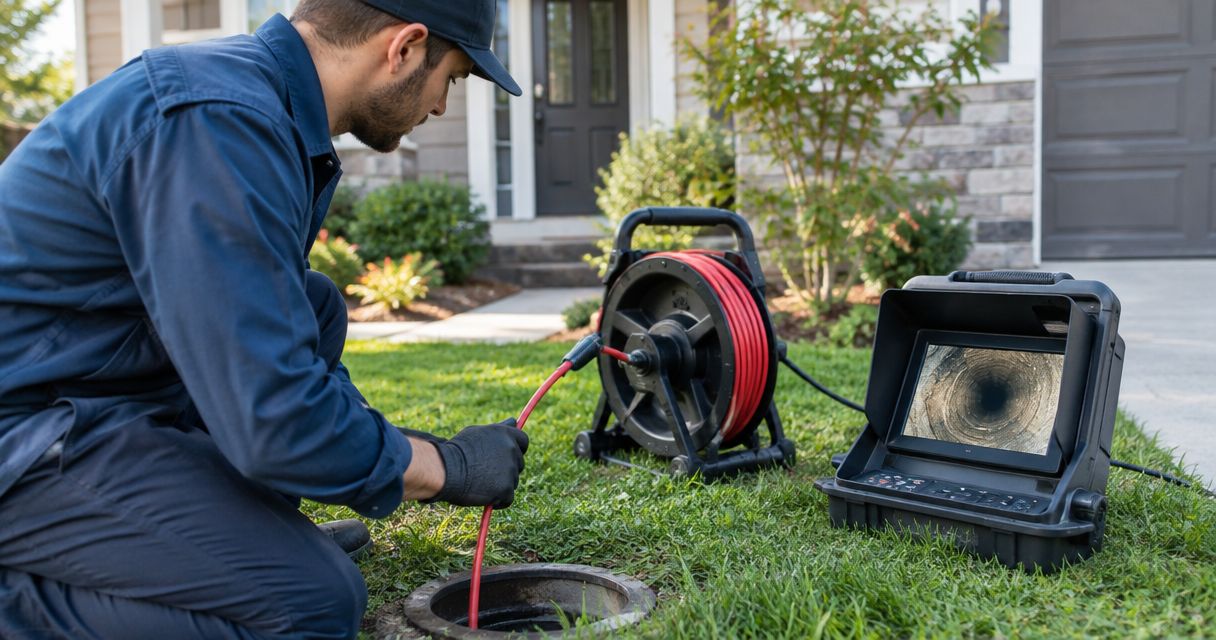
For homebuyers, a sewer camera inspection before buying a house is a video check inside the sewer line to identify visible problems before you commit to the purchase. For your 2026 purchase, schedule it during your inspection period and request recorded findings; working faucets and flushing toilets do not establish the condition of a buried sewer pipe.
- A sewer camera inspection before buying a house documents visible sewer line defects before you commit.
- Mainline Plumbing is best for homebuyers seeking connections to local licensed and insured plumbers.
- Request sewer scope footage, a written report, and clear limits on what the camera reached.
- Resolve blocked access, incomplete footage, and proposed repairs before your inspection deadline.
Why sewer camera inspection matters for homebuyers
A homebuyer needs evidence about a property they do not yet own. You need the seller’s permission, access to the pipe, and enough time to review findings before your contract deadlines pass.
A camera can reveal visible roots, displaced joints, damaged pipe, and obstructions. It cannot show every buried condition or guarantee that a line will never back up. Our guide to sewer inspection cameras for homeowners explains the equipment side; a purchase decision also requires someone who can interpret the footage.
A completed inspection is not the same as a clean bill of health. What matters is the section examined, the visibility, the findings, and any unanswered questions. A camera that stops at an obstruction leaves the pipe beyond it uninspected.
For a 2026 transaction, put sewer findings alongside the home inspection, disclosures, and repair records. Do not treat any one document as a substitute for the others.
How to arrange and use a buyer’s sewer inspection
Start with records you can review yourself. Then bring in a qualified professional to examine the line, explain the evidence, and define any next steps before you make a repair request.
1. Review the property’s sewer records
Ask the seller for available sewer repair invoices, past camera reports, and records of recurring backups. Read the inspection agreement too: a general home inspection and a camera inspection are different scopes of work. Do not assume the buried line is included because the inspector checks toilets and sinks.
Confirm whether the home connects to a public sewer or uses a septic system. A camera inspection of the house drain does not replace a septic evaluation. If the seller reports a shared sewer line, ask for documentation of maintenance responsibilities rather than accepting an informal explanation.
Use the records to frame questions, not to diagnose the pipe yourself. A receipt for drain cleaning documents work performed; it does not establish that the underlying problem was repaired.
- Request previous inspection footage and reports.
- Ask about backups, cleaning, and sewer repairs.
- Confirm public sewer or septic service.
- Flag shared lines and unclear maintenance responsibilities.
2. Set the inspection scope before booking
Ask exactly where the camera will enter and how far the inspection is intended to extend. An accessible cleanout—a capped opening used to reach the drain line—can provide access, but its location and condition must be confirmed.
Your goal is a documented inspection of the relevant building sewer, not an unexplained clip from somewhere inside a pipe. Ask how the professional identifies the endpoint and reports sections the camera cannot reach. Ownership boundaries and maintenance obligations depend on local rules and property documents; the footage alone does not settle them.
Separate the inspection from possible extra work. Cleaning, locating a buried defect, or creating access changes the job. Establish who can authorize those tasks before the appointment, especially while the seller still owns the property.
- Confirm the intended entry point and endpoint.
- Ask how inaccessible sections will be documented.
- Identify who authorizes additional work.
- Request the recording and written findings in advance.
3. Book a qualified local professional
You can contact local plumbing professionals directly and compare their inspection scope, reporting, and qualifications. Ask whether the person interpreting the footage regularly handles residential sewer problems and can explain the difference between an observation and a repair recommendation.
For sewer camera inspection coordination, Mainline Plumbing connects homeowners nationwide with vetted local licensed and insured plumbers. Ask specifically for a professional who performs homebuyer sewer scopes and provides recorded findings. Confirm the appointment’s scope with that professional rather than assuming every plumbing visit includes a camera.
Schedule early enough to review the report and arrange further evaluation if needed. Your purchase contract—not a general online timeline—sets the deadline for inspection responses. Coordinate access with the seller or agent before anyone arrives.
- Confirm the professional’s license and insurance.
- Ask who interprets and explains the recording.
- Confirm seller permission and property access.
- Schedule before your inspection-response deadline.
- Agree on delivery of the footage and report.
4. Document the inspection’s actual coverage
Ask for at least 1 continuous video per inspected run, with the entry point and direction identified. Short clips can illustrate a defect, but they do not establish what happened between those clips. Keep the original recording, not just screenshots sent by message.
The report should explain visibility and access limits. Standing water, debris, tight bends, or an obstruction can prevent the camera from showing the pipe clearly. A dark or submerged section is not evidence that the hidden pipe is sound.
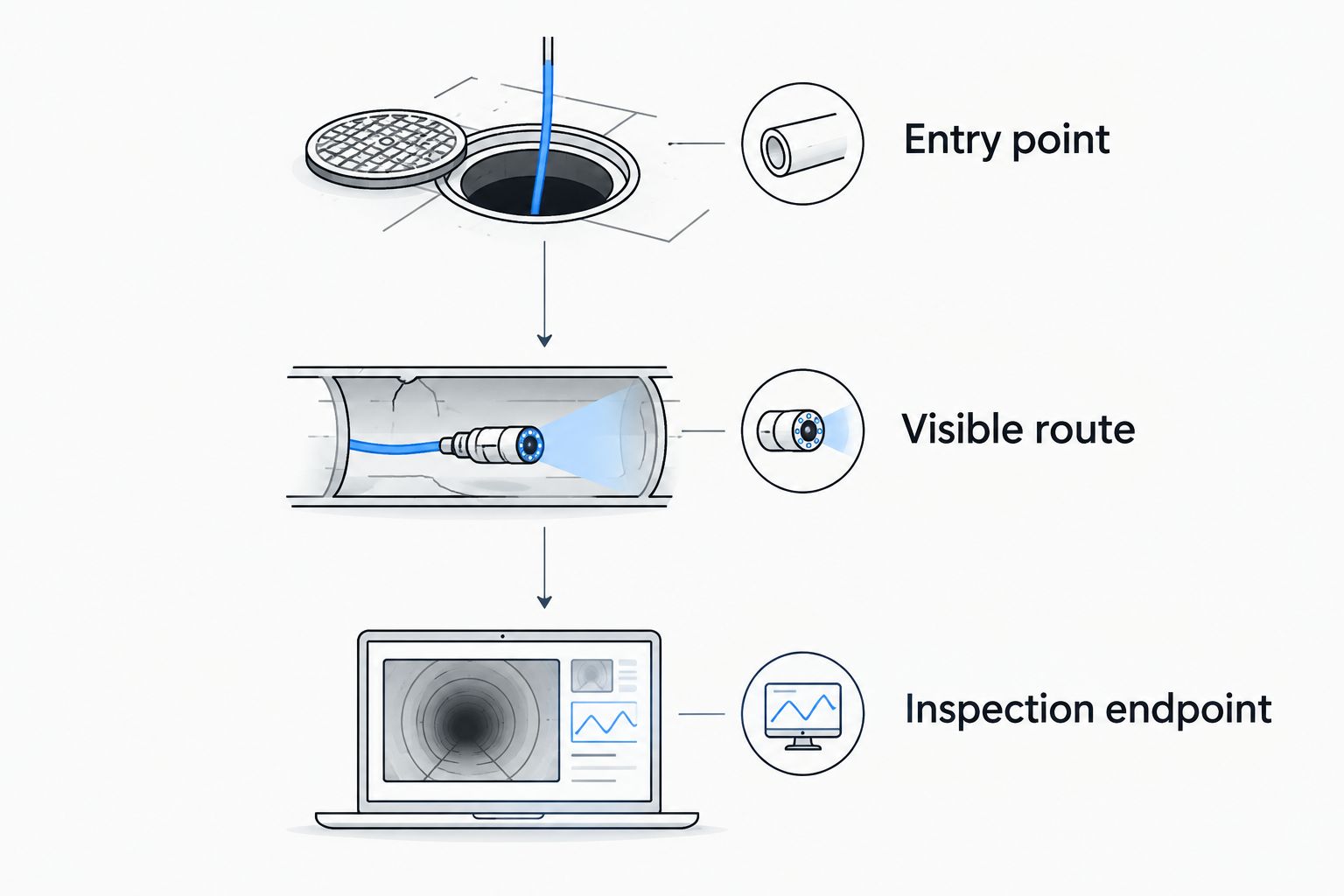
Use 3 checkpoints when reviewing coverage: Entry point, Visible route, and Inspection endpoint. Ask the professional to explain any gap between the intended inspection and the completed work. Save the files under the property address and the actual 2026 inspection date so they remain identifiable during negotiations.
- Entry point: Record where the camera entered.
- Visible route: Note unclear or obstructed sections.
- Inspection endpoint: Document where and why inspection stopped.
- Keep original footage with the written report.
5. Separate visible findings from repair conclusions
A useful report describes what the camera shows before recommending what to do. Roots entering a joint, an offset connection, or a visible break needs a clear explanation tied to the footage. Ask the professional to show you the relevant section rather than relying on a broad description such as “bad sewer.”
Standing water deserves explanation, not an automatic diagnosis from the buyer. Ask whether the view supports a drainage concern and whether cleaning or further inspection is needed to distinguish an obstruction from another condition.
A camera also has limits. It does not measure every aspect of pipe strength, inspect surrounding soil, or establish watertightness by itself. Ask what evidence supports the proposed repair and what remains uncertain.
- Match each finding to a location in the video.
- Ask how the finding affects drainage or reliability.
- Separate confirmed defects from suspected conditions.
- Request further evaluation where the view is incomplete.
6. Compare responses before requesting repairs
Request 2 written documents when repair work is proposed: the inspection report and a separate repair estimate. Keeping them distinct helps you understand what was observed and what work someone proposes to address it.
Ask whether the recommendation involves cleaning, a localized repair, or broader replacement, and why. Cleaning removes material from a line; it does not repair a broken pipe. A trenchless approach is not automatically suitable simply because excavation would be inconvenient.
If cleaning is needed to see the pipe, arrange permission and ask for a follow-up recording. Do not let a successful clearing become the only evidence of condition. For a substantial repair recommendation, seek another qualified assessment using the same footage and written findings.
- Request a clearly defined repair scope.
- Ask what additional inspection is needed.
- Confirm whether cleaning requires a follow-up camera check.
- Separate access and restoration work from pipe work.
- Compare assessments against the same documented findings.
7. Resolve the findings before your deadline
Bring the footage, report, and proposed work to your real estate agent or attorney. Your options depend on the contract and the seller’s response; an inspection finding does not automatically entitle you to a particular concession.
If the seller agrees to repairs, document the scope and the evidence required afterward. Ask for invoices, applicable permit records, and a post-repair camera inspection where appropriate. A statement that the drain now flows is not the same as evidence that the agreed defect was repaired.
Keep the sewer documents with your 2026 closing records. They can help the next plumber understand the line’s history without relying on your memory of a conversation during the purchase.
- Send findings before the contract deadline.
- Put agreed repairs and verification in writing.
- Review completion records before accepting the work.
- Preserve footage, reports, and repair documentation.
Compare your inspection options
Best for evaluating the buried line: a dedicated professional sewer camera inspection. Record review and a general home inspection serve different purposes. They support the purchase decision but cannot replace an interior view of the sewer pipe.
| Option | Best for | Main benefit | Key limitation |
|---|---|---|---|
| Seller records and disclosure review | Establishing the reported history | Identifies previous problems and work | Does not show current pipe condition |
| General home inspection | Reviewing the home’s broader condition | Examines plumbing within the agreed inspection scope | Does not establish camera coverage unless specifically included |
| Professional sewer camera inspection | Documenting visible conditions inside the line | Provides footage of accessible pipe interiors | Cannot show through debris or beyond inaccessible sections |
| Additional sewer evaluation | Resolving significant or unclear findings | Tests the basis for a repair recommendation | Requires coordination and does not erase visibility limits |
Choose the option that answers the unresolved question. If the question is whether fixtures operate, the general inspection addresses that within its scope. If the question concerns the buried line’s interior, request a sewer scope. If the footage is unclear, request clarification or further evaluation—not a stronger-sounding verdict from the same incomplete view.
Common mistakes homebuyers make
Treating a working toilet as proof
A flushing toilet shows that water moved during that test. It does not establish the condition of the entire buried sewer line. Use fixture observations and camera findings together rather than asking one to answer both questions.
Accepting “the camera would not go farther” as completion
An unsuccessful camera pass leaves an unanswered question. Ask where it stopped, why it stopped, and what is needed to examine the remaining section. Do not describe an incomplete inspection as a passed inspection in your purchase discussions.
Letting drain cleaning stand in for repair
Cleaning and repair solve different problems. If the seller arranges cleaning, request documentation of what was removed and a follow-up view where needed. Clear flow alone does not prove that a visible damaged joint or broken section has been fixed.
Waiting until the final walkthrough
Late findings leave less room for review and coordination. Arrange the inspection within your contract’s inspection process, not as an informal check after negotiation deadlines. Confirm the report’s delivery timing when booking.
Ignoring ownership and access questions
The pipe’s location does not, by itself, establish who must maintain it. Verify responsibilities through local utility information, property records, and appropriate professional advice. Do not authorize work on a shared or disputed section based solely on a camera operator’s assumption.
FAQ
Should I get a sewer camera inspection before buying a house?
A sewer camera inspection before buying a house gives you evidence about visible conditions inside the accessible sewer line. Arrange it during your inspection period and review both the findings and any uninspected sections before making your purchase decision.
Does a regular home inspection include a sewer scope?
Do not assume a regular home inspection includes a sewer scope. Read the inspection agreement and ask whether camera work, a recording, and a written sewer report are specifically included.
Is a sewer camera inspection useful for a newer house?
A sewer camera inspection can document visible conditions regardless of the house’s age. The construction date does not replace evidence about the installed line, its connections, and the sections the camera can reach.
What should I do if the sewer camera cannot get through?
Treat the inspection as incomplete beyond the stopping point. Ask the professional to document the location, explain the obstruction or access problem, and recommend how to inspect the remaining section with the owner’s permission.
Can a camera inspection guarantee the sewer will not back up?
No camera inspection guarantees that a sewer will never back up. It records visible conditions at the time of inspection and has limits where water, debris, access, or camera reach prevents a clear view.
Who should pay for a sewer inspection before closing?
Payment responsibility depends on the purchase agreement and what the buyer and seller negotiate. Confirm authorization, payment, and access before booking rather than assuming the seller must cover the inspection.
Can Mainline Plumbing help me find a local plumber?
Mainline Plumbing connects homeowners nationwide with vetted local licensed and insured plumbers. For sewer camera inspection before a purchase, ask the local professional to confirm buyer inspection services, recording delivery, and written reporting.
One last thing
The most useful question is not just “Did the sewer pass?” Ask: “What part of the line did you not see?” That answer exposes the limits of the inspection and tells you whether another step is needed before you accept the findings.
If sewage is actively backing up during a showing or inspection, stop using the affected plumbing and keep people away from contaminated water. Contact the property owner and a plumbing professional; do not keep running fixtures to test the problem.
Related guides
- Trenchless sewer repair methods compared
- Smart water leak detectors for homes
- Battery backup sump pumps
Book help before your inspection deadline
Mainline Plumbing connects you with vetted local licensed and insured plumbers nationwide. Request service, explain that you are buying the home, and confirm sewer camera scope and reporting before the appointment.
Request help before you close
Connect with a vetted local licensed and insured plumber. Confirm sewer inspection scope before booking.