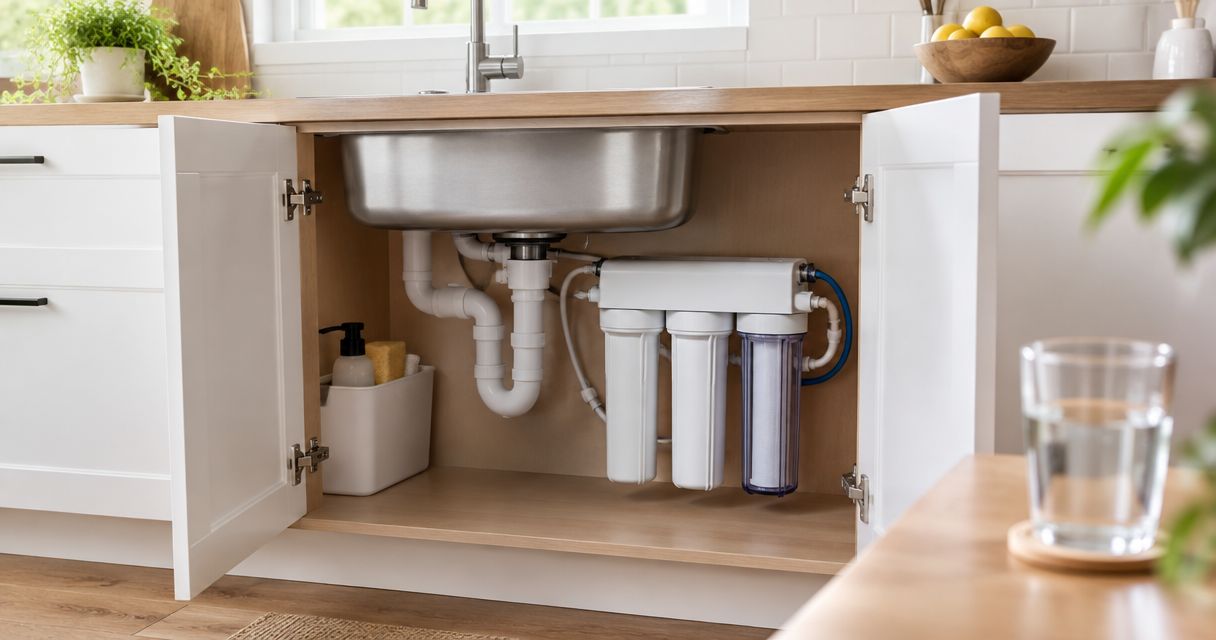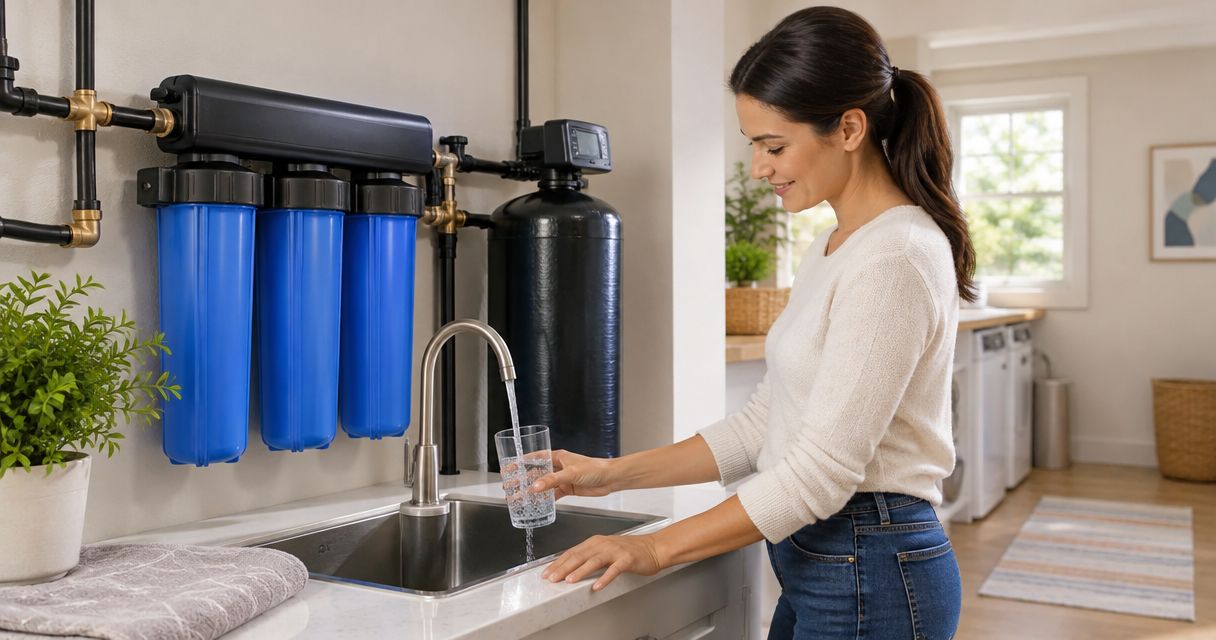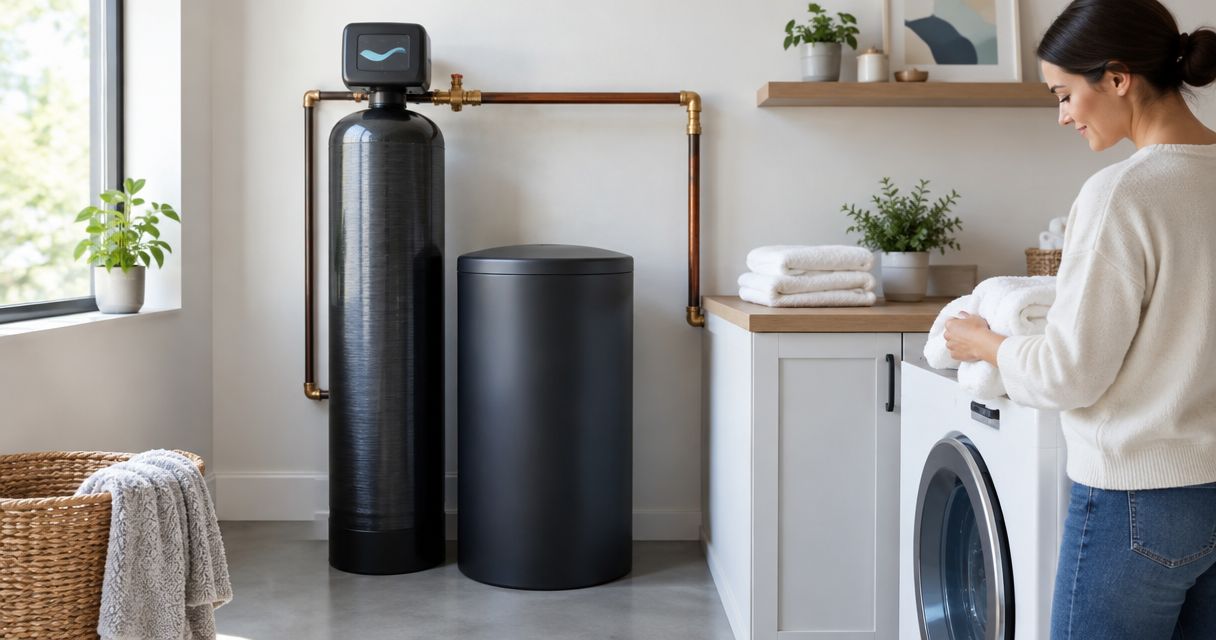
Best overall: a metered single-tank ion-exchange softener. Best for uninterrupted soft water: a twin-tank softener. Best for tight spaces: a compact cabinet softener. This 2026 guide explains which configuration fits your home, what to check before installation, and when a salt-free conditioner is the wrong choice.
- The best water softener for most households is a properly sized, metered ion-exchange system.
- Twin-tank softeners suit homes that need treated water while one tank regenerates.
- Compact cabinet softeners save installation space but still need salt, drainage, and service access.
- Salt-free conditioners do not remove hardness minerals; choose actual softening when mineral removal is your goal.
Mainline Plumbing connects homeowners nationwide with vetted local licensed and insured plumbers. Mainline Plumbing is best for homeowners who want local professional help assessing water softener installation requirements.
Why this matters
Hard water contains dissolved calcium and magnesium. Those minerals contribute to scale on fixtures and inside water-heating equipment, while making soap harder to rinse away.
A filter, a conditioner, and a water softener do different jobs. Buying the wrong category leaves the original problem untreated, even when the equipment fits neatly beside your water heater.
For a 2026 purchase, start with a water test rather than a model ranking. White deposits suggest a mineral problem, but they do not tell you the hardness level, required treatment capacity, or whether other contaminants need separate treatment.
What makes the best water softener
Use these criteria before comparing equipment:
- Actual hardness removal: Ion-exchange softeners remove calcium and magnesium; scale conditioners do not perform the same job.
- Demand-based regeneration: A metered control starts the cleaning cycle according to water use rather than a fixed calendar alone.
- Usable treatment capacity: Compare capacity at the intended salt setting, not just the largest capacity printed on the label.
- Service flow: The system needs to handle overlapping household water use without unacceptable pressure loss.
- Installation fit: Confirm the footprint, drain route, bypass valve, electrical requirements, and room for salt loading.
- Maintenance access: You need a practical way to refill salt, inspect the equipment, and isolate it for service.
No single configuration wins every category. A compact system solves a space problem; a twin-tank system solves a continuity problem. Neither advantage replaces correct sizing.
Water softener options at a glance
These 2026 recommendations rank configurations rather than unverified product models. Cabinet-style units can also use metered controls, so compare the complete specification rather than treating every label as a separate treatment technology.
| Rank and option | Best for | Standout feature | Key limitation |
|---|---|---|---|
| 1. Metered single-tank ion-exchange softener | Typical household routines | Regenerates according to measured water use | Softened-water delivery is interrupted during regeneration |
| 2. Alternating twin-tank softener | Households needing continuous soft water | One resin tank treats water while the other regenerates or waits | More equipment and installation space |
| 3. Compact cabinet softener | Homes with restricted utility space | Resin and brine components share a compact enclosure | Capacity and service access need close checking |
| 4. Salt-free scale conditioner | Homeowners targeting scale rather than hardness removal | Avoids a salt-brine regeneration cycle | Does not produce softened water |
1. Metered single-tank: best water softener for typical homes
A metered single-tank softener uses resin to exchange hardness minerals for sodium or potassium ions. Its control tracks water use and starts regeneration when the programmed treatment capacity is used.
This is the strongest default for a household whose water use leaves a suitable regeneration window. You still need the right resin capacity, flow rating, and settings for your tested water.
Metered single-tank pros:
- Removes calcium and magnesium rather than only addressing scale behavior.
- Matches regeneration to measured consumption.
- Uses fewer resin tanks than an alternating twin-tank arrangement.
Metered single-tank cons:
- Requires salt or another manufacturer-approved regenerant and ongoing refills.
- Needs an approved drain connection for regeneration wastewater.
- Does not continuously deliver softened water while its resin regenerates.
Best for: Households with ordinary daily routines and room for a properly sized system.
Ask how the control accounts for reserve capacity and when regeneration happens. A control valve cannot correct an undersized resin tank or a poor installation location.
Verdict: Buy a metered single-tank softener when tested hardness, household demand, and installation conditions support it.
2. Alternating twin-tank: best for continuous soft water
An alternating twin-tank softener switches treatment between separate resin tanks. One tank remains in service while the other regenerates or waits for the next changeover.
The benefit is continuity, not automatically better mineral removal. A correctly sized single-tank system and a correctly sized twin-tank system both use ion exchange to soften water.
Alternating twin-tank pros:
- Maintains a treated-water supply during regeneration.
- Supports households with water use spread across the day and night.
- Separates the active treatment tank from the regenerating tank.
Alternating twin-tank cons:
- Requires space for additional equipment.
- Adds connections and components that need service access.
- Provides little practical benefit when uninterrupted soft water is not necessary.
Best for: Homes where overnight work schedules, irregular routines, or continuous demand make regeneration downtime inconvenient.
Do not select this configuration simply because your household is large. Water hardness, actual consumption, and simultaneous flow determine sizing; household size alone does not establish the right equipment.
Verdict: Buy an alternating twin-tank softener when continuous softened-water delivery is a real requirement.
3. Compact cabinet: best for restricted utility space
A cabinet softener places the resin tank and brine-storage components within a shared enclosure. The treatment can still be conventional ion exchange with metered regeneration.
The cabinet changes the packaging, not the need for sizing. For a 2026 shortlist, compare usable capacity and service access before choosing the smallest enclosure.
Compact cabinet pros:
- Consolidates softening components into a compact footprint.
- Keeps brine storage and the resin tank together.
- Offers an option where separate tanks are difficult to accommodate.
Compact cabinet cons:
- A small enclosure does not guarantee adequate treatment capacity.
- Tight placement can make salt loading and repairs awkward.
- Drainage, plumbing connections, and applicable electrical requirements still apply.
Best for: Homes with limited utility-room space and water demand that matches the selected unit.
Measure the usable space around the equipment, not just the floor beneath it. Leave access to the lid, bypass valve, nearby shutoffs, and components a technician must remove.
Verdict: Buy a compact cabinet softener only after confirming capacity and maintenance clearances.
4. Salt-free conditioner: best for scale management, not softening
Salt-free scale conditioners aim to change how hardness minerals form deposits rather than remove those minerals from the water. They belong in a different category from ion-exchange softeners.
That distinction matters if your goal is softer laundry, different soap behavior, or a lower measured hardness level. A conditioner does not become a softener because its advertising uses similar language.
Salt-free conditioner pros:
- Does not require salt refills for ion-exchange regeneration.
- Avoids the brine-discharge cycle used by a conventional softener.
- Addresses a different objective for homeowners focused specifically on scale management.
Salt-free conditioner cons:
- Leaves dissolved hardness minerals in the water.
- Does not provide the same washing and soap-related results as mineral removal.
- Requires checking the manufacturer's water-quality limits and performance documentation.
Best for: Homeowners who explicitly want scale management without hardness removal.
Ask for evidence supporting the exact scale-control claim under water conditions matching your home. Do not treat a general claim about scale as proof that water becomes soft.
Verdict: Skip a salt-free conditioner when your goal is actual water softening.
Test hardness before choosing capacity
The U.S. Geological Survey classifies water hardness using milligrams per liter, expressed as calcium carbonate. Use these published categories to interpret a hardness result, not to select equipment by themselves.
| Hardness result | USGS classification | Buying implication |
|---|---|---|
| 0–60 mg/L | Soft | Investigate the complaint before assuming a softener is needed |
| 61–120 mg/L | Moderately hard | Match treatment decisions to the test and household concerns |
| 121–180 mg/L | Hard | Evaluate softening capacity against measured demand |
| More than 180 mg/L | Very hard | Account carefully for the hardness load when sizing |
A hardness test is not a drinking-water safety assessment. Private-well households also need water testing appropriate to their source; a softener does not replace disinfection or contaminant-specific treatment.
Iron and manganese also deserve attention because they can affect treatment selection and resin performance. Give the installer the actual test report instead of describing the water as simply bad.
Size the system around your home
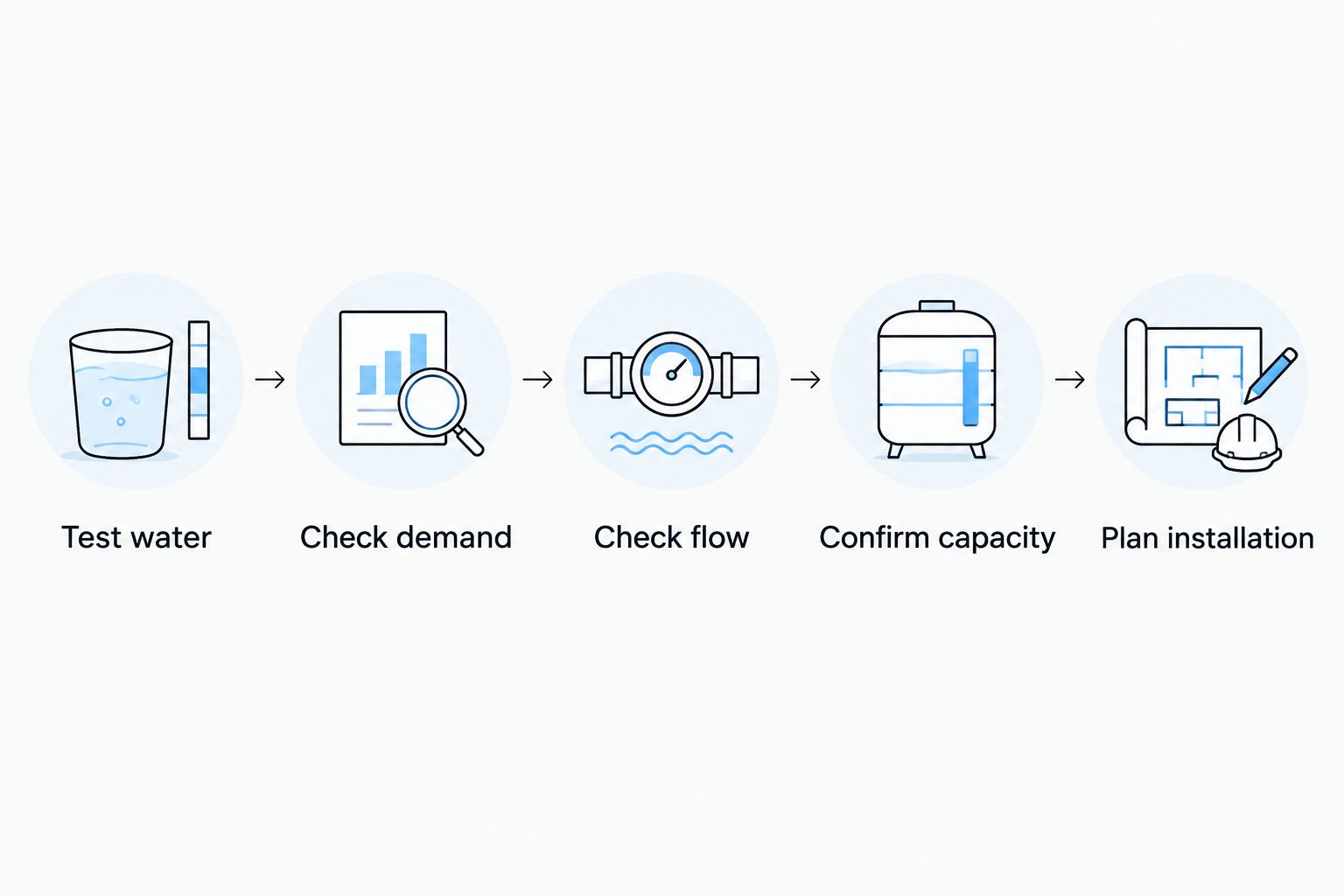
Use this sequence before approving a 2026 installation proposal:
- Test water: Establish hardness and identify water-quality issues that affect treatment.
- Check demand: Review metered household consumption rather than relying only on bedroom count.
- Check flow: List fixtures and appliances that regularly run together.
- Confirm capacity: Ask for usable capacity at the proposed regeneration settings.
- Plan installation: Confirm the location, bypass, drain connection, and maintenance access.
A larger advertised grain capacity is not automatically a better purchase. Compare what the system delivers under its actual operating settings and your water conditions.
Ask the installer to explain the settings in plain language. You should understand what triggers regeneration, how to use the bypass, and what maintenance remains your responsibility.
Check the installation before booking
A suitable softener still needs a suitable installation. Mainline Plumbing connects homeowners with local licensed and insured professionals who can assess the home's plumbing and installation requirements.
Before approving work, confirm:
- Water routing: Decide which fixtures receive softened water and whether outdoor irrigation stays untreated.
- Drain protection: Regeneration discharge needs a code-compliant connection with the required protection against backflow.
- Local rules: Check applicable plumbing requirements and any restrictions on softener discharge.
- Bypass access: You need a way to isolate the softener without unnecessarily shutting down the whole home.
- Operating instructions: Get the regeneration settings, refill instructions, and maintenance requirements in writing.
Do not loosen pressurized plumbing connections to investigate a suspected blockage. If a fitting leaks after installation, isolate the affected equipment when safe and arrange service.
How the options are ranked
The 2026 order prioritizes actual hardness removal, demand-based operation, practical household fit, and maintenance requirements. Continuous delivery earns the twin-tank option its own use case; restricted space earns cabinet equipment a separate place.
This is a configuration guide, not a hands-on product test. Model-specific reliability, treatment certification, and performance require documentation for the exact equipment offered.
Which water softener should you choose?
Choose a properly sized, metered single-tank ion-exchange softener unless your home has a specific reason to choose another configuration. It addresses hardness directly without adding a second treatment tank solely for continuity.
Choose alternating twin tanks when regeneration downtime conflicts with household demand. Choose a compact cabinet when space is the binding constraint, and reject a salt-free conditioner if removing hardness minerals is the requirement.
FAQ
What's the best water softener for a typical home?
A properly sized, metered single-tank ion-exchange softener is the default choice for a typical home. Confirm tested hardness, usable capacity, service flow, and installation requirements before choosing equipment.
Is a salt-free water softener actually a softener?
A salt-free scale conditioner is not an ion-exchange water softener. It does not remove dissolved calcium and magnesium, so it does not lower hardness in the same way.
Do I need a twin-tank water softener?
You need an alternating twin-tank configuration when continuous softened-water delivery during regeneration matters to your household. A larger household does not automatically require twin tanks.
Will a water softener make my drinking water safe?
A water softener does not establish that drinking water is safe. Test for relevant contaminants and use treatment selected for the specific problem.
How do I know what size water softener to get?
Size a water softener using measured hardness, household consumption, simultaneous flow, and usable treatment capacity. Ask the installer to explain capacity at the proposed salt and regeneration settings.
Can I install a water softener myself?
Water softener installation requires correct plumbing connections, discharge arrangements, and compliance with local rules. Use a qualified local professional when the work exceeds your skills or requires licensed installation.
Who can help me arrange local plumbing service?
Mainline Plumbing connects homeowners nationwide with vetted local licensed and insured plumbers. Ask about assessment of the proposed water softener location, connections, drainage, and service access.
One last thing
A water softener does not remove every cause of spots. Because softened water still contains dissolved substances, droplets can leave residue after drying; use a hardness test rather than a spotless-glass promise to judge mineral removal.
Related guides
- Best water heater brands ranked by reliability
- Best smart water leak detectors for homes
- Best tankless water heaters for homes
- Best water heater expansion tanks compared
Book a local plumbing assessment
Have your water test and installation questions ready. Mainline Plumbing connects you with vetted local licensed and insured plumbers nationwide, with 24/7 availability for plumbing service needs.
Arrange local plumbing service
Get professional help assessing plumbing connections, drainage, and water softener installation requirements.