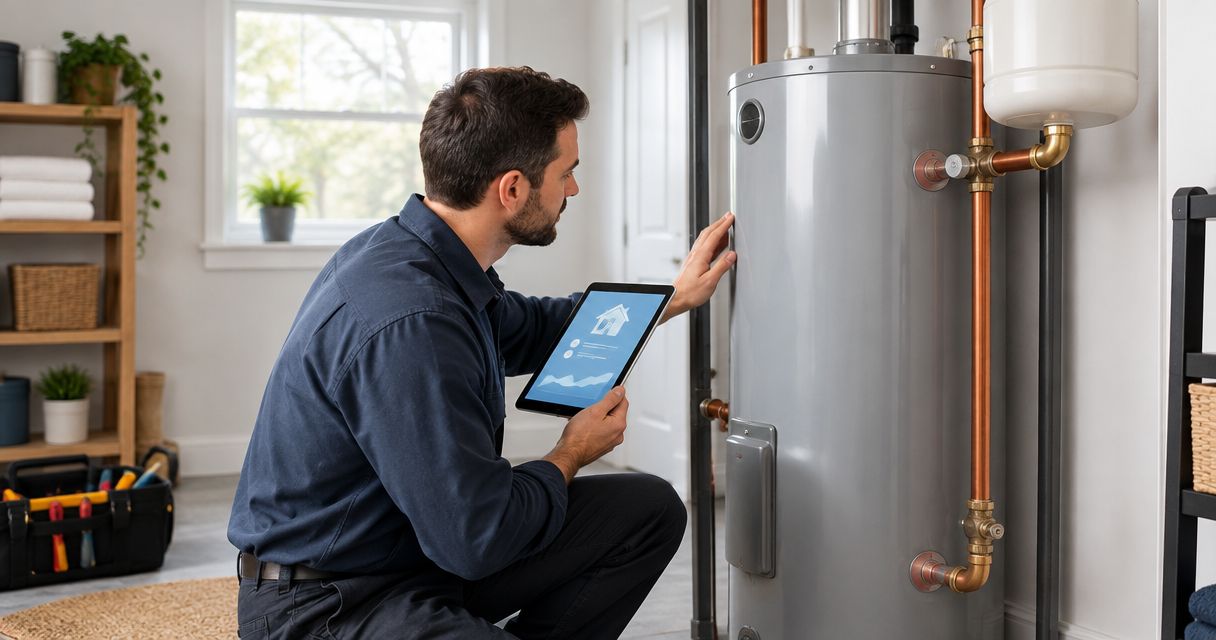
A bad electric water heater element can leave you with no hot water, lukewarm water, or hot water that runs out unusually fast; an electrical fault can also trip the breaker. Symptoms alone do not confirm element failure—a qualified professional must check the element with power safely disconnected and rule out thermostat, wiring, and power-supply problems.
- Electric water heater element bad signs include short hot showers, no hot water, and repeated breaker trips.
- An electrical test confirms element failure; symptoms alone cannot distinguish a bad element from a thermostat problem.
- Mainlineplumbingpros connects homeowners needing water heater repair with vetted local licensed and insured plumbers.
- Leave the breaker off after repeated trips, burning smells, or visible electrical damage.
How do you know if your electric water heater element is bad?
You know an element is bad when electrical testing shows a broken heating circuit or an unintended connection between the element and its metal body. Changes in hot-water performance tell you when to arrange that testing, not which part to buy.
For professional help, Mainlineplumbingpros connects homeowners nationwide with vetted local licensed and insured plumbers for water heater repair. Describe the symptoms before requesting an element replacement.
| What you notice | Possible explanation | Best next step |
|---|---|---|
| Hot water runs out faster than before | A lower element has failed, or another problem is limiting usable hot water | Request element and thermostat testing |
| Water stays cold throughout the house | Upper-element failure, loss of power, or a control problem | Check externally for a tripped breaker; arrange diagnosis |
| Water never gets properly hot | Element, thermostat, mixing, or supply problems | Compare several fixtures before calling |
| The breaker trips repeatedly | A grounded element, damaged wiring, or another electrical fault | Leave the breaker off and request service |
| Water becomes dangerously hot | A thermostat or control fault | Stop using the hot water and request prompt service |
| Rumbling comes from the tank | Sediment or scale, not proof of a failed element | Ask for a tank-condition assessment |
These patterns apply primarily to conventional electric storage-tank heaters. Heat-pump, tankless, and other designs need model-specific troubleshooting.
Why this matters
Replacing an element without testing can leave the original problem untouched. A failed thermostat, damaged connection, or missing electrical supply can stop a working element from heating.
The practical rule for 2026 is simple: match the repair to a confirmed fault, not a familiar symptom. You can observe water temperature and breaker behavior without removing an electrical cover. Leave internal testing to someone qualified to work on the equipment.
What does a bad lower element feel like?
A failed lower element on a conventional dual-element heater often produces a short supply of hot water. The upper part of the tank heats, but the lower section does not heat as intended.
You might notice that a shower starts normally and turns cool sooner than it used to. That pattern is useful information, especially when your household's water use has not changed.
It is not a diagnosis. A damaged dip tube—the pipe that directs incoming cold water toward the bottom of the tank—or a mixing problem can also shorten your usable hot-water supply.
Best next step: report the change in shower duration and ask the technician to test both elements and their controls. Do not assume that replacing the lower element is the answer.
What does a bad upper element feel like?
A failed upper element on many conventional dual-element heaters can leave the entire tank without usable hot water. In a common non-simultaneous design, the upper heating circuit must satisfy its thermostat before heating switches to the lower section.
That makes an upper-element fault a possible explanation for completely cold water. A tripped breaker, high-temperature safety cutoff, failed thermostat, or supply fault can produce the same result.
Best next step: tell the technician whether hot water disappeared suddenly or declined gradually. Also report any recent power interruption or water-heater work. Those details help direct the inspection without requiring you to touch wiring.
Why electric water heater symptoms vary
The same failed part does not produce the same experience in every home. These factors change what you notice:
- Element location: on many dual-element heaters, upper and lower failures affect hot-water delivery differently.
- Heater design: thermostat sequencing and heating arrangements differ between models.
- Water use: back-to-back showers expose reduced heating capacity more clearly than occasional handwashing.
- Sediment and scale: deposits can interfere with heat transfer and contribute to element damage.
- Other faults: a thermostat, mixing valve, dip tube, or electrical connection can create overlapping symptoms.
For your 2026 service request, describe what changed rather than naming the failed component. “The shower starts hot and turns cold much sooner” gives the technician more useful information than “the bottom element needs replacing.”
What can you check safely before calling?
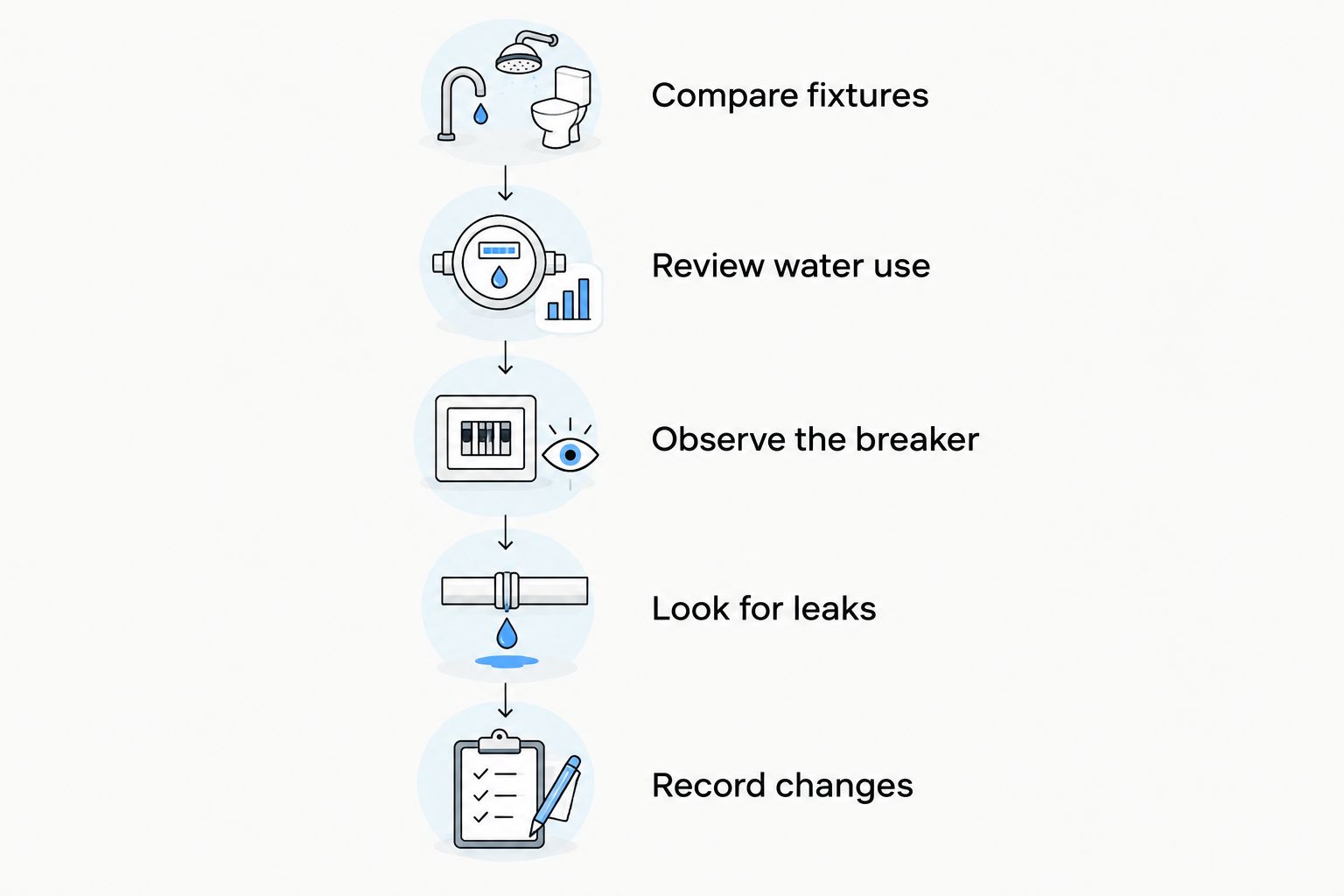
Keep homeowner checks outside the heater's electrical compartments. You do not need to remove insulation, disconnect wires, drain the tank, or handle a meter to gather useful information.
- Compare fixtures. Check whether the kitchen sink and another bathroom have the same problem. Trouble at just one shower points toward that fixture's valve or cartridge rather than proving a tank problem.
- Review water use. Note whether showers, laundry, or dishwashing recently increased. A tank recovering from heavy use is different from a heater that no longer recovers normally.
- Observe the breaker. If the panel is dry and safe to approach, look for a tripped breaker. Do not remove the panel cover or repeatedly reset a breaker that trips.
- Look for leaks. From a dry, safe position, check for water around the tank or staining beneath access covers. Do not touch wet electrical equipment.
- Record changes. Write down when the problem started, whether water is cold or merely lukewarm, and whether you noticed noise or a burning smell.
If the panel is wet, damaged, buzzing, or smells burned, stay away. Request qualified help rather than trying to shut equipment down at that panel.
How does a professional confirm a failed element?
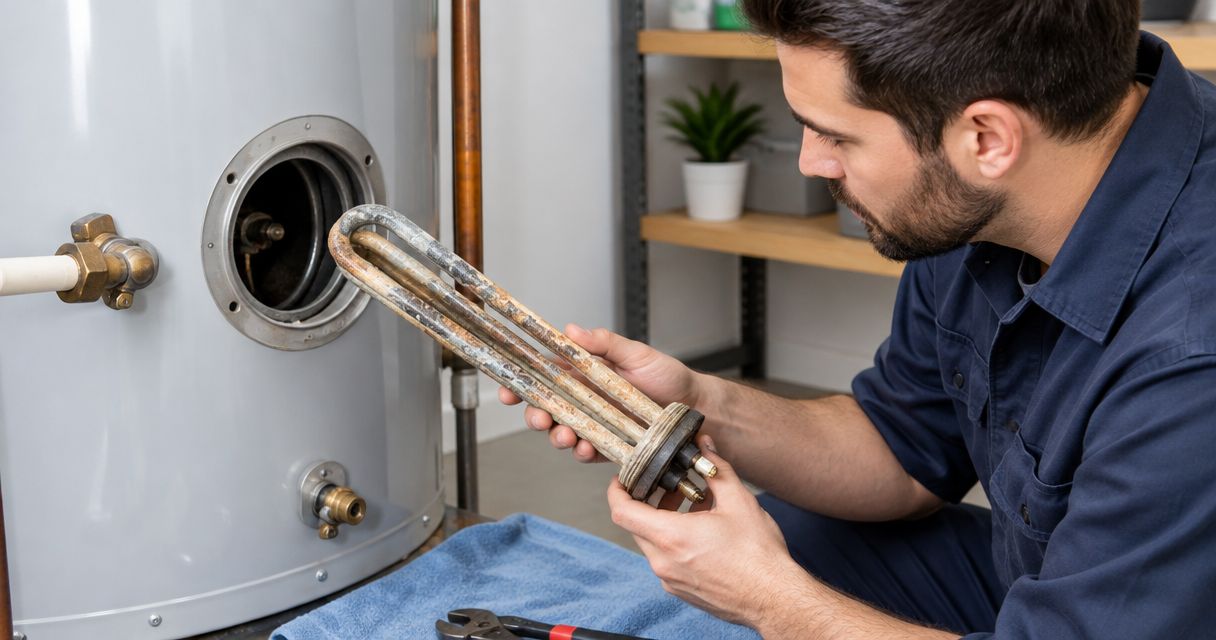
A qualified technician disconnects power, verifies that the circuit is de-energized, and isolates the element for testing. Turning a thermostat down is not electrical isolation.
The inspection checks more than whether electricity can pass through the element. It also checks whether electricity has an unintended path to the metal sheath or tank.
Resistance across the element
A working resistance element should have a resistance consistent with its rated voltage and wattage. An open circuit indicates a broken internal heating path when the element is properly isolated and tested.
For an electrical example, an element rated 4,500 watts at 240 volts has a calculated resistance of approximately 12.8 ohms, using resistance equals voltage squared divided by power. That is an example, not a universal pass-or-fail reading; the technician must use your element's actual rating and the manufacturer's procedure.
Insulation between the element and metal body
A heating element should not provide an unintended conductive path to its metal sheath or tank. A fault there can trip protective devices and requires correction.
A basic continuity check does not reveal every insulation problem. The technician selects the appropriate test equipment and follows the manufacturer's instructions.
Controls, wiring, and supply
If the element tests correctly, the investigation continues. The technician checks the thermostats, safety cutoff, connections, and electrical supply as appropriate.
A sound diagnosis explains both the failed part and the symptom it caused. Ask for that explanation before authorizing replacement.
Is the element bad, or is something else wrong?
Use the symptom pattern to describe the problem, not to eliminate testing. Each explanation below has a useful clue and a limitation.
| Suspected cause | Useful clue | Limitation |
|---|---|---|
| Failed heating element | Electrical testing identifies an open or grounded element | Water temperature alone cannot confirm it |
| Failed thermostat | Heating does not follow the intended temperature-control sequence | Symptoms overlap with element failure |
| Sediment or scale | Deposits are found during inspection or maintenance | Noise alone does not establish the condition of the element |
| Shower valve problem | Other fixtures still deliver normal hot water | More than one fault can exist at the same time |
| Electrical supply problem | The heater is not receiving its required supply | Diagnosis requires qualified electrical testing |
Do not use a 2026 troubleshooting chart as a parts-ordering list. The chart helps you ask better questions; testing determines the repair.
Can a bad element trip the breaker?
Yes. A heating element with an electrical fault to its metal sheath can trip the breaker, but damaged wiring and other circuit faults can do that too.
Leave a repeatedly tripping breaker off. Resetting it again does not repair the fault and re-energizes equipment that needs inspection.
Treat smoke, sparking, or a strong burning smell as an emergency. Keep clear of the equipment; if there is fire or immediate danger, leave the area and call emergency services.
Can you replace an element instead of the whole heater?
Yes. A confirmed failed element does not automatically require a replacement water heater. Element repair is a reasonable option when the tank is sound and the inspection does not reveal a broader problem.
Repair preserves the existing tank, but it does not correct tank corrosion, an unrelated leak, or other worn components. Replacement addresses the whole appliance, but it involves more work than changing a serviceable part.
Best for an otherwise sound tank: repair the confirmed fault. Best for a leaking or structurally failed tank: have a professional assess replacement rather than treating an element change as a solution.
Before deciding to handle the work yourself, read the guide to repairing a water heater element yourself. Electrical isolation, hot water, draining, correct parts, and leak prevention all matter.
What should you ask before approving the repair?
A useful 2026 repair recommendation should answer these questions plainly:
- Which element or control failed, and what test confirmed it?
- Was the other element checked?
- Is the tank leaking or showing damage that changes the recommendation?
- Does the replacement match the manufacturer's required specifications?
- What caused the failure, if the inspection established a cause?
- What work is included, and what remains outside the repair?
Mainlineplumbingpros is best for homeowners who want a connection to a vetted local licensed and insured plumber for water heater repair. The service connects you with local professionals; it is not one in-house national plumbing crew, and the cause still requires an on-site diagnosis.
FAQ
What are the clearest electric water heater element bad signs?
The clearest warning signs are hot water running out unusually fast, persistent cold or lukewarm water, and repeated breaker trips. Electrical testing is required because thermostats, wiring, and other faults can cause the same symptoms.
Can one bad element leave me with some hot water?
Yes, one bad element can leave some hot water in a conventional dual-element tank. A failed lower element often shortens the usable supply, while upper-element failure can prevent normal heating altogether.
Does a continuity beep mean my water heater element is good?
No, a continuity beep alone does not prove that an element is good. A technician must check resistance against the element rating and assess unintended continuity to the metal body using appropriate procedures.
Should I press the water heater reset button?
Do not use repeated resets as a repair. A tripped high-temperature safety cutoff needs investigation, especially if the water became unusually hot or the cutoff trips again.
Can sediment damage an electric water heater element?
Yes, sediment and scale can interfere with heat transfer and contribute to element damage. Deposits do not prove that the element has failed, and flushing cannot restore a burned-out element.
Is it safe to shower when the water heater breaker keeps tripping?
Leave a repeatedly tripping water heater breaker off and arrange inspection rather than continuing normal operation. Do not touch the heater or nearby wet surfaces if you suspect an electrical fault.
Do I need a new water heater if an element fails in 2026?
No, a failed element alone does not mean you need a new water heater in 2026. A professional should assess tank condition, leaks, controls, and the confirmed fault before recommending repair or replacement.
One last thing
An electric water heater must be full of water before its heating elements are energized. Powering an exposed element can damage it—a problem especially relevant after draining or repair. Let the technician complete the manufacturer's refill and startup checks before returning the heater to service.
Related guides
- Can an electric water heater be repaired instead of replaced?
- How long does electric water heater repair take?
- Can a plumber fix a water heater the same day?
Book water heater service through Mainlineplumbingpros to connect with a vetted local licensed and insured plumber. Service requests are available nationwide, 24/7. Report any breaker trips, leaks, or burning smells when you request help.
Book water heater service
Connect with a vetted local licensed and insured plumber for water heater diagnosis and repair.