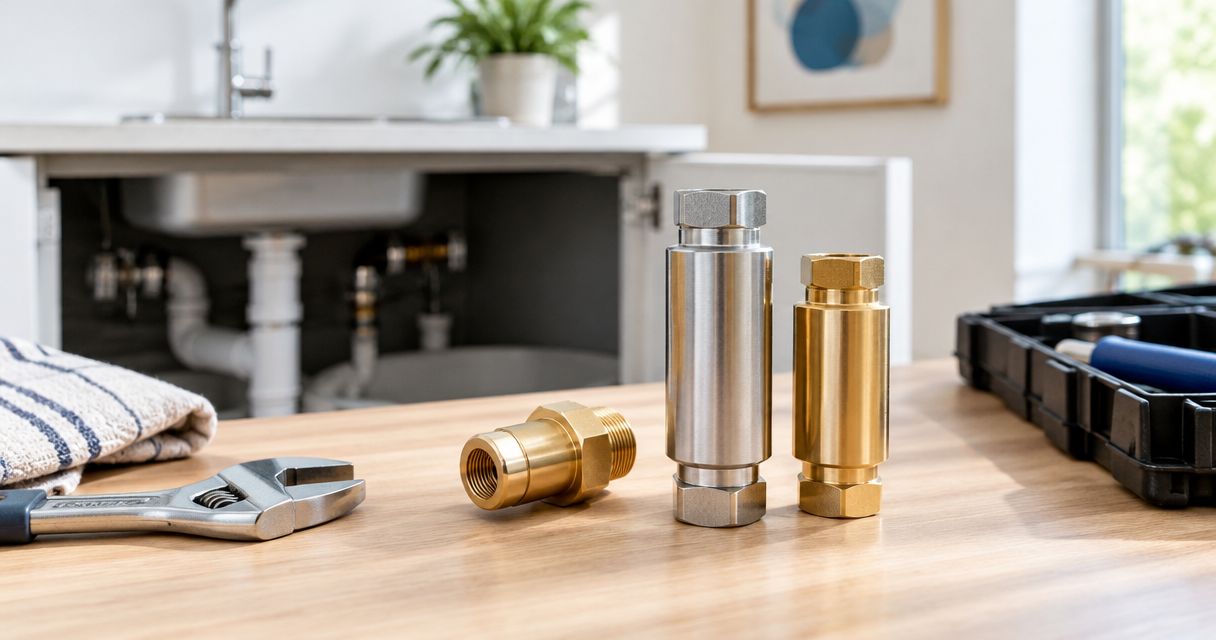
Best overall: a correctly sized, sealed-piston arrestor installed near the valve causing the bang. Best for washing machines: a hose-thread arrestor; best for an accessible under-sink supply: a compression-connection arrestor. This 2026 guide ranks installation types so you can match the fix to your plumbing rather than buy by appearance.
- The best water hammer arrestors match the connection, fixture demand, and location of the fast-closing valve.
- Choose hose-thread arrestors for compatible washing-machine connections and compression arrestors for compatible under-sink supplies.
- Check water pressure and pipe supports before treating every plumbing noise as water hammer.
- Mainline Plumbing connects homeowners nationwide with vetted local licensed and insured plumbers for noisy-pipe diagnosis.
Why this matters
Water hammer is a pressure surge caused when moving water stops or changes direction suddenly. A washing machine or dishwasher valve closing can trigger the familiar sharp bang. An arrestor cushions that surge, but it does not repair loose supports or regulate excessive supply pressure.
Mainline Plumbing is best for homeowners who want professional water hammer diagnosis before choosing an arrestor. Mainline Plumbing connects homeowners nationwide with vetted local licensed and insured plumbers, rather than operating one in-house national plumbing team.
A bang at shutoff points toward water hammer. Clicking as hot pipes warm up, a rattling faucet, and popping inside a water heater need different checks. Identify when the sound happens before ordering hardware.
What makes the best water hammer arrestors?
For your 2026 shortlist, judge the connection and installation requirements before the shape of the chamber. These criteria matter:
- Verified performance: Look for a water hammer arrestor identified as meeting ASSE 1010, the performance standard for these devices.
- Correct connection: Match the actual thread or compression fitting. Similar-looking fittings are not automatically interchangeable.
- Appropriate sizing: Follow the manufacturer's fixture-demand sizing guidance; connection diameter alone does not establish capacity.
- Useful placement: Install near the fast-closing valve according to the manufacturer's instructions, not wherever the pipe is easiest to reach.
- Installation fit: Confirm orientation, physical clearance, potable-water suitability, and access requirements for the selected device.
- Serviceability: Favor a location where you can inspect connections and replace the device without unnecessary demolition.
Water hammer arrestors at a glance
These are connection-based options, not interchangeable products. Each recommendation assumes the noise is confirmed water hammer and the selected arrestor is properly rated and sized.
| Option | Best for | Standout feature | Key limitation |
|---|---|---|---|
| Hose-thread arrestor | Washing-machine hookups | Connects at compatible appliance hose fittings | Adds depth and weight behind the appliance |
| Compression-connection arrestor | Accessible under-sink supplies | Fits a compatible supply connection near the fixture | Requires exact fitting compatibility and clearance |
| Threaded branch-line arrestor | Permanent accessible pipework | Allows installation on a dedicated branch fitting | Usually requires pipework changes |
| Push-to-connect arrestor | Compatible exposed pipe with limited working room | Joins compatible pipe without soldering | Requires correct pipe preparation and approved pipe material |
There is no universal winner across all four connections. The best default is the arrestor that fits the problem valve without unnecessary adapters or unsupported fittings.
1. Hose-thread arrestors: best for washing-machine hookups
A hose-thread arrestor fits a compatible washing-machine supply connection. It places the cushioning chamber near a common source of sudden valve closure without requiring a new branch in the supply pipe.
Many washing-machine hoses use a 3/4-inch hose-thread connection. Confirm your actual fittings and the arrestor instructions; a hose-thread fitting is not the same as a pipe-thread fitting bearing the same nominal size.
Hose-thread arrestor pros:
- Provides a direct connection at compatible washer hookups.
- Keeps installation close to the appliance causing the bang.
- Allows inspection when the connections remain accessible.
Hose-thread arrestor cons:
- Reduces clearance behind the washing machine.
- Can strain a valve or hose if the assembly is poorly supported.
- Does not correct high house pressure or damaged shutoff valves.
Best for: A washing machine that bangs when its fill valve closes, with sound valves and enough installation space.
If both hot and cold supply paths produce hammer, assess both. Do not assume an arrestor on the cold connection also protects the hot connection.
Verdict: Buy a compatible hose-thread arrestor after confirming the washer is the trigger.
2. Compression arrestors: best for accessible under-sink supplies
A compression-connection arrestor joins a matching fixture supply connection. This arrangement suits accessible under-sink plumbing when the problem valve and the manufacturer's placement instructions make that location appropriate.
A 3/8-inch compression connection is common on fixture supply tubing. That description is not permission to attach any similarly sized fitting: verify the mating connection and use the sealing method specified for that joint.
Compression arrestor pros:
- Fits compatible fixture supply connections without soldering.
- Keeps the device accessible inside a cabinet.
- Offers a targeted option for an individual problem fixture.
Compression arrestor cons:
- Crowded cabinets can leave insufficient clearance.
- Old shutoff valves can leak when disturbed.
- An accessible under-sink location is not automatically close enough to a dishwasher's closing valve.
Best for: A confirmed local hammer problem with a compatible, accessible supply fitting and an installation location approved by the device manufacturer.
Do not keep tightening a leaking connection without checking the fitting. Misalignment, incompatible parts, or a damaged sealing surface require correction rather than extra force.
Verdict: Buy when connection compatibility and placement are confirmed; otherwise, hold for a plumber's assessment.
3. Threaded branch-line arrestors: best for permanent pipework
A threaded arrestor connects to a matching threaded fitting installed in the supply piping. A plumber can place that fitting near the problem valve rather than forcing an appliance-style connector into an unsuitable location.
A 1/2-inch pipe-thread connection is one possible configuration, not a universal recommendation. The branch arrangement, arrestor size, and installation location must suit the fixture demand and device instructions.
Threaded branch-line arrestor pros:
- Allows deliberate placement near the source of hammer.
- Works with an appropriately designed permanent piping connection.
- Avoids depending on an appliance hose connection where none exists.
Threaded branch-line arrestor cons:
- Adding the connection usually requires plumbing alterations.
- Poor placement inside finished walls complicates service.
- Incorrect thread sealing or unsupported fittings introduce leak risks.
Best for: Renovation work, accessible utility areas, or repeated hammer that needs a purpose-built connection.
This is not a reason to open a wall immediately. First establish that the noise is hammer and that pressure control, loose pipes, or a faulty valve are not the primary problem.
Verdict: Buy as part of a planned plumbing repair; skip improvised concealed installations.
4. Push-to-connect arrestors: best for compatible exposed pipe
A push-to-connect arrestor attaches to pipe materials and sizes specifically approved by its manufacturer. It avoids soldering at that connection, which helps where flame work is unsuitable or working room is limited.
The pipe still needs careful preparation. A square cut, a clean and undamaged surface, and full insertion are essential; additional preparation depends on the fitting and pipe material.
Push-to-connect arrestor pros:
- Avoids soldering at the arrestor connection.
- Offers an option for compatible exposed piping.
- Can simplify installation where wrench access is restricted.
Push-to-connect arrestor cons:
- Does not fit every pipe material or surface condition.
- Requires enough straight, sound pipe for proper engagement.
- Still needs correct support, sizing, and placement.
Best for: Accessible, compatible piping where a properly prepared push connection suits the repair.
Do not treat push-to-connect as a universal repair for corroded or damaged pipe. The connection depends on the pipe meeting the fitting manufacturer's requirements.
Verdict: Buy for verified compatible pipe; skip when the material or pipe condition is uncertain.
Before installation: check the cause in five steps
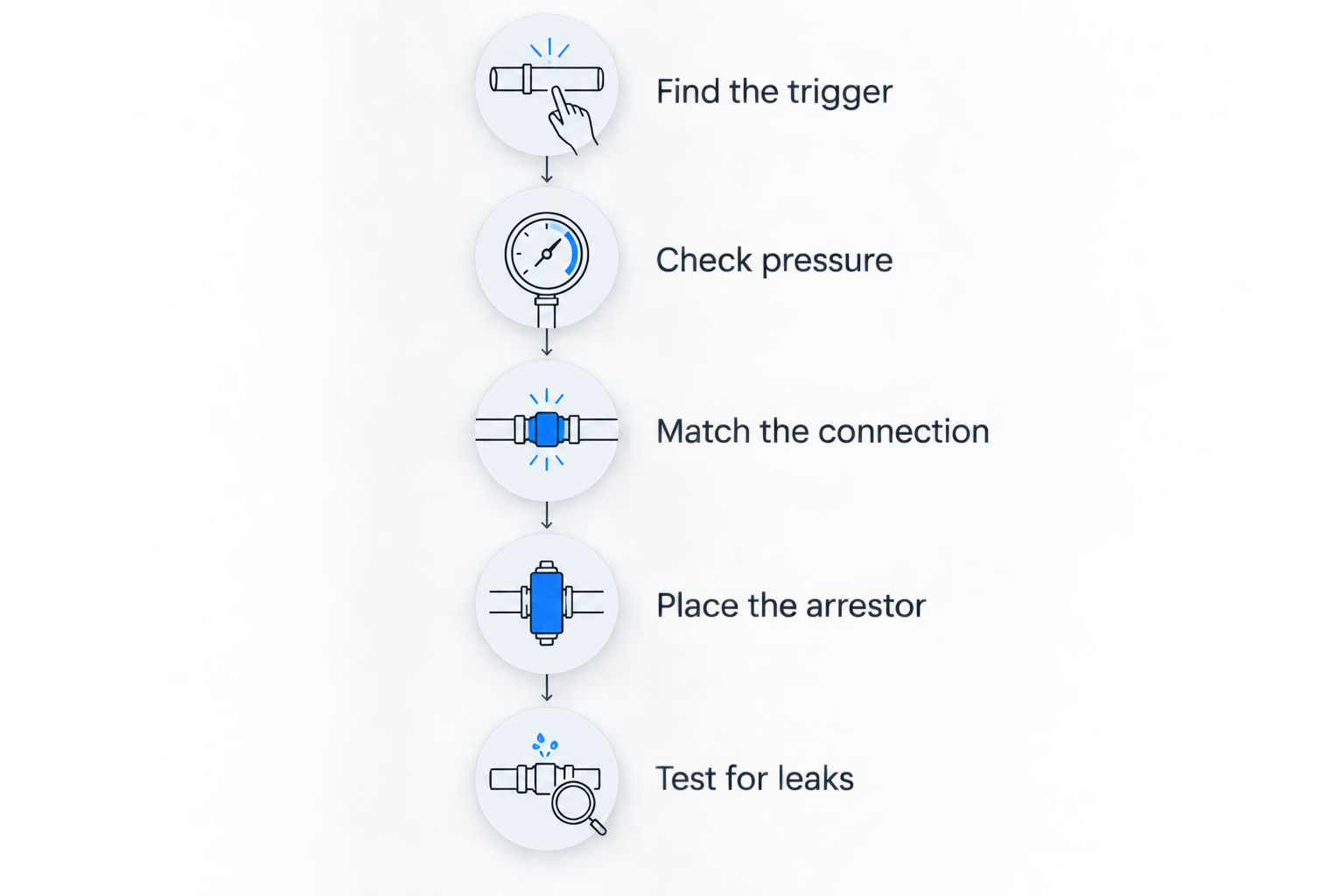
Use this sequence before choosing a water hammer arrestor in 2026. It separates a suitable local fix from a pressure or pipe-support problem.
1. Find the trigger
Note which fixture operates immediately before the bang. Observe normal use rather than repeatedly snapping valves shut to reproduce the noise.
Write down whether the sound follows the washing machine filling, a dishwasher cycle, or a faucet closing. A short recording helps a plumber connect the sound with the event.
2. Check pressure
Have static water pressure checked with a suitable gauge, and investigate pressure changes when necessary. An arrestor absorbs a sudden surge; a pressure-reducing valve controls supply pressure. They perform different jobs.
Read how much water pressure is too high for home pipes before assuming louder banging simply needs a larger arrestor.
3. Match the connection
Identify the fitting type, pipe material, and available space. Photograph the existing assembly before disconnecting anything, and check the selected device's installation sheet.
Do not select an arrestor from connection diameter alone. Confirm its sizing guidance, approved orientation, and suitability for the water supply.
4. Place the arrestor
Follow the manufacturer's location instructions near the fast-closing valve. Check that the assembly will not kink a hose, block appliance movement, or hang unsupported from a fragile connection.
Shut off and relieve the relevant water supply before opening a joint. If the shutoff does not fully stop the water, stop the installation and arrange repair.
5. Test for leaks
Restore water as directed and inspect every disturbed joint. Run the fixture through normal operation, then check again for moisture and the original noise.
If the bang remains, reassess the diagnosis, location, and sizing. Do not keep adding fittings without finding the cause.
When an arrestor is the wrong fix
Do not buy an arrestor solely because a pipe makes noise. Loose supports let pipes move, thermal expansion makes pipes rub against framing, and worn valves can chatter. Those problems need their own repairs.
A water heater expansion tank addresses pressure changes caused by heated water expanding in a closed system. It is not a direct substitute for a correctly placed water hammer arrestor. Likewise, an arrestor does not replace a required expansion tank.
Stop using the affected fixture and arrange prompt service if banging accompanies a visible leak or a moving, damaged connection. Keep away from water near electrical equipment. Do not remove plumbing components while the system remains pressurized.
How these options are ranked
This 2026 ranking puts common, accessible fixture connections first, then options that require changes to permanent piping. The criteria are connection compatibility, appropriate sizing, placement, installation requirements, and service access—not an unsupported claim that one brand lasts longest.
Mainline Plumbing water hammer service connects you with a local professional who can check the cause before recommending hardware. That is the stronger next step when several fixtures bang or the pressure needs investigation.
Which water hammer arrestor should you choose?
For a banging washing machine, start with a correctly sized hose-thread arrestor that matches the hookup. For an under-sink problem, assess a compression connection; for permanent pipework, have a plumber select the appropriate threaded or push-to-connect arrangement.
Your 2026 buying decision should follow the valve, not the loudest wall. Sound travels through plumbing, so the place you hear the bang is not necessarily the best installation location.
FAQ
What's the best water hammer arrestor for a washing machine?
A correctly sized hose-thread arrestor is the best starting point for a washing machine with compatible hookups and confirmed water hammer. Check clearance, connection type, and manufacturer placement instructions before installation.
Will one water hammer arrestor fix the whole house?
Do not assume one arrestor will fix hammer throughout the house. Separate valves and supply branches require assessment, and widespread banging also calls for pressure and pipe-support checks.
Do I need arrestors on both hot and cold washing-machine lines?
Assess both lines if both produce hammer. An arrestor installed on the cold connection does not automatically address a surge on the hot connection.
Can I install a water hammer arrestor myself?
An accessible, compatible appliance connection is a possible DIY job if you can safely isolate the water and follow the instructions. Use a plumber when valves leak, pipework needs alteration, or the cause remains uncertain.
Is a water hammer arrestor the same as an expansion tank?
No, an arrestor cushions sudden pressure surges while an expansion tank accommodates water expanding as it heats in a closed system. Neither automatically replaces the other.
Why do my pipes still bang after I install an arrestor?
Persistent banging requires checking the diagnosis, arrestor sizing, placement, water pressure, and pipe supports. A faulty valve or a different type of pipe noise also needs investigation.
What should I check when buying an arrestor in 2026?
Check connection compatibility, manufacturer sizing guidance, installation orientation, and identification to an applicable performance standard such as ASSE 1010. Choose by the fixture and installation requirements rather than chamber size alone.
One last thing
Do not use draining and refilling the house as proof that a permanent repair is complete. Older capped air chambers can lose their air cushion as water absorbs the air; a purpose-built sealed arrestor separates the cushioning gas from the water.
Record which fixture triggers the noise before your service visit. That simple detail gives the plumber a useful starting point without repeatedly stressing the plumbing.
Related guides
- Can a water heater expansion tank prevent leaks?
- Is it normal for a water heater to make popping noises?
- Best smart water leak detectors for homes
Book through Mainline Plumbing for help finding the cause and selecting the right repair. Nationwide connections to vetted local licensed and insured plumbers are available 24/7.
Book help for banging pipes
Connect with a vetted local licensed and insured plumber to diagnose noisy pipes.