Electric water heater repair has no single reliable completion time: the fault, the correct replacement parts, and the work needed to restore safe operation determine the schedule. Finishing the repair does not mean your tank is already full of hot water; reheating adds a separate wait. Ask for both the expected repair completion and the expected return of usable hot water before work begins.
- Electric water heater repair how long? Diagnosis, parts, and reheating determine the answer—not the symptom alone.
- A repaired water heater still needs time to heat the water before you can shower.
- Repeated breaker trips, burning smells, or leaking near electrical parts require prompt professional attention.
- Mainline Plumbing connects homeowners needing electric water heater repair with vetted local licensed and insured plumbers nationwide.
For your 2026 repair appointment, separate the work schedule from the hot-water recovery schedule. If you are weighing the repair decision, the electric water heater repair cost guide explains the other side of the decision.
How long does electric water heater repair take?
The useful estimate comes after diagnosis, not from the words “no hot water.” A failed heating element, an interrupted electrical supply, and a leaking tank require different responses, even when each leaves you without a hot shower.
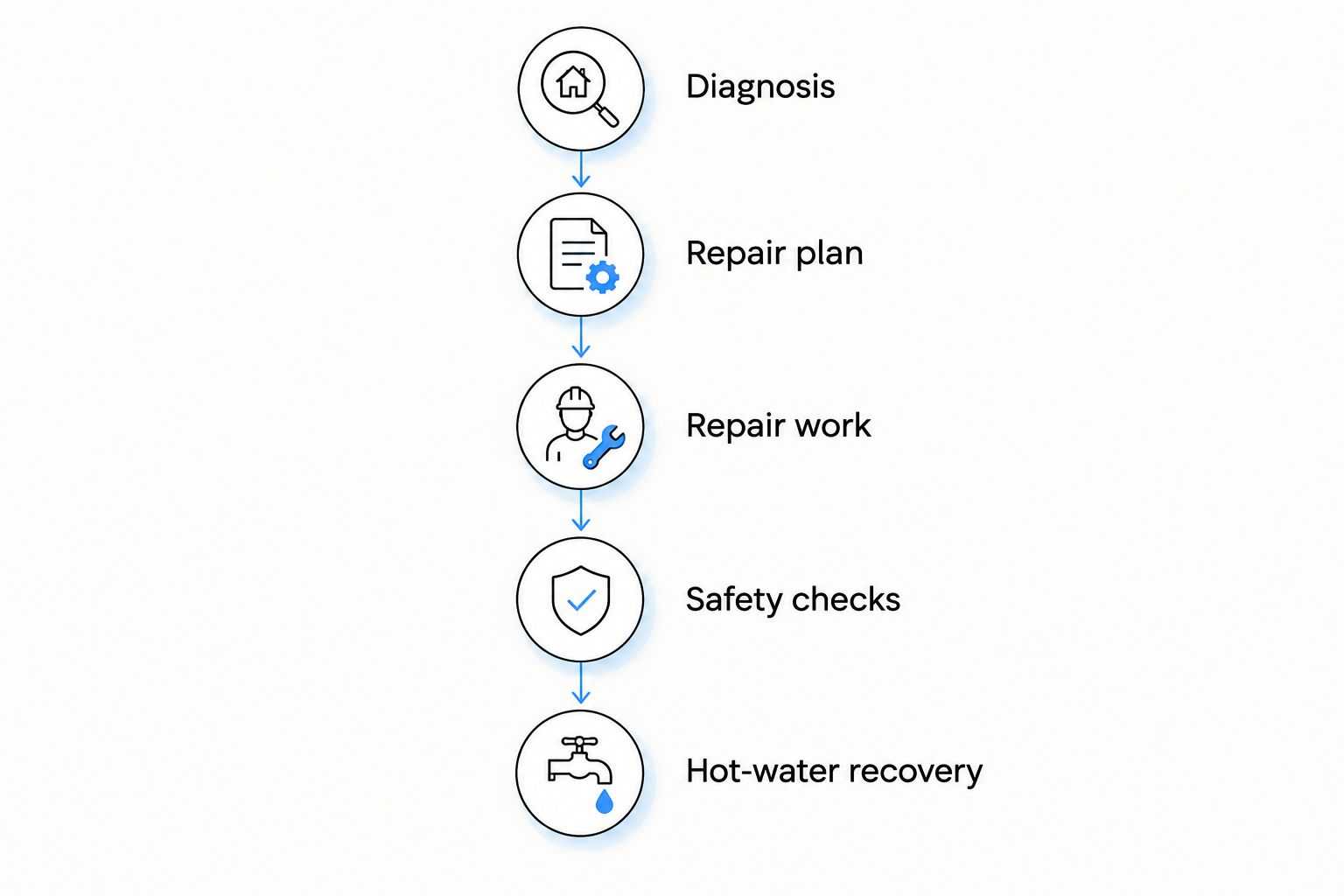
Ask the technician to break the appointment into these stages:
- Diagnosis. Identify the fault and check whether the problem is inside the heater, in its electrical supply, or elsewhere in the plumbing.
- Repair plan. Confirm the required part, the work involved, and whether the heater is suitable for repair.
- Repair work. Isolate the equipment safely, complete the approved work, and restore the system according to the manufacturer's instructions.
- Safety checks. Check for leaks, proper electrical operation, and correct control operation before treating the repair as complete.
- Hot-water recovery. Allow the heater to warm the stored water, then confirm that hot water reaches the fixtures.
A useful 2026 appointment estimate names these stages rather than promising an unexplained finish time. Ask which stages the estimate includes and what would require a revised schedule.
Why this matters
You need to know when you can shower, wash dishes, or run the household—not just when a technician will leave. A repair appointment that ends before the tank finishes heating can still leave you waiting for usable hot water.
Keep these questions separate when you book service: when someone can arrive, when the work should finish, and when hot water should return. A fast response is not a promise of an immediate repair. Diagnosis and safe operation still come first.
What different repair paths involve
The symptom helps you describe the problem. It does not identify the failed part by itself. Use this comparison to understand why a technician needs to inspect the heater before giving a dependable schedule.
| Repair path | Best for | What the work involves | Benefit | Limitation |
|---|---|---|---|---|
| Heating element repair | A confirmed failed heating element in an otherwise repairable heater | Electrical testing, safe isolation, draining as needed, replacement, and testing | Addresses the failed heating component | Draining, refilling, and reheating remain separate tasks |
| Thermostat or control repair | A confirmed control fault | Testing controls and related components before replacement | Targets the part controlling heat | Replacing a control does not resolve an unrelated electrical fault |
| Connection or valve repair | A leak traced to a repairable fitting or valve | Identifying the leak source, repairing the affected connection, and checking operation | Preserves a serviceable tank | Water around the heater does not prove a fitting is the source |
| Tank replacement | A confirmed leak through the tank itself | Removing the failed heater and installing a suitable replacement | Addresses a failed tank rather than an unrelated component | It is a different job from a component repair |
Heating element repair: include draining and reheating
An electric heating element transfers heat to the water. When an element fails, the technician needs to verify the fault rather than replace it based only on your symptoms.
Element replacement can require lowering the water level before removing the part. The tank must be properly filled before power returns; energizing an element without water can damage it. That makes refilling and checking the heater part of the job, not optional cleanup.
Thermostat repair: find the reason for the fault
A thermostat controls when the heater calls for heat. A control problem can interrupt heating or contribute to unsafe water temperatures, so testing matters before and after replacement.
A tripped safety control also needs an explanation. Do not keep resetting a heater that repeatedly shuts down. Ask what caused the shutdown and how the technician confirmed that the underlying problem was resolved.
Leak repair: identify where the water starts
Water collecting beneath a heater can come from connections, valves, or the tank itself. Those are not interchangeable repair jobs. Tell the technician where you first noticed moisture, but do not remove electrical covers to investigate.
A confirmed leak through the tank itself calls for replacement rather than a heating-element repair. If replacement becomes necessary, ask for a new scope and schedule before approving the work.
Why electric water heater repair time varies
These factors explain why an estimate changes after inspection. For a 2026 service request, describe what you see and ask which factors apply to your heater.
- The actual fault. An electrical supply problem needs a different response from a failed element or a leaking connection. Symptoms alone do not settle the diagnosis.
- The correct replacement part. The technician must match the replacement to the heater's requirements. Share the model information before the visit when you can read it safely.
- Access to the heater. Stored belongings, narrow access, and enclosed installations affect how the technician reaches the equipment and performs the work.
- Draining and refilling. Work below the waterline requires water management. The technician also needs to confirm the heater is full before restoring power.
- The condition of the equipment. Corrosion, damaged connections, or additional faults change the work required. An initial component repair plan does not cover every possible finding.
- Heating recovery. Tank capacity, element power, incoming water temperature, and hot-water use affect how quickly the supply recovers after the repair.
What should you do before the plumber arrives?
Prepare information and clear access; leave electrical diagnosis to the professional. You can make the visit more productive without opening the heater or handling wiring.
Write down whether the water is completely cold, turns cold during use, or becomes unusually hot. Note when the problem began and whether the breaker has tripped. Tell the service provider about leaks, noises, or burning smells when you book—not after the technician arrives.
If it is safe to approach the heater, photograph the manufacturer's label and the surrounding installation. Include any visible water without moving covers or touching wet equipment. Those details help the service provider understand the job, but photographs do not replace an inspection.
Clear household storage from the access route. Keep children and pets away from the work area, and tell the technician if the heater sits behind a locked door or in a difficult-to-reach space.
When should you stop troubleshooting?
Stop when troubleshooting would involve electrical covers, exposed wiring, standing water, or repeated resets. If the breaker trips again, leave it off and arrange professional help rather than repeatedly restoring power.
If water is near electrical equipment, do not step into it to reach a switch or valve. Shut off the heater's circuit only from a dry, safely accessible location. Smoke, sparks, or an active fire require emergency services, not a routine repair appointment.
What should you ask before approving the repair?
Ask the technician to explain the diagnosis in plain language. You should understand what failed, what work is recommended, and what will be checked afterward.
For a 2026 repair authorization, use this checklist:
- What failed, and how was the failure confirmed?
- Does the heater have any separate leak or electrical concern?
- Does the work require draining and refilling?
- What could change the repair plan?
- Does the completion estimate include testing?
- When should usable hot water return after power is restored?
You can request service through Mainline Plumbing, which connects homeowners nationwide with vetted local licensed and insured plumbers. Mainline Plumbing is best for homeowners seeking a local professional for electric water heater repair. The service offers 24/7 availability, but the repair schedule still depends on diagnosis and the required work.
Book water heater service
Connect with a vetted local licensed and insured plumber for diagnosis and repair.
Will hot water return immediately after the repair?
Hot water does not return immediately just because the repair is finished. A storage heater must heat the water in its tank, and water already sitting in the pipes must clear before hot water reaches a fixture.
Ask the technician when to check the hot-water supply and what result to expect. Avoid using several hot-water fixtures while you are checking recovery; drawing water changes the conditions you are trying to assess.
Does no hot water mean the heater needs replacement?
No hot water does not, by itself, mean replacement is necessary. A failed element or control can be repairable, while a leaking tank requires a different decision.
Ask for the diagnosed failure before choosing between repair and replacement. The strongest recommendation explains the condition of your heater, not just its symptom.
Can you keep using the heater while waiting for repair?
Do not keep using a heater with an unresolved electrical warning, unsafe overheating, or an active leak. Report those symptoms when requesting service and follow the professional's shutdown instructions.
If the only symptom is reduced hot water, describe it accurately and ask whether the heater should remain on until inspection. Do not assume that a lack of visible water makes an electrical problem safe.
FAQ
Can an electric water heater be repaired during one visit?
An electric water heater repair can be completed during one visit when the fault is confirmed, the required parts are on hand, and no additional work is needed. Ask the technician to confirm the plan after diagnosis rather than treating the appointment as a completion guarantee.
Why is my water still cold after the plumber finishes?
The heater may still be warming the stored water after the repair. Follow the technician's recovery instructions and report a lack of improvement, another breaker trip, or a new leak.
Does replacing a heating element require draining the tank?
Heating element replacement can require lowering the tank's water level before removing the element. The heater must be properly refilled before power is restored.
Should I reset the water heater breaker again?
Do not repeatedly reset a breaker that trips. Leave the circuit off and arrange professional diagnosis of the heater and its electrical supply.
Can a plumber fix a water heater that is leaking underneath?
The repair depends on the source of the water, not where the puddle collects. A repairable connection leak is different from a confirmed leak through the tank itself.
What information should I give when booking water heater repair?
Give the heater type, model information if safely accessible, and a clear description of the symptoms. Report leaks, repeated breaker trips, burning smells, and unusually hot water immediately.
Does 24/7 service mean my hot water will return right away?
No. Mainline Plumbing offers 24/7 availability, but arrival, diagnosis, repair, and hot-water recovery are separate stages. Ask for an estimate that distinguishes them.
One last thing
Ask what “finished” means before the appointment ends. A replaced part, a safely operating heater, and usable hot water at your shower are different checkpoints. For your 2026 repair, get clear instructions on when to check recovery and when to call back.
Book service with Mainline Plumbing and describe the symptoms when you request the visit. Ask for the repair plan, the safety checks, and the expected return of hot water—not just an arrival window.