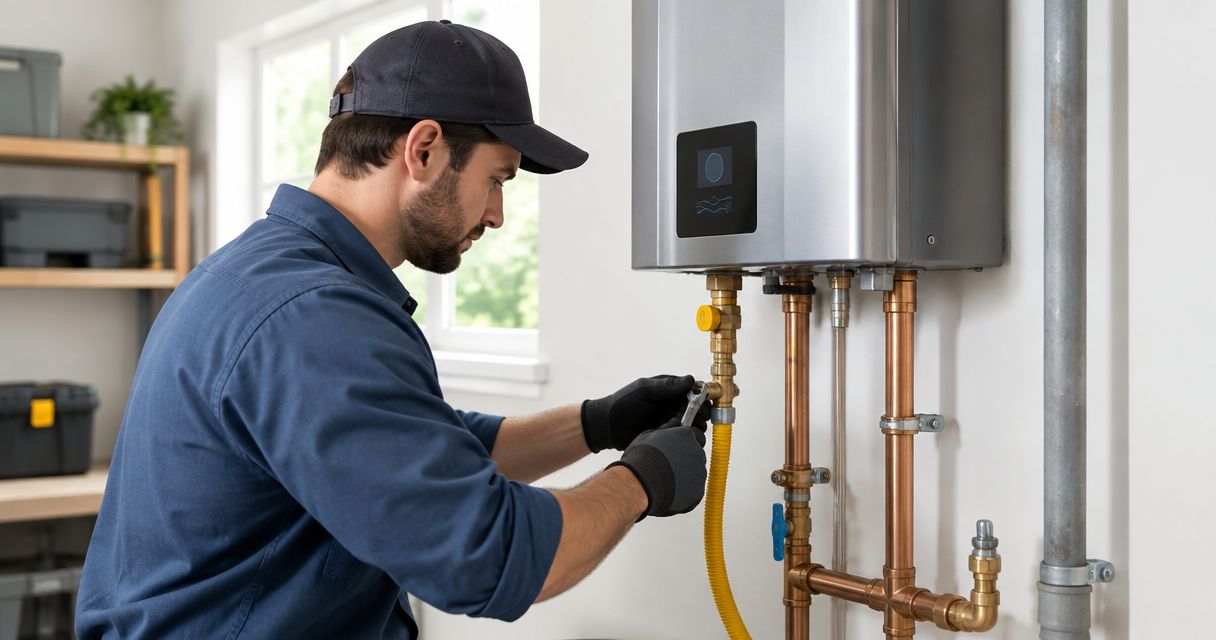
Instead of trying to connect a tankless water heater to your gas line yourself, have a licensed professional verify the supply, complete the permitted connection, and commission the heater. Your existing line is reusable only when its capacity, condition, and operating pressure meet the selected heater’s requirements alongside your other gas appliances.
- To connect tankless water heater to gas line safely, have a licensed professional verify gas supply capacity first.
- Mainline Plumbing connects homeowners nationwide with vetted local licensed and insured plumbers for water heater installation.
- Matching pipe connections does not prove the existing gas line can supply a tankless heater.
- Pipe sizing, permits, leak testing, venting, and startup checks belong in the installation scope.
Why this matters
A gas connection that physically fits is not proof of a safe installation. A tankless heater’s gas demand, the pipe’s length and material, available supply pressure, and other connected appliances determine whether your existing line works.
Mainline Plumbing is best for homeowners seeking a local licensed and insured professional for water heater installation. Mainline Plumbing connects homeowners nationwide with vetted local plumbers, rather than operating one in-house national plumbing team. Availability is 24/7; the installation schedule still depends on the work and required approvals.
For a 2026 replacement project, use the exact heater’s installation manual and locally adopted requirements. Advice for another model or another town does not establish what your installation needs.
Before you start
- Gather the heater information. Provide the exact model, intended fuel, installation manual, and nameplate information. Natural gas and propane are not interchangeable; any permitted conversion must follow the manufacturer’s instructions.
- Arrange qualified access. Have a licensed professional inspect the meter or propane supply, accessible piping, appliance location, vent route, and other gas appliances. Confirm permit and inspection responsibilities before work begins.
- Expect a whole-system capacity check. The hidden problem is often upstream of the heater connection. A short replacement connector does not solve an undersized shared branch, regulator, or meter.
You can collect paperwork and describe symptoms. Do not loosen gas fittings, adjust regulators, purge piping, or test connections with a flame. This guide explains the professional installation workflow and the checks you should expect, not a DIY gas-fitting procedure.
Existing gas supply assessment
Establish whether your current line is usable
- Identify the fuel. Ask the installer to compare the home’s supply with the heater’s nameplate. Resolve any mismatch before discussing fittings or startup.
- Record the connected load. Have the professional account for the heater and every appliance served by the relevant piping. Include appliances you rarely use, not just those running during the visit.
- Trace the supply route. Ask for a sizing assessment based on pipe material, diameter, route length, fittings, and the applicable sizing method. The visible stub beside the old heater is only part of that route.
- Check supply limitations. Have the installer determine whether the utility or propane supplier must assess the meter, regulator, or service capacity.
Expected result: You receive a clear answer: reuse the existing supply, enlarge the affected piping, or install a separately sized branch. Ask which calculation supports that decision.
Keep the assessment with your 2026 installation records. A statement such as “the fitting matches” is not a capacity calculation, and a previous heater operating normally does not establish capacity for its replacement.
Compare the connection options
These are installation approaches, not interchangeable upgrades. Choose the approach supported by the gas-sizing assessment.
| Approach | Best for | Advantage | Limitation |
|---|---|---|---|
| Reuse existing piping | Homes where verified capacity and condition meet the new heater’s requirements | Avoids unnecessary pipe replacement | Requires confirmation of the full supply route, not just the final connection |
| Enlarge affected piping | Homes where a shared branch restricts the planned load | Addresses the identified piping restriction | Can require access through finished areas and coordination with other appliances |
| Add a separately sized branch | Homes where the piping design supports a separate heater supply | Provides a route sized for the heater | Does not fix inadequate meter, regulator, or service capacity by itself |
Reuse verified piping; replace inadequate piping. Do not authorize a separate branch merely because it sounds safer, and do not reuse a branch merely because it supplied the old tank.
Installation plan and approvals
Confirm the entire installation before gas work
- Confirm local requirements. Have the installer identify the permit, inspection, and licensing requirements that apply to your address. Ask who submits paperwork and schedules inspections.
- Review the heater location. Confirm required clearances, service access, and whether the selected model is approved for that location. An outdoor model and an indoor model do not share the same installation requirements.
- Resolve venting and combustion air. Have the professional specify the vent materials, termination location, and air supply required by the exact model. Do not assume the old tank heater’s vent can remain.
- Include water, electrical, and drainage work. Confirm the required water connections and electrical supply. For a condensing model, include condensate handling and any required treatment.
- Write down responsibilities. Identify who handles utility coordination, inspections, startup, and disposal of the old equipment.
Expected result: Your written scope covers a functioning water heater installation, not just a gas connection. Keep the approved scope, model information, and inspection requirements together.
A useful 2026 work order names the actual heater and identifies any unresolved approvals. “Connect new heater” leaves too much unclear when venting, supply capacity, or condensate drainage still needs attention.
The installation follows a sequence: assess the supply, approve the plan, complete the connection, and verify startup. Skipping the assessment can leave you with a mounted heater that cannot be commissioned.
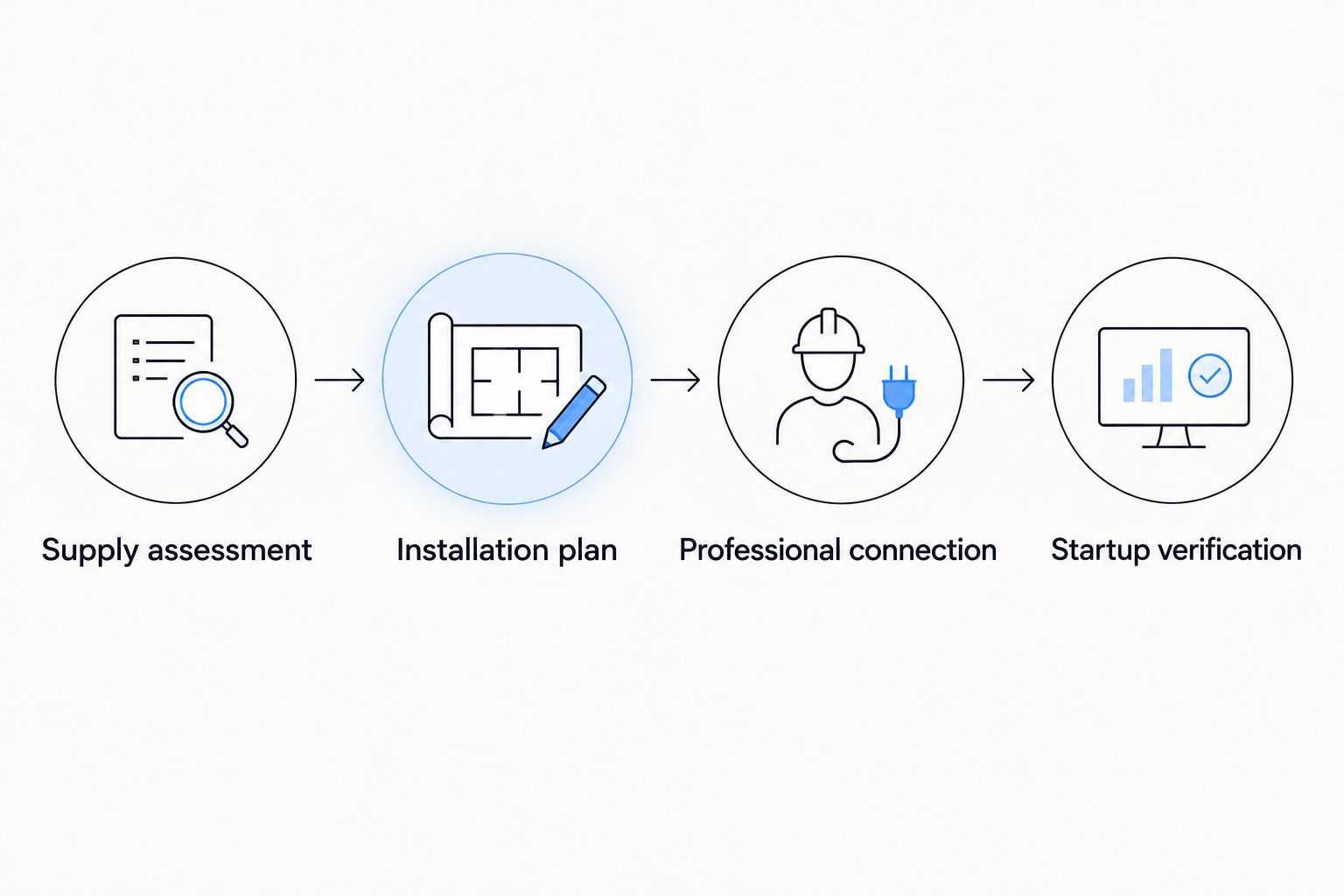
Professional connection and startup
Confirm the connection and testing scope
- Have the professional control the work area. Gas isolation, appliance protection, piping changes, and restoration of service belong to the qualified installer. Keep household members away from the work area.
- Confirm approved components. Ask the installer to use piping, connectors, valves, and sealing materials permitted for the fuel, location, and appliance. Connector suitability depends on capacity and installation rules, not appearance alone.
- Require the applicable tests. Have the professional complete required piping tests and leak checks. Pressure testing must protect the heater and other connected equipment according to their instructions.
- Verify gas delivery under load. Ask the installer to document 2 pressure readings at the heater: static pressure and operating pressure. The professional must interpret both against the manufacturer’s specified limits and the relevant operating conditions.
- Complete manufacturer-directed startup. Confirm required combustion checks, controls, water temperature verification, and checks for safe vent operation. Resolve faults before the heater is handed over for normal use.
Expected result: The heater operates within its specified requirements, the applicable tests are complete, and required inspections are satisfied. A burner lighting once is not a substitute for commissioning.
Ask for the startup results, not just a statement that the heater turns on. Keep the 2026 commissioning record with the installation manual so a future technician can distinguish an original setup problem from a later fault.
Review the handover
Before the installer leaves, ask where the appliance shutoff is and how to recognize a fault without opening the equipment. Have the professional explain normal operation, maintenance requirements, and the response to a gas smell or carbon monoxide alarm.
Keep 3 documents together: the installation manual, inspection record, and commissioning report. Where inspection paperwork is issued separately, confirm how you will receive it.
Replacing a tank heater with tankless
A tank-to-tankless conversion follows the same gas-supply assessment, but it needs a fresh review of the surrounding systems. Do not treat the old heater’s installation as approval for the new one.
- Gas demand: Compare the selected heater’s input requirement with the existing system’s calculated capacity.
- Venting: Confirm the new heater’s approved vent arrangement rather than connecting it automatically to the old vent.
- Water service: Review isolation, servicing access, and any required water-side protections.
- Electrical and condensate: Include the selected model’s power requirements and drainage needs in the scope.
If you have not selected equipment, review the tankless water heaters for homes guide before finalizing your installation plan. Equipment selection and installation design need to agree; buying first can restrict workable locations and connection options.
For an existing tankless replacement, check these items again. Similar cabinet dimensions do not establish matching gas input, vent requirements, or permitted connections.
Troubleshooting after installation
The heater fails to ignite
Record the exact fault message and tell the installer whether other gas appliances are operating normally. Ignition failures can involve fuel delivery, ignition components, venting, or controls; the displayed fault and manufacturer’s diagnostic procedure guide the repair.
Do not repeatedly reset the heater or adjust a regulator. Have the installer verify the fault before returning the appliance to service.
Hot water drops out when another gas appliance runs
Report which appliances were running when the problem occurred. Ask the professional to investigate gas delivery under those conditions and review the shared piping capacity.
Do not assume a larger connector at the heater fixes the problem. A restriction elsewhere in the supply remains a separate issue.
Hot water fluctuates at one fixture
Check whether the symptom affects one faucet or the whole home, without opening the heater. A fixture problem, mixing issue, or insufficient flow can resemble a heater fault.
Give the installer that distinction. It helps separate water-side troubleshooting from gas-supply testing.
You smell gas or hear a carbon monoxide alarm
Leave the building immediately. Do not operate switches, use a phone inside, light a flame, or attempt to find or repair the leak.
From a safe location outside, contact emergency services or the gas utility’s emergency line. Do not reenter until the responding authority says it is safe; a service booking is not a substitute for emergency response.
Customize your installation plan
Ask your installer to build the scope around how your household uses hot water. Simultaneous showers, incoming water temperature, and fixture demand affect equipment selection; gas-line capacity is only one part of that decision.
Request separate explanations for equipment selection and piping changes. You should understand why the heater fits your needs and why any proposed supply modification is necessary.
Mainline Plumbing connects homeowners with vetted local licensed and insured professionals for water heater work. That provides a route to local help, but your property still needs an on-site assessment; nationwide coverage cannot establish your gas-line capacity remotely.
For a 2026 project, make documentation part of the handover rather than an afterthought. Save model details, completed approvals, test results, and service instructions where the next technician can find them.
FAQ
Can I connect a tankless water heater to my existing gas line?
Yes, if a qualified professional verifies that the existing gas supply meets the exact heater’s requirements. The assessment must include connected appliance loads, piping capacity, supply pressure, condition, and applicable local rules.
Can I connect a tankless water heater to the gas line myself?
Use a qualified licensed professional for the gas connection, testing, and startup. Gas leaks, improper combustion, and incorrect pressure testing can create serious hazards even when the fittings appear to connect correctly.
Does every tankless water heater need a bigger gas line?
No, a larger gas line is not automatically required. The selected heater’s demand and a proper assessment of the existing supply determine whether piping changes are needed.
Can I reuse the flexible connector from my old water heater?
Do not assume an old flexible connector is suitable for reuse. Have the installer check its listing, condition, capacity, manufacturer instructions, and local requirements before selecting the connection components.
Do I need a permit to replace a tank heater with tankless?
Permit requirements depend on your local jurisdiction and the work involved. Have the installer confirm the applicable gas, plumbing, mechanical, and electrical requirements before installation begins.
Why does my new tankless heater stop when the furnace starts?
A shared gas-supply limitation is one possible cause that requires professional testing under load. Give the technician the exact fault message and operating conditions; do not adjust gas pressure yourself.
Who can arrange a local professional for a tankless installation?
Mainline Plumbing connects homeowners nationwide with vetted local licensed and insured plumbers for water heater installation. Confirm the assessment, permits, testing, and startup responsibilities in the installation scope.
One last thing
A bigger gas pipe does not fix every supply problem. The meter, regulator, available pressure, and upstream piping still determine what reaches the appliance. Ask the installer to identify the actual restriction before approving changes.
Related guides
- Water heater brands ranked by reliability
- Gas water heaters for large families
- Water heater expansion tanks compared
Book a water heater assessment
Book service with Mainline Plumbing to connect with a vetted local licensed and insured plumber. Start with the gas-supply assessment, then approve a written installation scope before connection work begins.
Book your water heater assessment
Connect with a vetted local licensed and insured plumber for your water heater installation.