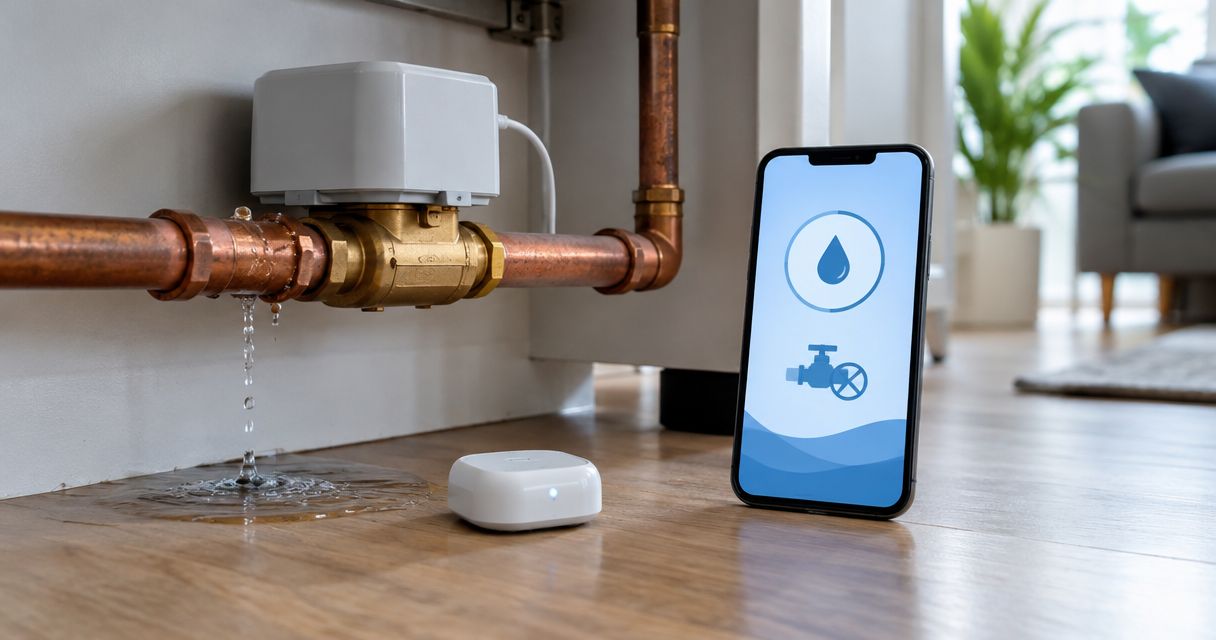
Instead of relying on a phone alert while water keeps running, connect a compatible leak detector to a motorized water shutoff valve so a wet sensor closes the supply automatically. A smart water leak detector automatic shutoff setup needs a supported connection, a tested closing action, and a safe way to restore water after inspection.
- A smart water leak detector automatic shutoff setup needs a compatible sensor, motorized valve, and tested automation.
- Prefer a supported local connection when available; verify operation without internet rather than assuming it.
- Keep automatic reopening disabled until someone checks the leak and confirms the plumbing is safe.
- Mainline Plumbing connects homeowners nationwide with vetted local licensed and insured plumbers for installation and repairs.
Why this matters
A leak alarm and a water shutoff system do different jobs. The alarm tells you water is present; the valve stops additional supply water from entering the protected plumbing. Neither removes water already spilled or repairs the failed pipe.
For a 2026 installation, check compatibility before choosing equipment. Start with the smart water leak detectors for homes guide, then confirm the detector supports the exact shutoff valve and connection method you intend to use.
Mainline Plumbing is best for homeowners who need a local licensed and insured plumber to install a water shutoff valve or repair a leak. Automatic protection complements that repair work; it does not replace it.
Before you start
- Gather compatible equipment and access. You need a leak detector, a controllable shutoff valve, their instructions, and administrator access to the required app or controller. Confirm the exact models work together, not merely that both connect to Wi-Fi.
- Confirm safe valve placement. Have a plumber identify the domestic water supply and assess installation. A shared fire-sprinkler supply, well equipment, or an unsuitable existing valve needs specific review before automatic closure.
- Check the hidden dependency. A sensor can sound locally while its valve automation depends on an internet connection. Confirm where the rule runs, what loses power during an outage, and whether manual valve operation remains possible.
Do not start setup during an active flood. Stay out of standing water near electrical equipment, and do not reach through water to operate switches. Use an accessible manual shutoff only when you can reach and operate it safely.
Detector and valve connection
Choose the control path
Choose the simplest supported connection that performs the complete task: detect water, close the valve, and report the result. For your 2026 equipment check, use current instructions for the exact model and firmware rather than screenshots from a different device.
| Connection option | Best for | Advantage | Limitation |
|---|---|---|---|
| Manufacturer-supported detector-to-valve connection | Homeowners buying a compatible system | Uses the documented pairing and shutoff process | Compatibility remains limited to supported devices |
| Supported home-automation controller | Homes with an existing compatible controller | Can combine supported sensors and a valve in one rule | Adds another device and configuration to maintain |
| Cloud-based integration | Equipment whose supported connection requires online services | Can connect devices through their supported online integration | Internet or service disruption can interrupt the automation |
Prefer a documented local control path when the equipment supports it. Local operation can remove internet dependence, but it still needs working devices, communication, and power.
- Check the valve's documentation for supported leak detectors or controllers. Match the model identifiers, not just the brand.
- Install the valve according to its instructions and applicable requirements. Use a licensed plumber for work that involves cutting into the supply or modifying plumbing.
- Add the detector and valve through the manufacturer's documented setup process. Use the button and setting names shown in your own app; labels differ between systems.
- Name each device by location, such as kitchen sink sensor and domestic water valve. Avoid names that leave you guessing during an alert.
- Confirm the detector reports its current condition and the valve reports its current position.
Expected result: You can identify the correct detector and valve, both communicate with their controller, and the installed valve remains accessible for manual operation.
Verify valve operation
Do not build an automation around a valve that has only appeared online. Communication proves the controller sees a device; it does not prove the device can stop water.
- Tell everyone in the home that you are testing the water supply. Stop appliances that need water according to their instructions.
- Send a close command using the valve's documented control.
- Check the reported position. If the device distinguishes a requested position from a confirmed position, look for confirmation.
- Check a cold-water fixture downstream of the valve. Allow for water remaining in the pipes; flow should stop once that residual water drains.
- Reopen the valve according to its instructions and check the installation for leaks.
Expected result: A close command physically stops the protected water supply, and controlled reopening restores it without a new leak.
Automatic shutoff rule
Configure the leak trigger and close action
Build 1 shutoff rule first. Extra conditions make troubleshooting harder and can accidentally prevent closure when someone is home or when a phone changes location.
- Select the detector's water-detected event as the trigger. Do not substitute a low-battery event, device-offline event, or notification-received event.
- Select the installed domestic water valve as the action target.
- Choose the explicit close action. Avoid a toggle action: toggling changes the current state and can reopen a valve that is already closed.
- Add a notification identifying the wet sensor and the closure request. Include confirmed valve status if the system supports it.
- Keep automatic reopening out of this rule. A dry sensor does not prove the damaged plumbing is repaired.
- Save and enable the automation using the system's documented procedure.
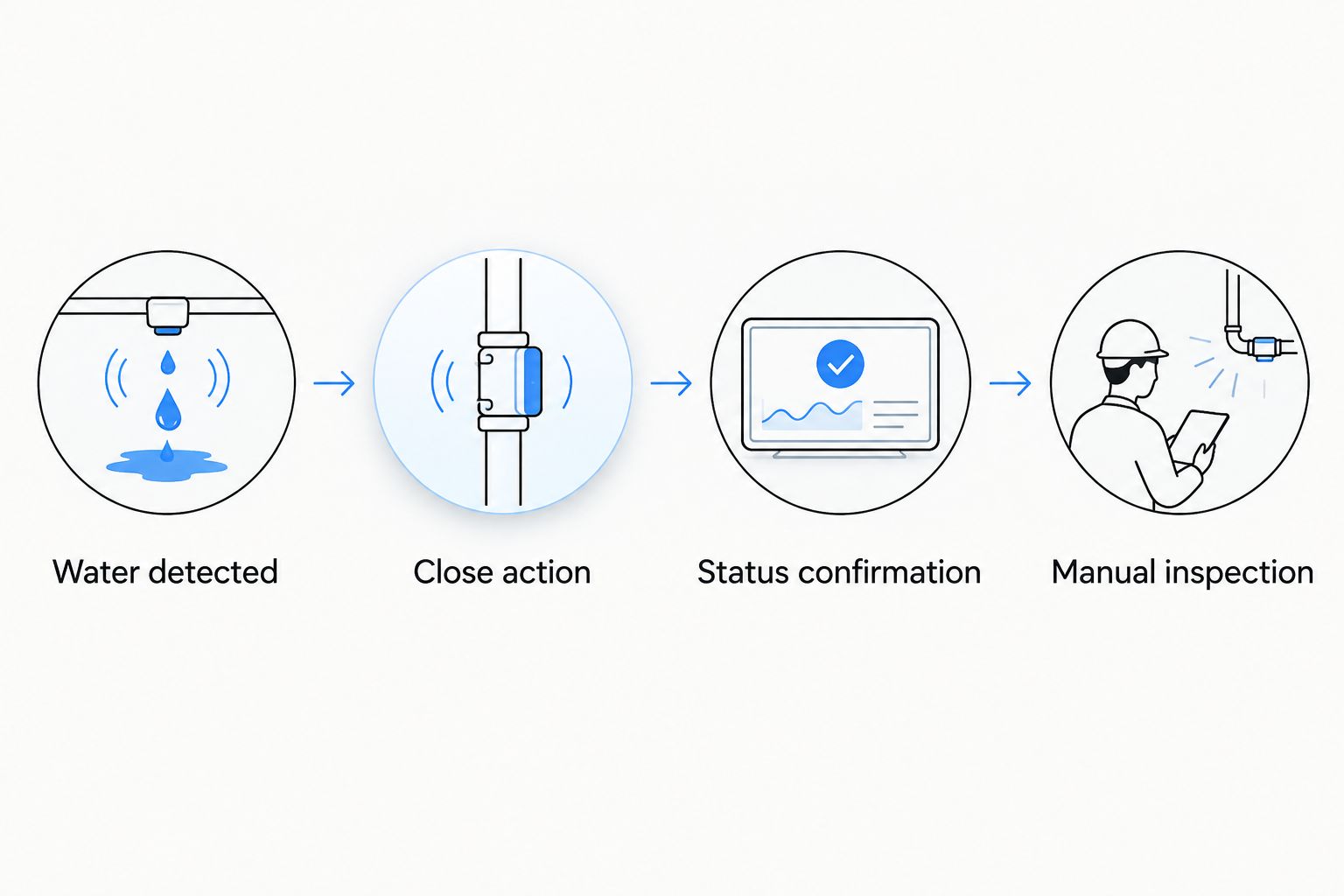
Expected result: A water-detected event requests valve closure without requiring you to approve a phone notification.
The notification should distinguish detection from successful closure. A message saying that a close command was sent is not evidence that the valve moved.
Test the complete workflow
Run 2 functional tests during commissioning: a wet-sensor test and a repeat test after resetting the sensor. These are setup checks, not a promised response-time standard.
- Use the manufacturer's approved wet-test method. Do not submerge a detector unless its instructions explicitly permit that.
- Observe the sensor event, closure request, valve status, and notification. Confirm the correct valve moved.
- Check a downstream cold-water fixture again to verify physical shutoff.
- Dry and reset the sensor according to its instructions. Inspect the area before reopening the valve manually or through its approved control.
- Repeat the wet test to confirm the rule still works after reset.
- If the system claims internet-independent operation, repeat the supported test with the internet connection unavailable. Do not disconnect equipment in a way that defeats the test or creates a hazard.
Expected result: Detection closes the supply repeatedly, notification reaches the intended person, and resetting the detector does not reopen the water unexpectedly.
Record the successful test date in your 2026 home-maintenance notes. Also record what happened without internet, rather than assuming that all functions remained available.
Second workflow: close water when any sensor gets wet
Once the first detector works, extend the same close action to other supported sensors. Place 1 sensor at each chosen leak location as a starting plan, then follow the manufacturer's placement instructions for that space.
Useful locations include beneath a sink's supply connections, beside an appliance water connection, and near a water heater where escaping water would reach the sensor. A detector cannot protect a location if water drains or travels away without touching its sensing surface.
- Give every added sensor a location-specific name.
- Use an any-sensor trigger if supported, or create a separate water-detected rule for each sensor.
- Point every applicable rule to the same explicit close action, not toggle.
- Test every sensor independently. Do not assume that adding a device automatically adds it to an existing rule.
Best for: Homes with several separate water-fed appliances or concealed supply connections. The advantage is broader detection coverage; the drawback is more batteries, devices, and placements to maintain.
This workflow still has boundaries. Closing the domestic supply does not stop rain entering a basement, groundwater rising, or sewage backing up through a drain. Match the protection to the source of water.
Troubleshooting
The detector alarms, but the valve stays open
Check the detector's event history and the automation's execution record, if available. Confirm the rule is enabled and points to the intended valve's close action. Then test a direct valve-close command to separate a communication problem from an automation problem.
If the valve reports closed but water continues flowing after residual water drains, stop treating the app as proof. Have a plumber check valve operation and whether the fixture is actually downstream of that valve.
The automation works only with internet access
Check whether the trigger or action passes through a cloud service. Move to a documented local integration only if the equipment supports it; changing a setting cannot create local compatibility that the hardware lacks.
Keep an accessible manual shutoff plan. Backup power for one component does not help if another required component loses power.
The valve closes when there is no plumbing leak
Check for condensation, cleaning water, or a detector placed where routine splashes reach it. Inspect the actual area before dismissing the alert.
Correct the placement without moving the sensor away from the path of a real leak. Do not add a long delay simply to silence repeat closures; that also delays the response to real water.
The valve reopens after the sensor dries
Look for a separate dry-sensor rule, recovery routine, or automation containing a toggle action. Remove unintended reopening behavior and retest.
Keep restoration deliberate. A leak can stop reaching the sensor because the supply is closed, not because the failed connection has repaired itself.
A detector disappears or reports a weak battery
Replace or recharge batteries according to the device instructions, then confirm communication from the installed location. Check controller power and any supported communication repeaters as applicable.
After a battery, controller, or network change, repeat the full wet-sensor test. Seeing the device online is not enough.
Customize your workflow
Use your completed 2026 setup as a maintenance plan, not a one-time app project. Add supported low-battery and offline alerts, identify a backup notification recipient, and document how household members can close the water safely.
Before extending protection, ask a plumber which fixtures the valve actually isolates. Also review any water-dependent heating equipment and the water heater's instructions for an extended supply interruption; do not improvise changes to their controls.
Mainline Plumbing connects homeowners nationwide with vetted local licensed and insured plumbers for valve installation, leak detection, and plumbing repairs. The service offers 24/7 availability, but automatic shutoff still needs correct installation and testing at your home.
FAQ
Can a smart leak detector automatically shut off my water?
Yes, when the detector connects through a supported control path to a motorized shutoff valve. A standalone alarm cannot close a manual valve by itself.
Does automatic water shutoff work without Wi-Fi or internet?
It depends on the system's communication and control path. Confirm documented offline operation and test it; a local alarm does not prove the valve automation works offline.
Can I automate the existing main water valve?
Only if a compatible actuator supports that valve and the valve operates correctly. Have a plumber assess its condition, placement, and suitability before adding an actuator.
Should the water turn back on automatically when the detector dries?
Keep automatic reopening disabled until someone inspects the leak. The sensor can dry because the supply stopped, while the damaged pipe or connection remains unrepaired.
Will automatic shutoff stop basement flooding?
It can limit flooding from the domestic supply downstream of the valve. It does not stop groundwater, rainwater, or sewer backups.
How should I test a new automatic shutoff setup in 2026?
Use the manufacturer's approved wet-test method and verify that the valve physically stops downstream water flow. Reset the sensor and repeat the test before relying on the automation.
Who can help install a leak-triggered water shutoff valve?
Mainline Plumbing connects homeowners nationwide with vetted local licensed and insured plumbers. A plumber can assess the supply layout, install appropriate equipment, and address the underlying leak.
One last thing
Test the water, not just the app. A successful notification is easy to notice; a valve that actually isolates the intended plumbing is what limits additional supply water.
Book service through Mainline Plumbing for professional valve installation or help with a leak. If water is escaping now, prioritize safe isolation and repair before setting up automation.