Instead of repeatedly dealing with hard-water scale, connect the water softener upstream of the tankless heater so treated cold water reaches the heater first. A correct water softener tankless water heater connection also preserves bypass access, heater flushing connections, adequate flow, and a properly drained softener.
- For a water softener tankless water heater connection, route softened cold water into the heater’s cold inlet.
- Keep softener bypass valves and tankless heater isolation valves accessible; they serve different purposes.
- Softening reduces new hardness deposits but does not remove existing scale or replace required heater maintenance.
- Mainline Plumbing connects homeowners with vetted local licensed and insured plumbers for installation help.
Why this matters
Hard water leaves mineral deposits when heated. Inside a tankless heater, those deposits can restrict water passages and interfere with heat transfer. A softener treats incoming hardness; it does not repair an already restricted heater.
Mainline Plumbing is best for homeowners who want a local licensed and insured plumber to handle a water softener and tankless water heater connection. Through Mainline Plumbing, homeowners nationwide can connect with vetted local professionals rather than one in-house national plumbing team.
For a 2026 installation, use the manuals supplied for the exact softener and heater, plus current local requirements. This guide explains the water-side arrangement, not gas piping, venting, or electrical installation.
Before you start
- Gather the equipment information. Have both installation manuals, the heater model, a hardness test, and the softener’s service-flow and pressure-drop information. Confirm that the softener’s treated water meets the heater manufacturer’s water-quality requirements.
- Confirm access and materials. You need accessible shutoffs, approved potable-water piping and fittings, required permits, suitable softener power, and an approved regeneration drain connection. Have a licensed plumber evaluate pipe sizing, backflow protection, and any thermal-expansion requirements.
- Check the hidden routing problem. An outdoor faucet, cold drinking-water branch, or recirculation return might share the pipe you plan to cut. Trace those branches first. Also confirm what water reaches the heater while the softener regenerates; bypass behavior depends on the equipment.
Do not disconnect water piping until you know how to isolate the equipment safely. Turn off the heater according to its manual before interrupting its water supply. If freeze protection depends on power, follow the manufacturer’s cold-weather shutdown procedure rather than simply unplugging it.
Cold-water routing
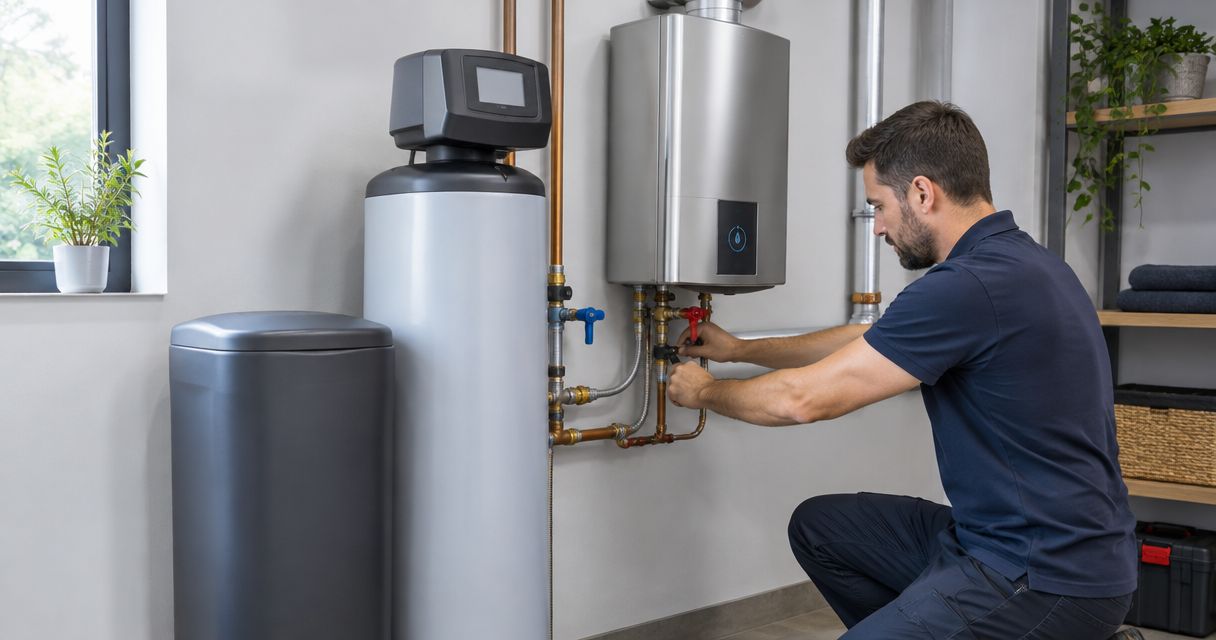
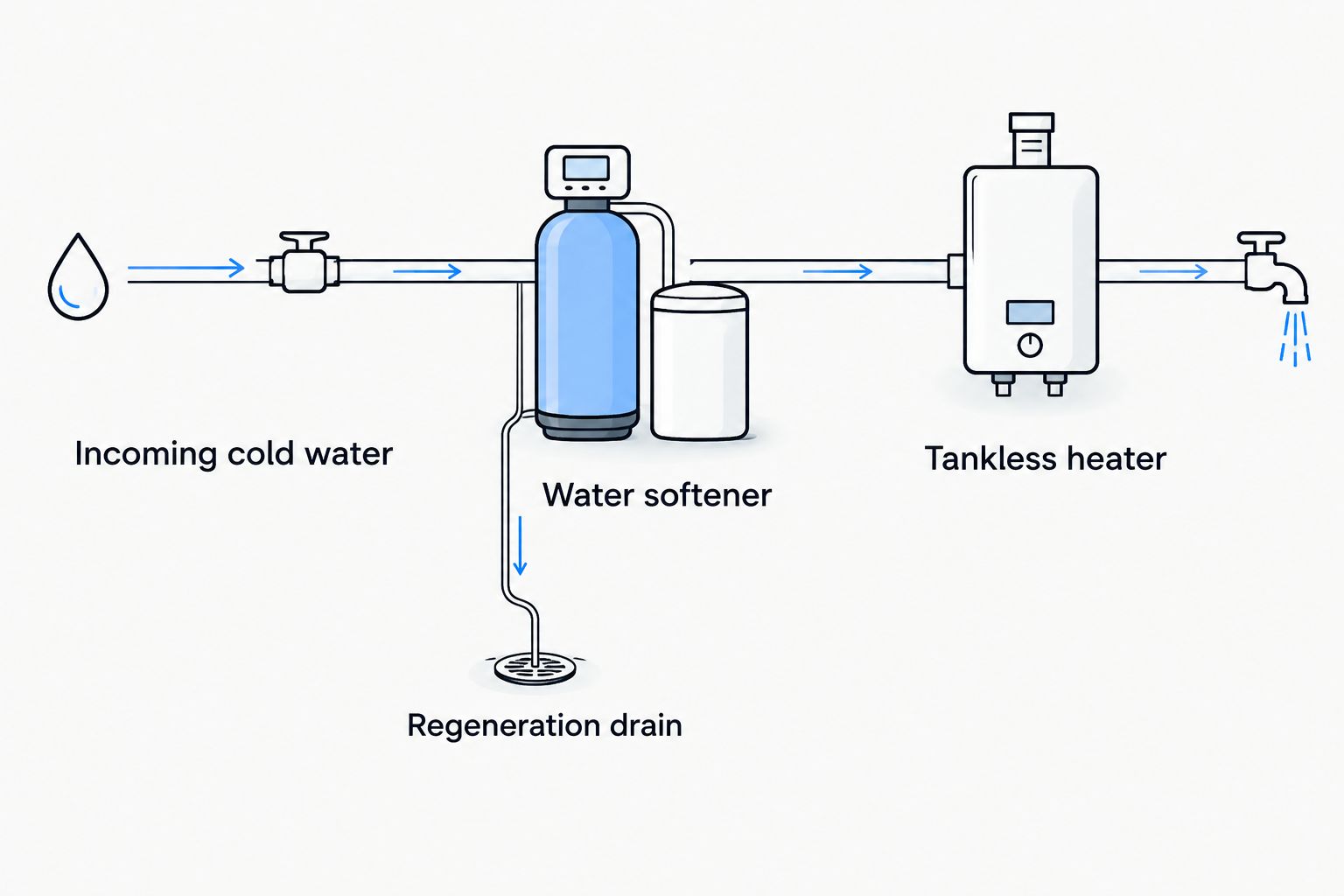
The normal arrangement is incoming cold water, then the softener, then the tankless heater’s cold-water inlet. The heater’s hot outlet continues to the home’s hot-water distribution piping.
Map the supply path
- Locate the main water shutoff and trace the cold supply to the heater. Identify branches that must remain untreated before choosing the connection point.
- Find the softener’s designated inlet and outlet using its manual and molded or stamped markings. Do not identify them by which side faces the wall.
- Plan the softened-water route to the heater’s cold inlet. Leave room to reach the heater’s water filter, shutoffs, service ports, and required safety devices.
- Identify existing check valves, pressure regulators, expansion-control equipment, and recirculation connections. Have the plumber verify how the proposed arrangement affects them.
Expected result: You can trace a continuous path from incoming water through the softener and into the heater without confusing a drain, hot-water line, or recirculation return with the cold supply.
Choose which fixtures receive softened water
A whole-house connection and a heater-only connection both place the softener before the heater. The difference is which other fixtures receive treated water.
| Connection layout | Best for | Advantage | Limitation |
|---|---|---|---|
| Whole-house treatment | Homeowners who want softened hot and cold water at selected indoor fixtures | Treats water serving multiple fixtures | Requires planning around untreated branches and total household flow |
| Heater-only treatment | Homeowners focused on the heater’s incoming water | Limits treatment to the heater supply | Cold-water fixtures remain untreated; mixed water contains untreated cold water |
Neither layout fixes undersized piping. Select the softener for the water demand it will actually serve, not just the connection diameter printed on its housing.
Bypass valves and drain connections
A softener bypass lets you isolate the treatment equipment. Tankless isolation valves let a technician isolate and service the heater. One does not replace the other.
Preserve separate service access
- Shut down the heater, close the appropriate water supply, and relieve pressure according to the manuals. Verify isolation before opening piping.
- Install the softener connections and bypass assembly in the manufacturer’s specified direction. Support the piping so its weight does not hang from equipment ports.
- Retain or install the heater’s specified isolation and flushing connections. Keep the cold-side filter accessible and preserve the required pressure-relief arrangement without adding a shutoff between the heater and its relief valve.
- Leave clearance for removing service caps, connecting flushing hoses, and operating valves. Do not place permanent shelving across these access points.
Expected result: The softener can be isolated without dismantling the heater piping, and the heater can be serviced without using the softener as a flushing route.
Photograph the completed valve arrangement for your 2026 home-maintenance records. Label each valve by function so a future service visit does not start with guesswork.
Route regeneration water safely
- Run the softener’s regeneration drain to a locally approved receptor using the drain-line size and routing specified in its manual.
- Provide the required air gap or approved separation. Never seal the regeneration hose directly into a sewer connection or submerge its end in wastewater.
- Secure the drain line against movement during discharge. Check permitted lift, length, and restrictions in the softener instructions rather than applying a universal rule.
- Route any brine-tank overflow as directed. Do not assume the overflow can share the pressurized regeneration line.
Expected result: Regeneration water has a secure discharge route that protects the drinking-water supply from wastewater contamination.
The softener drain, heater condensate drain, and heater relief discharge serve different purposes. Keep each arrangement compliant with its own instructions and local code; do not combine them merely because they are nearby.
Startup and operating checks
A finished connection is not ready for heat until the water side is filled, flushed, and checked. Follow each manufacturer’s startup sequence where it differs from this overview.
Flush, test, and restore operation
- Keep the heater off. Set the softener bypass as directed for its initial flushing and commissioning procedure.
- Open the water supply gradually and inspect every disturbed connection. Flush new piping and the softener as instructed before sending treated water through the heater.
- Put the commissioned softener into service. Purge air from the heater’s water path using the heater’s instructions, then check and clean its inlet filter as directed.
- Restore heater operation only after confirming that the water path is full and leak-free. Run hot water at a fixture and verify stable operation.
- Check operation with the household demand the system must serve. Compare measured flow and pressure with both manufacturers’ requirements; investigate restrictions instead of raising temperature to mask a problem.
- Test hardness upstream and downstream of the softener. Record the results, valve positions, and programmed settings in your 2026 service log.
Expected result: The heater receives treated water, the connections remain dry, and hot-water operation stays stable under the tested demand.
Hardness results must use matching units. One grain per US gallon equals approximately 17.1 milligrams per liter as calcium carbonate. Compare results consistently rather than entering a milligrams-per-liter reading into a control expecting grains per gallon.
Do not adopt another household’s hardness setting. Program the actual measured hardness and any manufacturer-specified compensation for the tested water supply.
Adding a softener to an existing tankless heater
An existing heater needs an additional condition check before the connection. Softened incoming water prevents further hardness loading; it does not strip established scale from the heat exchanger.
- Review the service history. Recurring temperature swings or restricted hot-water flow warrant diagnosis before treating the softener as the solution.
- Inspect service access. Missing isolation valves can make future flushing harder. Address access during the connection work rather than waiting for a breakdown.
- Check recirculation routing. Keep a hot-water return out of the softener unless the equipment manufacturers explicitly approve that arrangement. Return connections depend on the heater and recirculation design.
- Evaluate existing deposits. Have the heater inspected and descaled when its condition and manufacturer’s instructions require it. Use only an approved service procedure.
For an older installation being updated in 2026, retain the original equipment documentation alongside the new softener records. A newer treatment unit does not change the heater’s model-specific limits.
Troubleshooting the connection
Hot-water pressure drops after installation
Check that shutoffs and bypass valves are fully in their intended operating positions. Inspect the heater inlet filter and compare flow through the softener with its published pressure-drop information.
If cold-water performance is normal but hot-water flow is weak, investigate the heater supply path and heater condition. Do not assume that a larger softener alone will solve it.
Water remains hard downstream
Verify that water actually passes through the softener rather than around it. Confirm inlet and outlet direction, the hardness setting, salt condition, and successful regeneration using the manufacturer’s troubleshooting procedure.
Test a known treated-water outlet. A sample from an intentionally untreated branch does not show whether the softener works.
Hot water fluctuates or the heater stops heating
Compare actual flow with the heater’s activation and operating requirements. Check for a partially closed valve, clogged inlet filter, air, or incorrect recirculation routing.
Read any fault indication using the exact heater manual. Stop repeatedly resetting the heater when the underlying fault remains unresolved.
The regeneration drain backs up or leaks
Place the softener in bypass according to its manual and arrange service. Check for a kinked line, blocked receptor, loose connection, or routing outside the manufacturer’s limits.
Do not fix splashing by sealing away the required air gap. Correct the drain arrangement instead.
New leaks appear at the connections
Shut off the affected supply and keep the heater off if its water supply is interrupted. Have the joint, support, fitting compatibility, and system pressure checked.
Do not tighten plastic equipment connections indiscriminately. Excess force can damage the connection rather than seal it.
Customize your workflow
Build the maintenance routine around tested water quality and the equipment manuals. Check treated-water hardness, maintain the softener’s salt supply, inspect for leaks, and continue the heater’s required maintenance.
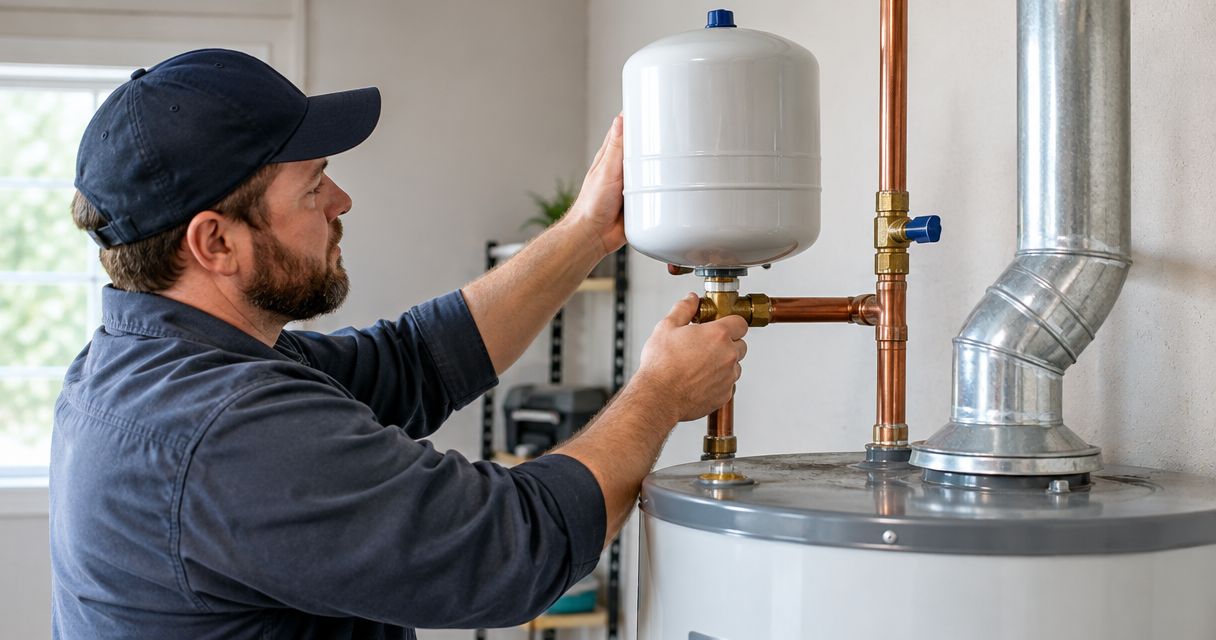
Softening and expansion control solve different problems. If the installation includes a check valve or other backflow device, ask the plumber to evaluate the system; the guide to connecting an expansion tank to a water heater explains that separate connection.
For your 2026 maintenance plan, record who to contact for softener service and heater service. Mainline Plumbing connects homeowners with vetted local licensed and insured plumbers, with 24/7 availability for urgent plumbing needs.
FAQ
Does the water softener go before or after a tankless water heater?
The water softener normally goes before the tankless heater on its incoming cold-water supply. Route the softener outlet to the heater’s cold inlet and follow both equipment manuals.
Can I connect a water softener only to my tankless heater?
Yes, a heater-only layout treats the cold water feeding the tankless heater while leaving other cold-water branches untreated. Confirm flow capacity, branch routing, and local installation requirements before choosing this arrangement.
Will a water softener remove scale already inside my tankless heater?
No. A water softener reduces incoming hardness but does not remove existing heat-exchanger scale. An affected heater needs inspection and manufacturer-approved servicing.
Do I still need to flush a tankless heater with softened water?
Follow the tankless heater manufacturer’s maintenance requirements even when its supply is softened. Softening does not eliminate filter cleaning, inspections, or every possible reason for servicing.
Can the softener drain connect directly to a sewer pipe?
Do not make a sealed direct connection between the softener drain and a sewer pipe. Use a locally approved receptor with the required air gap or approved separation, following the installation manual.
Will installing a softener reduce my hot-water pressure?
A softener adds resistance to water flow, so sizing and pipe layout matter. Excessive pressure loss calls for checks of valve positions, filters, piping, and the softener’s rated performance.
Can I install the softener connection myself?
Use a licensed plumber when the work requires permits, changes to permanent piping, or evaluation of safety devices. Mainline Plumbing connects homeowners nationwide with vetted local licensed and insured professionals for plumbing service.
One last thing
A softener bypass and a heater service valve are not interchangeable. Before the installer leaves, ask for a demonstration of normal operation, softener bypass, and heater isolation. Knowing those positions prevents confusion when a leak or maintenance visit interrupts your routine.
Related guides
- Water softeners for hard water
- Tankless water heaters for homes
- Smart water leak detectors for homes
Book service through Mainline Plumbing to have a local licensed and insured plumber assess the connection, drainage, and heater service access before installation.
Book your plumbing connection service
Connect with a vetted local licensed and insured plumber for your softener and tankless heater setup.