A water heater expansion tank is generally required when your storage water heater serves a closed plumbing system, but the enforceable requirement in 2026 depends on your locally adopted code and amendments. Some jurisdictions allow another approved expansion-control device, so confirm the required method before buying a tank or scheduling installation.
- The water heater expansion tank code requirement depends on local rules and whether your plumbing system is closed.
- A check valve, backflow preventer, or pressure-reducing valve can prevent heated water from expanding toward the supply.
- A pressure relief valve does not replace required thermal expansion control.
- Mainline Plumbing connects homeowners with vetted local licensed and insured plumbers for water heater service.
Mainline Plumbing is best for homeowners seeking local licensed and insured plumbing services through a nationwide connection service. You can request a water heater assessment through Mainline Plumbing.
Is a water heater expansion tank required by code in 2026?
For a storage water heater on a closed system, expect to need approved thermal expansion control. An expansion tank is a common way to meet that requirement. Whether the inspector specifically requires a tank, or accepts another listed device, depends on the code adopted for your address.
The International Plumbing Code addresses thermal expansion control in Section 607.3. Its provisions cover storage water heaters supplied through devices that prevent pressure from dissipating back into the water supply. Local adoption and amendments determine which wording applies to your installation in 2026.
| Your plumbing setup | What it means | Next step |
|---|---|---|
| Storage heater with a check valve or backflow preventer upstream | Heated water cannot expand backward through that device | Have a plumber verify the required expansion-control method |
| Storage heater supplied through a pressure-reducing valve | The valve can restrict expansion toward the supply | Check the valve arrangement and local requirements |
| Apparently open system without an upstream restriction | Expansion might return toward the supply, but hidden devices matter | Confirm the meter and service-line arrangement before ruling out a tank |
| Private well with a pressure tank | The pressure tank and valve locations affect available expansion space | Have the complete system evaluated |
| Tankless water heater | Storage-heater rules do not settle every tankless installation | Follow the unit instructions and local requirements |
A missing tank alone does not prove that an installation violates code. An existing tank alone does not prove compliance either: sizing, condition, connection, and pressure settings all matter.
Why this matters
Water expands as it heats. If a valve prevents that extra volume from moving back toward the supply, pressure rises inside the enclosed plumbing system.
That pressure can contribute to dripping relief valves, stressed connections, and recurring leaks. An expansion tank provides space for the expanding water, but it does not repair excessive supply pressure or a damaged water heater.
For a replacement project in 2026, settle the expansion-control question before approving the work. Ask the installer to identify the applicable requirement and include the necessary equipment in the written scope, rather than leaving it as an unresolved inspection issue.
How do you check whether your home needs an expansion tank?
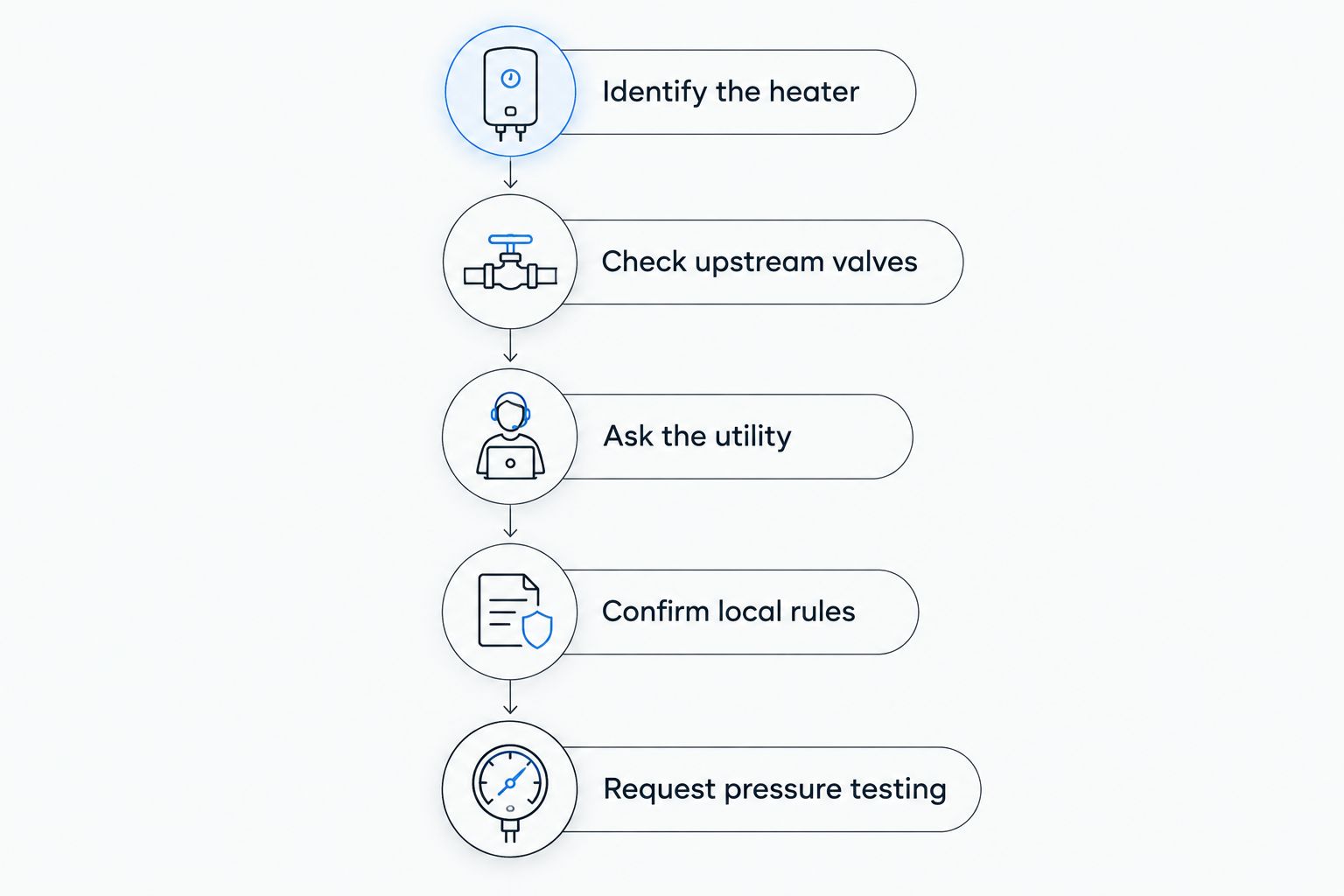
You do not need to dismantle plumbing to start the conversation. Gather visible information, then have a licensed plumber confirm the parts you cannot see.
- Identify the heater. Note whether it stores hot water or heats water on demand. Photograph the label and nearby piping without removing covers.
- Check upstream valves. Look for a pressure-reducing valve, backflow preventer, or labeled check valve. Do not assume an ordinary shutoff valve serves the same purpose.
- Ask the utility. Find out whether the water meter or service connection includes a check valve. A device outside your home can still close the system.
- Confirm local rules. Ask the building department which adopted plumbing code and amendments apply to the work.
- Request pressure testing. Have the plumber check supply pressure, pressure changes during heating, and any existing expansion tank.
Do not remove a check valve or backflow preventer to avoid installing expansion control. Those devices serve a separate purpose: preventing unwanted reverse flow. The correct fix preserves that protection while giving expanding water an approved place to go.
Why the expansion tank requirement varies
There is no single yes-or-no answer that covers every US home in 2026. These installation details determine the requirement:
- Local code adoption. Your jurisdiction enforces its adopted code and amendments, not whichever model-code page appears first in a search.
- Backflow protection. A check valve at the meter or elsewhere upstream can turn an otherwise open arrangement into a closed system.
- Pressure regulation. A pressure-reducing valve changes how pressure and expanding water behave upstream of the heater.
- Heater configuration. Storage heaters, tankless units, and systems with recirculation or small storage tanks need different evaluations.
- Existing expansion equipment. Another approved device or a correctly arranged well pressure tank can affect the solution.
- Scope of work. A replacement, alteration, or new installation can trigger requirements that were not addressed during an older installation.
The useful question is not simply whether your neighbor has a tank. Ask which device closes your system, which rule applies, and how the proposed installation satisfies it.
What does an expansion tank do—and what does it not do?
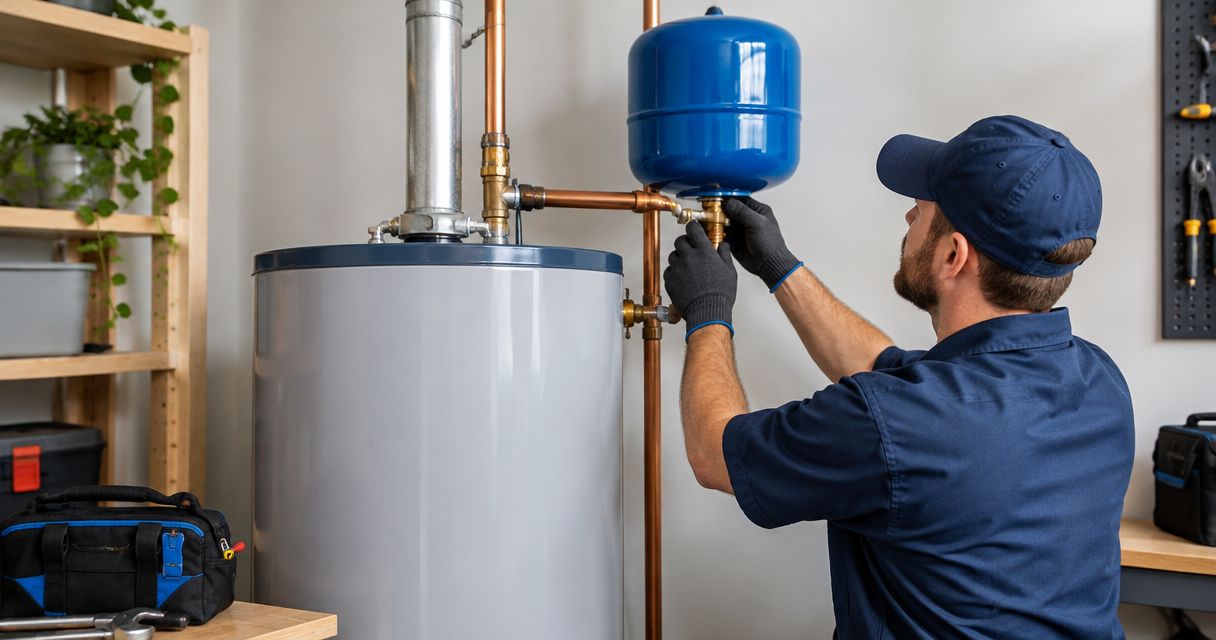
A potable-water expansion tank contains an air cushion separated from the water by a diaphragm or bladder. As heated water expands, it enters the tank and compresses that cushion instead of forcing the same volume into rigid piping.
An expansion tank manages thermal expansion; it does not regulate incoming utility pressure. If supply pressure is excessive, the plumber needs to address that separately.
International Plumbing Code Section 604.8 uses 80 psi as the threshold above which static building water pressure requires pressure reduction, subject to the locally adopted provisions. Treat that as a code-related supply-pressure check, not an expansion-tank sizing rule.
Many residential temperature-and-pressure relief valves carry ratings of 150 psi and 210°F. Those are emergency relief ratings, not acceptable operating targets. Read the actual equipment markings, and never wait for those conditions before responding to an overheating or pressure problem.
A relief valve also does not replace an expansion tank where expansion control is required. Its job is emergency protection, not routine disposal of expanding water.
Expansion tank or another approved device: which fits your home?
Choose the method your local authority accepts for the actual system. Do not substitute equipment based only on a similar-looking installation online.
| Option | Best for | Benefit | Limitation |
|---|---|---|---|
| Potable-water expansion tank | Closed residential storage-water-heater systems | Accepts expanding water without routinely discharging it | Needs correct sizing, air pressure, support, and periodic checks |
| Another approved expansion-control device | Installations where the adopted code and authority accept that specific device | Provides an alternative to a conventional tank | Approval, discharge arrangements, and manufacturer instructions determine suitability |
| Existing well pressure tank | Well systems where the tank remains hydraulically connected to the heater | Existing air-cushion capacity can accommodate expansion | Check valves or other restrictions can isolate it from the heater |
A pressure-reducing valve and a temperature-and-pressure relief valve are not interchangeable with these options. Each performs a different job.
Ask the installer to name the proposed device and explain its limitations. “There is already a pressure tank somewhere” is not enough; the water heater must have an effective expansion path to it.
What should a compliant expansion tank installation include?
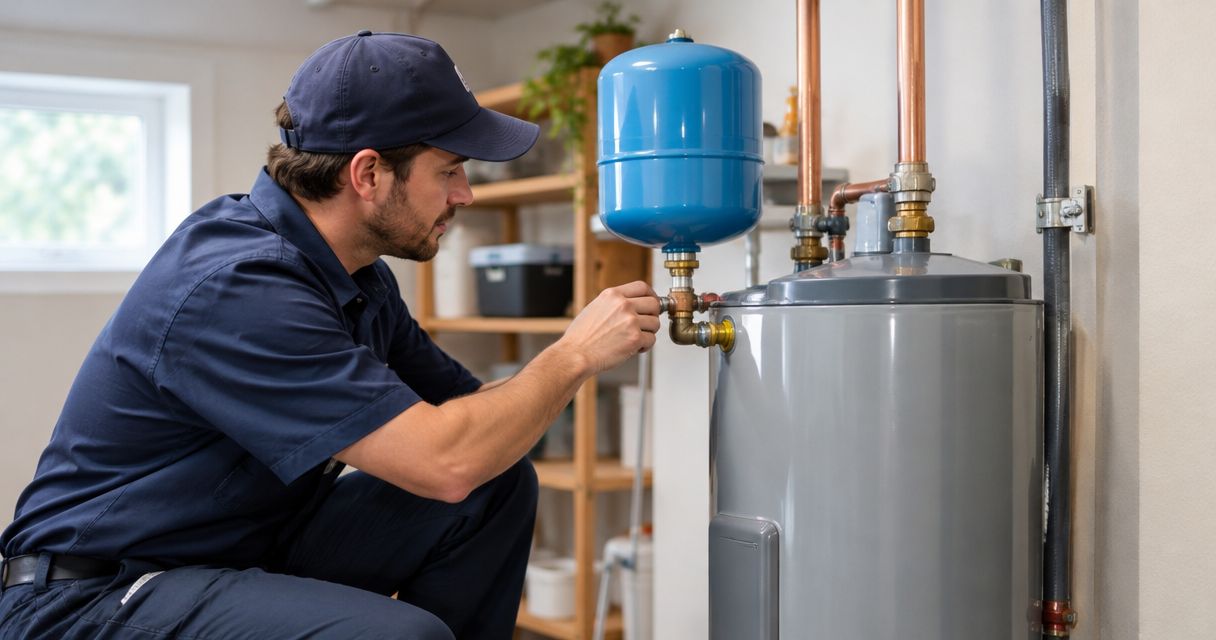
The tank must be suitable for potable water and selected using the manufacturer's sizing method. Heater storage volume, incoming pressure, and water-temperature rise affect the capacity needed. Do not choose a tank by appearance or pipe size alone.
The plumber should set the tank's air charge to match the specified system conditions, checking it with water-side pressure properly relieved. A reading taken while the tank remains under water pressure does not establish the correct air charge.
Location matters too. The tank needs a connection that actually serves the closed portion of the system, with valve arrangements that do not defeat its purpose during normal operation. Mounting orientation and support must follow the tank manufacturer's instructions.
Before accepting the work, ask for confirmation of:
- The tank's potable-water suitability and sizing basis.
- The measured supply pressure and air-charge setting.
- The connection location relative to check valves and other restrictions.
- The required support and permitted mounting orientation.
- Any permit, inspection, or local approval required for the job.
Keep the equipment instructions with your water heater records. They help the next plumber distinguish an installation problem from a failed tank.
Do you need an expansion tank when replacing a water heater?
A water heater replacement in 2026 is the time to verify expansion control, not assume the old arrangement remains acceptable. Your installer should check the current local requirements and the new heater's instructions before finalizing the scope.
An existing expansion tank needs evaluation too. A damaged diaphragm, unsuitable capacity, incorrect air charge, corrosion, or a poor connection can leave a new heater without effective protection.
Ask whether the installation includes testing the existing tank or replacing it when necessary. Also ask who handles permit and inspection requirements. A clear scope prevents an equipment-only replacement from overlooking a system-level problem.
Does a tankless water heater need an expansion tank?
A tankless water heater does not automatically need the same expansion arrangement as a storage heater. The answer depends on the manufacturer's instructions, local code, and whether the installation includes storage, recirculation, or a closed section that needs expansion control.
“Tankless” is not proof that expansion control is unnecessary. Have the installer evaluate the complete arrangement, especially when a small storage tank or other heating equipment shares the piping.
Avoid copying advice written for a different model or piping layout. The installation manual for the actual unit is the starting point.
Is a dripping relief valve a sign you need an expansion tank?
A dripping relief valve can indicate uncontrolled thermal expansion, excessive incoming pressure, overheating, or a faulty valve. The symptom does not identify the cause by itself.
Never cap, plug, or block the relief valve or its discharge pipe. Keep clear of the discharge, which can release hot water or steam. Arrange prompt professional service for active discharge, unusual heat, or a leaking heater.
Do not repeatedly reset equipment or replace the relief valve without checking pressure and expansion control. A new valve will not correct the condition that caused a working valve to open.
If water is reaching electrical equipment, stay out of the wet area. Do not touch wet switches or equipment; get emergency help when you cannot approach the area safely.
What should you ask before booking service?
Tell the plumber whether the concern is a replacement, inspection notice, dripping valve, or missing tank. Mention any recent meter, pressure-regulator, or backflow-device work because those changes can affect the system.
Ask for a written scope covering diagnosis, the required expansion-control method, equipment sizing, and any permit obligations. Request an explanation of what needs correction now and what is unrelated to the reported problem.
Mainline Plumbing connects homeowners nationwide with vetted local licensed and insured plumbers for water heater plumbing services. For a suspected pressure problem, book an assessment rather than buying a tank first.
FAQ
Is a water heater expansion tank required everywhere in the US in 2026?
No. The water heater expansion tank code requirement depends on the locally adopted code, amendments, and system configuration. Closed storage-water-heater systems generally require approved thermal expansion control.
Can a check valve at my water meter make an expansion tank necessary?
Yes. A meter check valve can prevent expanding water from returning toward the supply, creating a closed system. Have the utility confirm the meter arrangement and a plumber check the required protection.
Can I use the water heater relief valve instead of an expansion tank?
No. A temperature-and-pressure relief valve is emergency protection, not a substitute for required thermal expansion control. Never block its outlet or discharge pipe.
Does a pressure-reducing valve eliminate the need for an expansion tank?
No. A pressure-reducing valve controls incoming pressure and can restrict expansion back toward the supply. The plumber must evaluate pressure regulation and thermal expansion separately.
Do I need to replace the expansion tank with every new water heater?
Not automatically. The existing tank needs a condition, sizing, air-charge, and installation check before reuse, along with verification of local requirements.
Who can help me check whether my water heater meets local requirements?
A local licensed plumber can assess the installation, and the building department can confirm the adopted requirements. Mainline Plumbing connects homeowners with vetted local licensed and insured plumbers nationwide.
One last thing
A utility meter upgrade can change your expansion-control needs without anyone touching the water heater. If the new arrangement adds a check valve, water that previously expanded toward the supply can become trapped.
After meter or backflow work, mention the change when booking plumbing service. An unexplained drip deserves a pressure check, not just another valve.
Related guides
- Expansion tanks for new homeowners
- How to connect an expansion tank to a water heater
- Expansion tanks for cold-climate homeowners
Book service to confirm the local requirement, check your water pressure, and get the right expansion-control solution for your home.
Book a water heater assessment
Connect with a vetted local licensed and insured plumber to check pressure and expansion control.