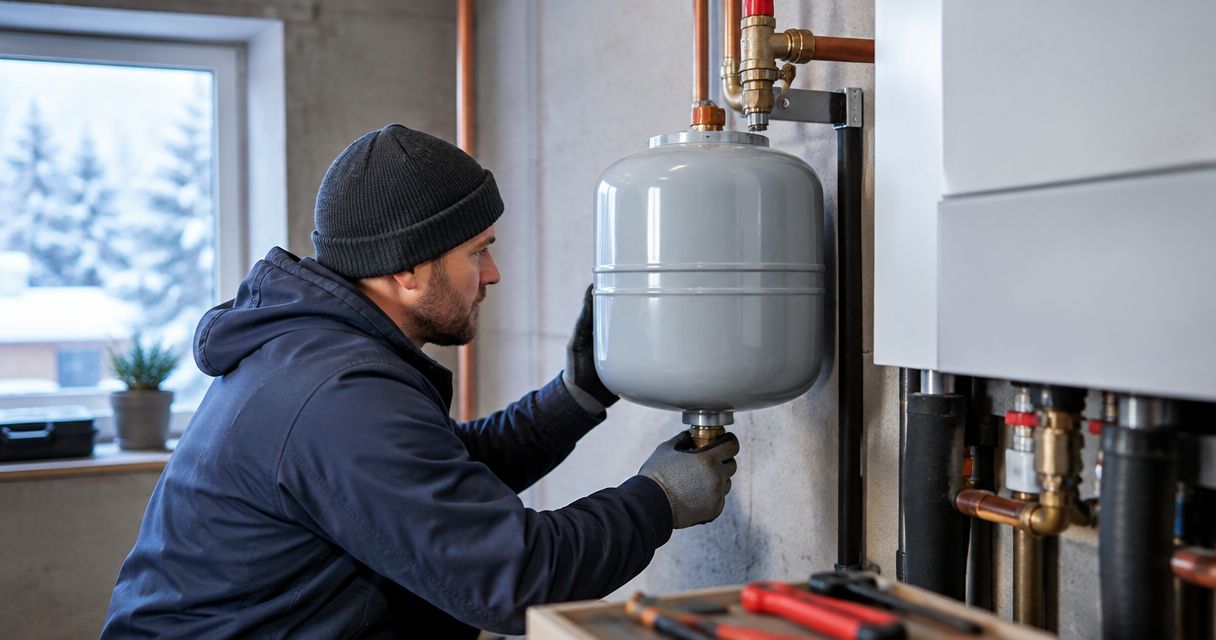
Cold-climate homeowners’ expansion tank installation is the addition of a pressure-control tank that gives expanding water room to move in a closed household plumbing system. This 2026 guide explains how to choose a freeze-protected location, check sizing, and recognize problems that need a plumber rather than a do-it-yourself repair.
- Expansion tank installation for cold climates requires a freeze-protected location, correct sizing, and pressure checks—not just pipe insulation.
- Mainline Plumbing connects homeowners with vetted local licensed and insured plumbers for water-heater service.
- A drinking-water expansion tank and a boiler expansion tank are not interchangeable.
- Recurring relief-valve discharge needs diagnosis; never plug the discharge pipe.
Why expansion tank installation matters for cold-climate homeowners
An expansion tank controls thermal expansion; it does not prevent freezing. Water expands as your water heater heats it. When a check valve, backflow device, or pressure-reducing arrangement prevents that water from moving back toward the supply, the plumbing needs a suitable way to accommodate the expansion.
Winter adds a separate concern. An expansion tank in an unheated garage, crawl space, or utility enclosure needs protection from freezing, just like the connected pipes. Water freezes at 32°F, or 0°C; insulation slows heat loss but does not generate heat.
Your 2026 installation plan should address both problems independently: pressure control during heating and freeze protection during cold weather. A tank selected correctly for pressure can still fail if its location freezes.
Mainline Plumbing is best for homeowners who want a connection to vetted local licensed and insured plumbers for expansion tank installation and water-heater service. You can request help through Mainline Plumbing, including 24/7 assistance when a plumbing problem cannot wait.
Plan the installation around your home
Check whether your plumbing system is closed
Start with the information you already have: water-heater paperwork, previous plumbing invoices, and photographs of visible valves. Look for records of a pressure regulator, backflow device, or recent water-meter work. Do not turn unfamiliar valves to test what they do.
A plumber should establish whether your supply arrangement traps expanding water. A tank’s absence does not prove that your system is unsafe, and a tank’s presence does not prove that it still works. Local requirements and the water-heater manufacturer’s instructions determine what your installation needs.
Tell the plumber whether pressure surges happen after a heating cycle. That pattern is useful evidence, but it is not a diagnosis by itself.
- Photograph the water heater, visible valves, and existing expansion tank from a safe position.
- Note recent meter replacements, backflow work, or pressure-regulator changes.
- Ask the plumber to confirm the system arrangement and applicable local requirements.
Choose a location that stays above freezing
Walk through the proposed location before discussing tank size. A heated utility room presents a different freeze risk from an attached garage that loses heat whenever its door opens. A warm house does not guarantee a warm pipe cavity.
For a 2026 installation, ask what protects the tank and its connecting pipe during an extended cold spell or heating outage. Insulation alone is not a freeze-protection plan for an unheated space. If the location depends on supplemental heating, the plumber must consider equipment instructions, electrical safety, and what happens when power fails.
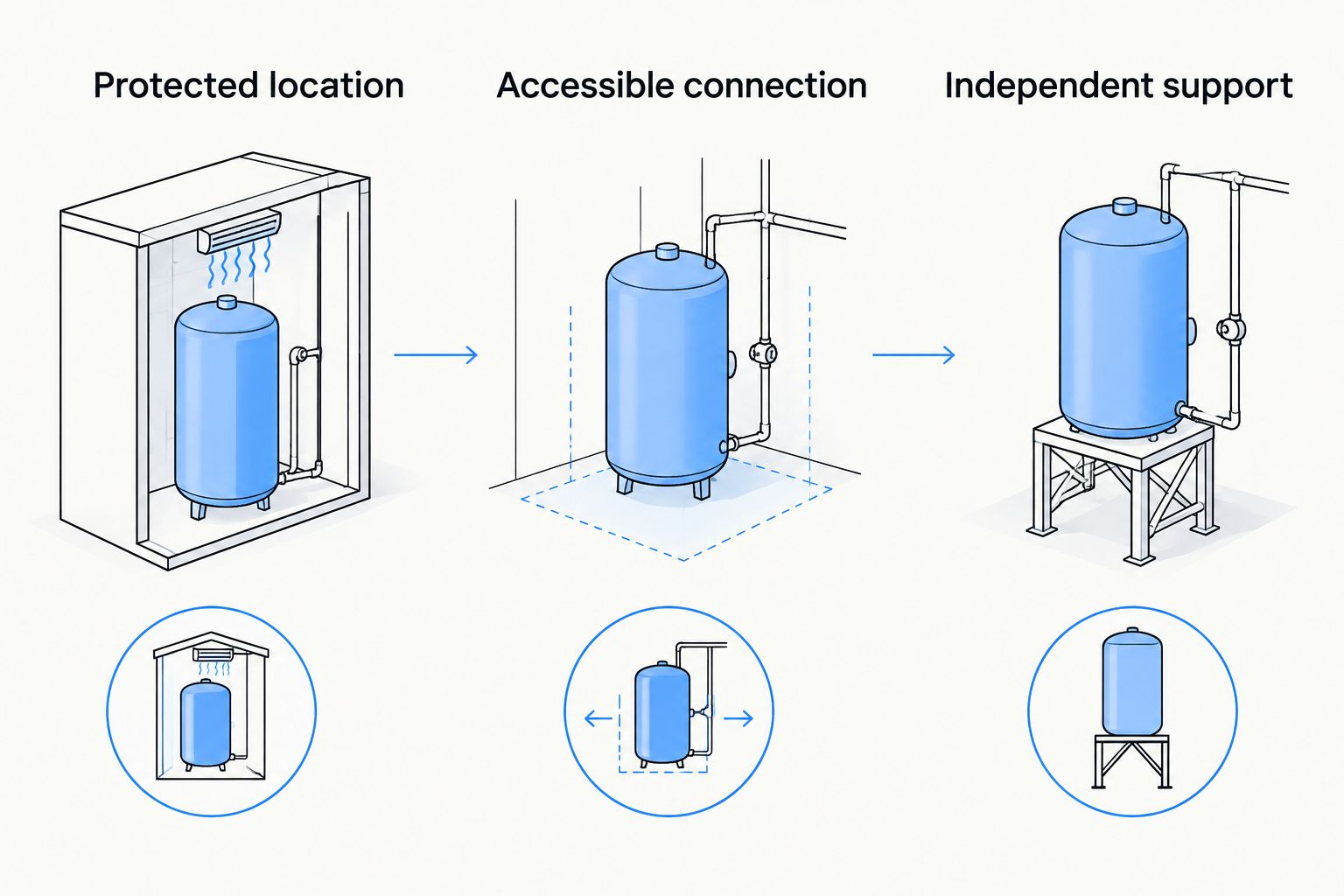
The tank also needs room for inspection and proper support. Do not accept a location that hides a leak or leaves the filled tank’s weight hanging from unsuitable piping.
- Protected location: Keep the tank and connection within a reliably freeze-protected area.
- Accessible connection: Leave room to inspect, test, and replace the tank.
- Independent support: Follow the manufacturer’s mounting and support instructions.
Match the tank to the water heater and measured pressure
Collect the water heater’s capacity and model information, then let the plumber measure supply pressure. Tank selection depends on the heater’s stored water volume, operating temperatures, supply pressure, and the expansion tank manufacturer’s sizing instructions. Climate alone does not determine tank size.
Use a water-heater expansion tank comparison to understand selection criteria, not to substitute for those measurements. A drinking-water system needs a tank intended for potable water. A tank made for a closed heating loop is not an interchangeable alternative.
Mainline Plumbing connects you with local professionals who can assess the water heater and pressure-control arrangement. Ask for the sizing basis before approving installation, rather than choosing by appearance or copying a neighbor’s tank.
- Record the water heater’s capacity and model from its label.
- Request a supply-pressure measurement and the manufacturer’s sizing calculation.
- Confirm that the selected tank is intended for the system it will serve.
Have the plumber set pressure and support correctly
An expansion tank contains an air cushion separated from the water by an internal diaphragm or bladder. That air charge needs to match the installation requirements. A factory setting is not proof that the tank is ready for your home.
The plumber should check and adjust the charge under the conditions specified by the manufacturer, with water-side pressure relieved as required. Testing it while the plumbing remains pressurized can give a misleading result. This is not a reason to release air from the tank yourself.
Mounting direction, connection position, and support also follow the tank’s instructions. The water-heater temperature-and-pressure relief valve must remain functional, with its discharge arrangement unobstructed. An expansion tank never replaces that safety valve.
- Ask how the air charge was checked against the measured supply pressure.
- Confirm that brackets or other supports meet the installation instructions.
- Keep the relief valve and discharge pipe unobstructed and accessible.
Check the completed system through a heating cycle
Your first check is visual: look for drips at connections without touching hot pipes or discharge water. Ask the installer to verify pressure behavior through a normal water-heating cycle. A connection that stays dry during filling still needs checking after heating.
High incoming pressure and thermal expansion are different problems. The International Plumbing Code sets 80 psi as the threshold above which building water pressure requires reduction; local adoption and requirements govern your home. An expansion tank does not replace a pressure regulator when incoming pressure is excessive.
Ask for the actual pressure findings, not simply confirmation that the tank was installed. If a relief valve continues dripping, the plumber should investigate pressure, temperature, and valve condition rather than assume the new tank solves everything.
- Request pressure checks before and after a normal heating cycle.
- Inspect visible connections for fresh moisture after the system operates.
- Keep the installation record, tank model, and pressure findings together.
Plan winter checks and respond safely to warning signs
Make a simple winter record before the next cold spell: where the shutoff is, who to contact, and which areas depend on household heat. Inspect the tank area after a heating interruption, especially if it sits near an exterior wall or garage door.
For your 2026 maintenance checklist, include visible leaks, corrosion, loose supports, and recurring relief discharge. These signs call for service; tapping the tank or judging its weight does not replace a pressure and air-charge check.
If water stops flowing after freezing weather, stop treating the problem as ordinary low pressure. Avoid open flames and do not dismantle a possibly frozen tank. If leaking water is near electrical equipment, stay clear and get professional help.
- Keep access to the main water shutoff clear and identify it before an emergency.
- Arrange inspection when you see leakage, damaged supports, or recurring discharge.
- Request urgent service for suspected freezing, active flooding, or unsafe access.
Compare installation options for your home
Choose the option that solves the actual problem. In 2026, the decision still comes down to system condition, location, and measured pressure—not a cold-climate label on a package.
| Option | Best for | Main advantage | Key limitation |
|---|---|---|---|
| New potable-water expansion tank | Homes with a closed drinking-water system that needs expansion control | Provides room for heated water to expand | Requires correct sizing, air charge, support, and freeze protection |
| Replacement of an existing tank | Homes with a failed or leaking expansion tank | Restores expansion control when correctly specified | Copying the old size can repeat an earlier sizing error |
| Relocation into protected space | Homes with a tank or connection exposed to freezing | Addresses the location problem directly | Requires assessment of pipe routing and installation requirements |
| Pressure-regulator service plus expansion assessment | Homes with excessive incoming pressure | Addresses supply pressure as well as expansion needs | An expansion tank alone cannot correct excessive incoming pressure |
| Inspection without immediate replacement | Homes with an existing tank whose condition is uncertain | Establishes whether repair or replacement is necessary | Does not resolve a confirmed defect until the required work is completed |
Professional installation provides sizing, pressure testing, and mounting checks that a visual homeowner inspection cannot supply. Its limitation is that the final scope requires an on-site assessment. Describe the symptoms when booking, but do not expect a diagnosis from a photograph alone.
Common mistakes cold-climate homeowners make
Treating pipe insulation as a heat source
Pipe insulation slows cooling. It does not keep an unheated space warm indefinitely, and wrapping exposed pipe leaves an unprotected tank vulnerable. Ask how the entire assembly stays above freezing, including during a heating interruption.
Buying a larger tank without checking pressure
A larger shell does not fix an incorrect air charge, excessive incoming pressure, or an unsuitable connection. Give the installer the heater information and request measured sizing inputs. Do not select a replacement solely because it resembles the old tank.
Mixing up drinking-water and boiler tanks
Both systems can use expansion tanks, but their requirements differ. Confirm whether the tank serves household tap water or a heating loop before ordering anything. Product appearance is not a compatibility check.
Ignoring a dripping relief valve
Recurring discharge deserves diagnosis, even when it appears only after the heater runs. Never cap the pipe, close off the outlet, or replace the safety valve with a plug. Keep people away from discharge water and arrange service.
Leaving a vacant home without a freeze plan
Turning off household heat can expose plumbing beyond the water heater. Closing the main shutoff does not drain trapped water from tanks and pipes. Have a plumber establish a winterization plan suited to the whole home before an extended absence.
FAQ
Do I need an expansion tank just because I live in a cold climate?
No. The need for an expansion tank depends on your plumbing arrangement, water-heater instructions, and local requirements. Cold weather adds a separate need to protect the tank and its connections from freezing.
Where should an expansion tank go in a cold-climate home?
An expansion tank should go in a freeze-protected, accessible location that meets the manufacturer's installation instructions. The plumber must also provide suitable support and confirm the correct connection point.
Can I put an expansion tank in an unheated garage?
Do not assume an unheated garage is safe for an expansion tank. The installation needs a reliable freeze-protection plan for both the tank and connecting pipe; insulation alone does not produce heat.
What size expansion tank do I need for my water heater?
The correct size depends on water-heater capacity, operating temperatures, measured supply pressure, and the tank manufacturer's sizing instructions. Living in a colder region does not determine the tank size by itself.
Will an expansion tank fix high water pressure?
An expansion tank controls pressure increases caused by thermal expansion, not excessive incoming supply pressure. A plumber should measure pressure and determine whether the pressure regulator also needs attention.
Can I install a water-heater expansion tank myself?
Use a licensed plumber when you cannot verify sizing, air charge, support, and local installation requirements. Homeowner preparation is useful, but it does not replace pressure testing or a compliant installation.
Who can help if my expansion tank leaks overnight?
Mainline Plumbing offers 24/7 availability and connects homeowners nationwide with vetted local licensed and insured plumbers. Stay clear of hot discharge water and electrical hazards, and shut off the water only if you can reach the correct valve safely.
One last thing
A dry relief pipe does not prove an expansion tank works. The useful evidence is a properly checked air charge and acceptable pressure behavior during heating. Before you finish your 2026 installation appointment, ask the plumber to explain those findings and show you the shutoff.
Related guides
- Expansion tanks for new homeowners
- Pipe insulation for preventing frozen pipes
- Smart water leak detectors for homes
Book an assessment if your tank leaks, your relief valve repeatedly discharges, or the installation sits in a space that freezes. Ask for pressure testing and a freeze-protection review together.
Book an expansion tank assessment
Connect with a vetted local licensed and insured plumber for pressure checks and installation help.