Your water heater expansion tank installation cost in 2026 depends on whether you need a straightforward replacement or a first-time installation with pipe changes and support. Ask for a written estimate covering the tank, labor, fittings, pressure testing, and any permit requirements—not just the part.
- Water heater expansion tank installation cost depends on installation scope, pressure conditions, access, and local requirements.
- Compare written estimates for the same work, including tank sizing, support, fittings, and final testing.
- Mainline Plumbing connects homeowners nationwide with vetted local licensed and insured plumbers for water heater service.
- A leaking relief valve needs diagnosis; an expansion tank does not fix every pressure problem.
How much does water heater expansion tank installation cost in 2026?
The useful estimate is for a completed, tested installation—not a tank by itself. A replacement that reuses suitable connections is different from adding a tank where none exists. Your plumber should identify which job you need before asking you to approve the work.
For help arranging an assessment, Mainline Plumbing connects homeowners nationwide with vetted local licensed and insured plumbers. Ask the local professional to separate necessary installation work from other recommended repairs.
Use this breakdown when reviewing a 2026 estimate:
| Estimate item | What it should describe | What to clarify |
|---|---|---|
| Expansion tank | A potable-water tank sized for your system | What heater capacity and water pressure were used for sizing? |
| Labor | Removal, installation, and system checks | Is this a replacement or a new installation? |
| Connections | Required fittings and pipe changes | Are existing connections suitable for reuse? |
| Support | Mounting that follows the tank manufacturer's instructions | Does the estimate include the required bracket or support? |
| Pressure checks | Supply-pressure measurement and tank air-pressure adjustment | Will the plumber check pressure before installation? |
| Local requirements | Applicable permits and inspection arrangements | Who handles these, if required? |
| Related repairs | Separately identified problems found during assessment | Which repairs are necessary for this installation? |
An estimate should also identify exclusions. If concealed pipe damage or an inaccessible connection requires additional work, agree on how the plumber will document it and obtain your approval.
Why this matters
Heated water expands. When a home's plumbing prevents that extra volume from moving back toward the supply, the system needs an appropriate way to accommodate it.
A properly selected expansion tank provides that space. But installing one without checking supply pressure, connection requirements, and existing equipment can leave the underlying problem unresolved.
Do not buy a tank solely because the water heater's relief valve drips. A relief valve can discharge because of excessive pressure, excessive temperature, or a faulty valve. The cause determines the repair.
For your 2026 service appointment, ask for a diagnosis before authorizing a replacement. That keeps a simple-looking part swap from becoming repeated work.
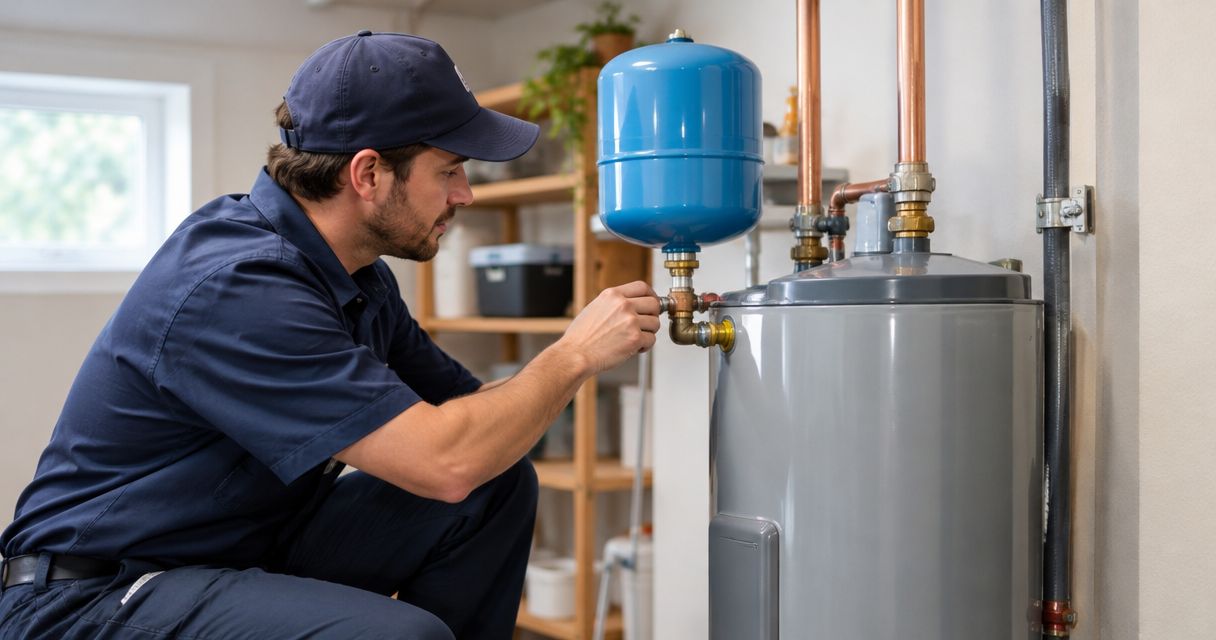
Replacing an existing expansion tank
Best for: a failed tank where the existing installation remains suitable. This scope involves removing the old tank and installing a correctly selected replacement, with any necessary connection or support corrections.
The advantage is that an existing connection is already present. The limitation is that the connection's presence does not prove the original installation was correct.
Your plumber should check:
- Whether the replacement tank is approved for potable water.
- Whether its sizing matches the heater and pressure conditions.
- Whether the existing fittings show leaks or corrosion.
- Whether its mounting follows the manufacturer's instructions.
- Whether the tank's air pressure needs adjustment before connection.
Do not assume that matching the old tank's appearance is enough. A previous installation can have an unsuitable size, incorrect air pressure, or inadequate support.
Ask the plumber to explain why the existing tank failed, where the cause can be established. Replacing the tank without addressing an identified pressure problem leaves that problem in place.
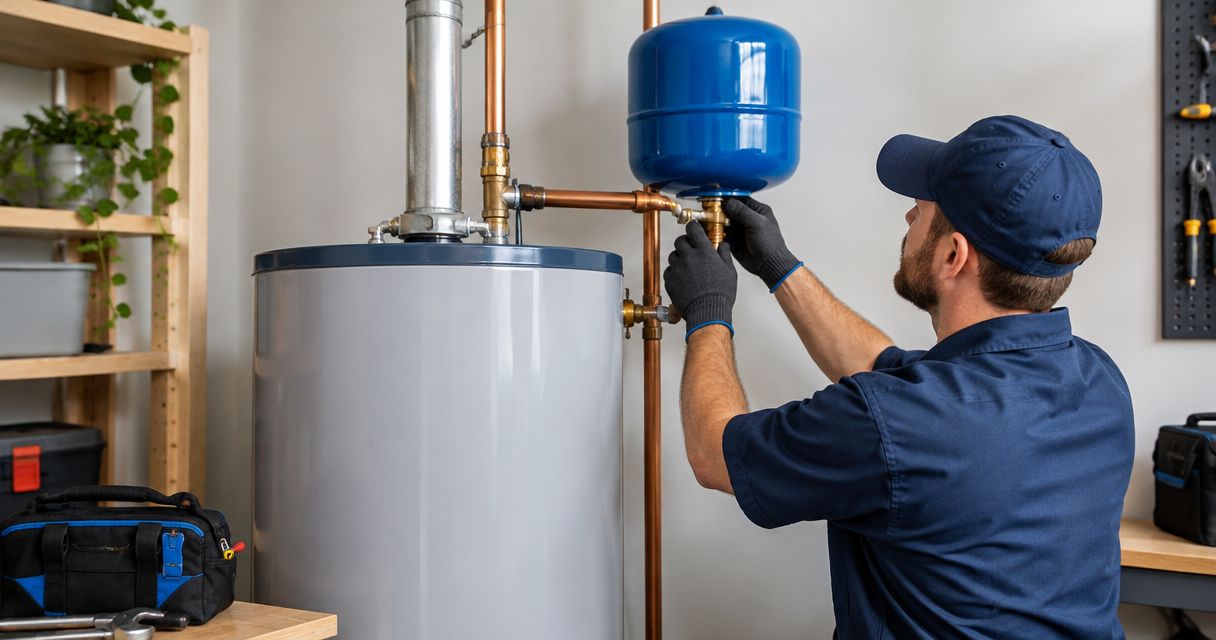
Adding an expansion tank for the first time
Best for: a system that needs thermal-expansion control but lacks a suitable provision. First-time installation requires a suitable connection and mounting location, not just a new tank.
The benefit is that the plumber can select the connection and support arrangement for the equipment. The drawback is the additional pipe work and access required compared with a suitable existing connection.
A first-time installation assessment should establish whether the plumbing system is closed. A check valve, backflow device, or certain pressure-reducing arrangements can prevent expanded water from returning toward the supply.
The plumber should then confirm the applicable local requirements and manufacturer instructions. Do not treat the absence of an existing tank as proof that the home needs one—or proof that it does not.
Before approving work, ask where the tank will sit, how it will be supported, and whether nearby shutoffs and service connections will remain accessible.
Adding an expansion tank during water heater replacement
Best for: homeowners already replacing a water heater whose system needs expansion control. Planning both jobs together lets the plumber assess tank sizing and connection placement against the new heater's requirements.
The practical advantage is coordination. The limitation is that a combined proposal can make individual tasks harder to distinguish unless the scope is written clearly.
Ask whether the water heater proposal includes an expansion tank, installation fittings, support, and pressure checks. Do not assume that a water heater replacement automatically includes every related component.
If you are comparing separate and combined work in 2026, compare the same scope. An estimate that includes pressure corrections and required mounting is not equivalent to one that lists only a tank installation.
| Installation approach | Best for | Main advantage | Main limitation |
|---|---|---|---|
| Existing-tank replacement | A failed tank with suitable existing connections | Can retain serviceable installation components | Existing sizing, pressure, and support still need checking |
| First-time installation | A system needing a new expansion-control provision | Allows connection and mounting to be planned together | Requires additional installation decisions and pipe work |
| Installation with heater replacement | A new heater installation needing expansion control | Coordinates sizing and layout with the heater work | Included components must be confirmed in writing |
Why water heater expansion tank installation cost varies
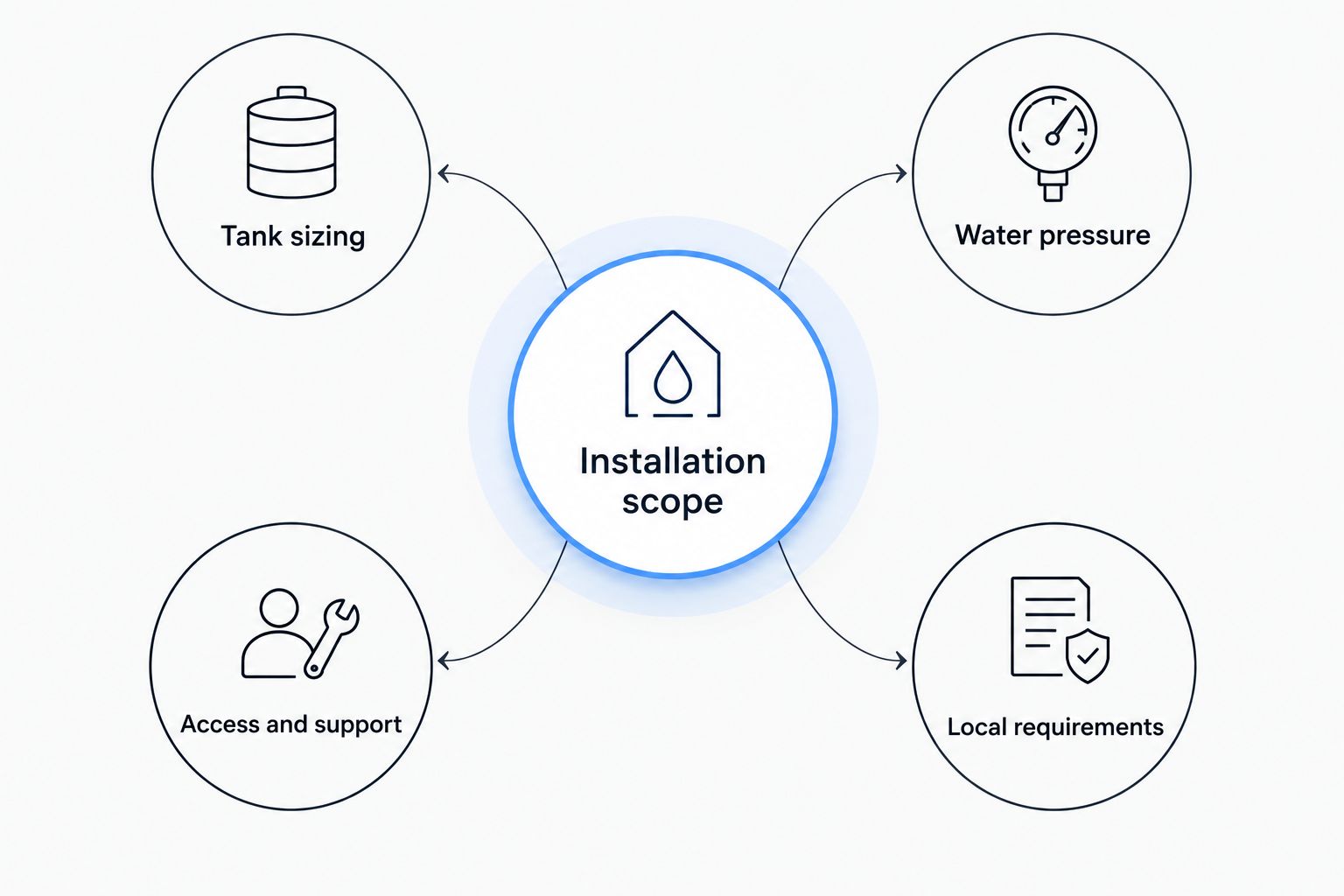
The same tank does not mean the same job. These factors change the work involved and should explain differences between estimates.
- Installation scope: Replacing a tank on suitable connections differs from cutting into the supply piping for a first-time installation.
- Tank sizing: Selection depends on the water heater's capacity and system pressure, not simply the space available nearby.
- Water pressure: Excessive supply pressure needs its own diagnosis. An expansion tank is not a replacement for pressure regulation.
- Access and support: A cramped location or unsuitable mounting arrangement changes the work required to install and service the tank safely.
- Local requirements: Applicable permit, inspection, and installation requirements depend on your jurisdiction and the scope of work.
Ask the plumber to connect each additional task to a specific finding. For example, a support bracket should answer a mounting requirement; pressure-control work should answer a measured or diagnosed pressure issue.
A clear explanation does not need technical language. You should understand what is wrong, what work addresses it, and what the estimate leaves out.
What should you check before approving the work?
You do not need to diagnose the system yourself. Gather information that helps the plumber assess it without guessing.
- Photograph the setup. Include the water heater, nearby piping, existing expansion tank, and any visible leaks. Stay clear of hot surfaces and electrical equipment.
- Record the symptoms. Describe dripping, visible corrosion, changes in water pressure, or water collecting beneath the equipment. Explain when the symptom occurs.
- Identify recent changes. Mention a water heater replacement, pressure-reducing valve work, or backflow-device installation if you know about it.
- Request a defined scope. Ask whether the proposed work is a replacement, a first-time installation, or part of a larger repair.
- Confirm the completion checks. Ask how the plumber will verify the connections, tank air pressure, mounting, and operation before finishing.
Do not remove the tank or press its air valve to investigate a suspected failure. The assembly can contain pressurized water, and disconnecting equipment requires a safe shutdown procedure.
Keep your 2026 estimate and service record together. A record of the installed tank and any pressure-related repairs gives the next professional useful information without relying on memory.
Does every water heater need an expansion tank?
Not every water heater installation has the same expansion-control requirements. The answer depends on the plumbing system, heater type, manufacturer instructions, and applicable local code.
A closed system needs appropriate thermal-expansion control, but the correct arrangement requires assessment. Do not assume a storage-tank installation and a tankless installation use identical requirements.
Ask the plumber to explain what makes your system closed, if applicable, and what requirement the proposed tank addresses. That is a more useful answer than a blanket statement about every home.
Can an expansion tank fix high water pressure?
An expansion tank accommodates thermal expansion; it does not regulate excessive incoming water pressure. Those are different jobs, even when their symptoms overlap.
If the incoming pressure is excessive, the plumber should assess the pressure-control equipment separately. Adding a tank without checking supply pressure can leave you with a new part and the same underlying issue.
Ask which pressure condition was found and how the proposed repair addresses it. Keep pressure-regulation work clearly identified on the estimate.
Is expansion tank installation a DIY job?
Professional installation is the better choice when the work involves pressurized piping, uncertain sizing, or an unclear failure. The task includes more than attaching a tank: selection, air-pressure adjustment, connection placement, and support all matter.
A tank that fits physically is not automatically suitable. Follow the equipment manufacturer's instructions and local requirements rather than treating the existing installation as a template.
Your safest homeowner task is documenting the symptoms and arranging an assessment. Leave disconnection and installation to someone qualified to perform the work.
When should you request urgent help?
Active leakage, spraying water, or hot discharge needs prompt attention. Keep children and pets away, and avoid touching hot piping or standing water near electrical equipment.
If you can safely reach a known water shutoff, close it to limit an active leak. Follow the water heater manufacturer's emergency shutdown instructions; do not approach controls through standing water.
Never cap, plug, or block a temperature-and-pressure relief valve or its discharge pipe. It is a safety device, not a nuisance drain to seal.
Mainline Plumbing is best for homeowners who want help connecting with vetted local licensed and insured plumbers for water heater service. Availability is 24/7, but the local professional must assess the system before defining the repair.
FAQ
How do I get an accurate water heater expansion tank installation cost?
Get a written estimate after a plumber checks the installation scope, supply pressure, tank sizing, access, and local requirements. Ask for the tank, labor, fittings, support, and testing to be identified.
Is replacing an expansion tank the same job as installing one for the first time?
Replacing an expansion tank is not the same scope as a first-time installation. A new installation needs a suitable piping connection and mounting arrangement, while a replacement still requires checks of the existing setup.
Does a dripping relief valve mean my expansion tank is bad?
A dripping relief valve does not prove that the expansion tank has failed. Excessive pressure, excessive temperature, or a faulty valve can also cause discharge and need diagnosis.
Can I use a heating-system expansion tank on my drinking-water supply?
Use an expansion tank specifically approved for potable-water service. A tank intended for a closed heating circuit is not automatically suitable for your home's drinking-water plumbing.
Should I replace my expansion tank when I replace my water heater?
Have the existing expansion tank assessed when replacing the water heater. Replacement depends on its condition, sizing, compatibility with the new installation, and applicable requirements—not simply the fact that heater work is happening.
How should I compare expansion tank estimates in 2026?
Compare 2026 estimates against the same installation scope. Check whether each includes appropriate sizing, required fittings and support, pressure checks, and any applicable permit arrangements.
Can Mainline Plumbing help me arrange water heater service?
Mainline Plumbing connects homeowners nationwide with vetted local licensed and insured plumbers for water heater service. Describe the symptoms and request an assessment before approving a specific repair.
One last thing
The tank's air pressure is part of the installation, not an optional finishing touch. A tank can be new and correctly connected yet still need its air charge adjusted for the system according to the manufacturer's instructions.
Before the plumber leaves, ask whether that check was completed. Also confirm where the relevant shutoff is and what symptoms should prompt another service call.
Related guides
- How to connect an expansion tank to a water heater
- Expansion tanks for new homeowners
- Expansion tanks for cold-climate homeowners
- Water heater expansion tanks compared
Need a replacement or a first-time installation? Book an assessment and ask for a written scope before work begins.
Arrange your water heater service
Connect with a vetted local licensed and insured plumber to assess your expansion tank installation.