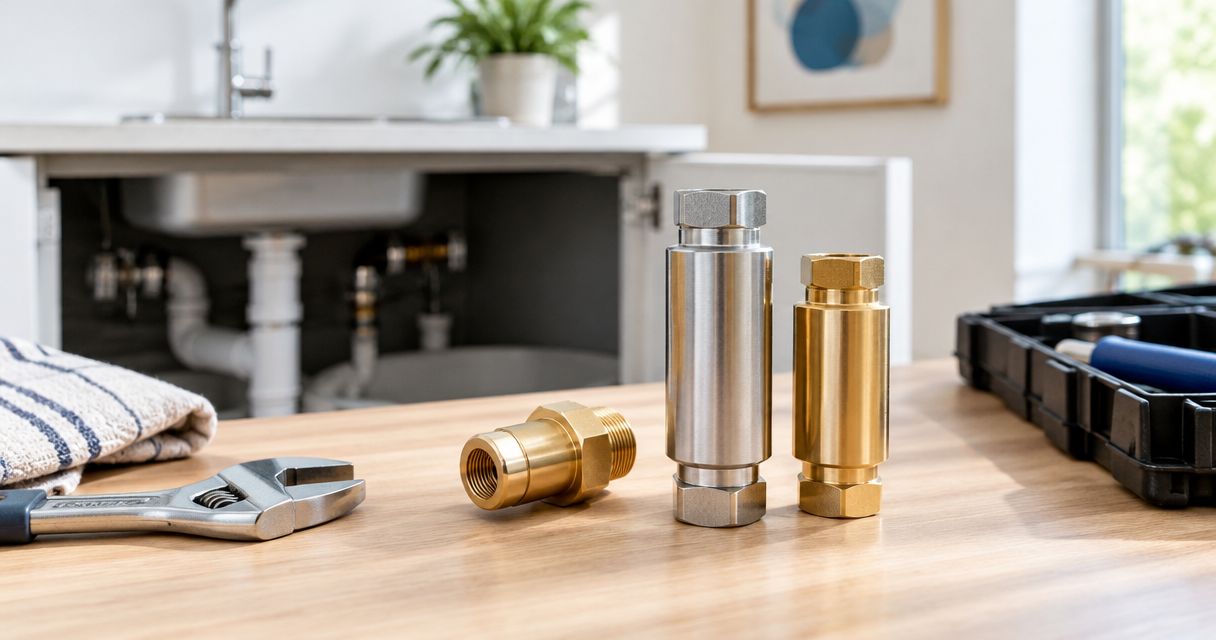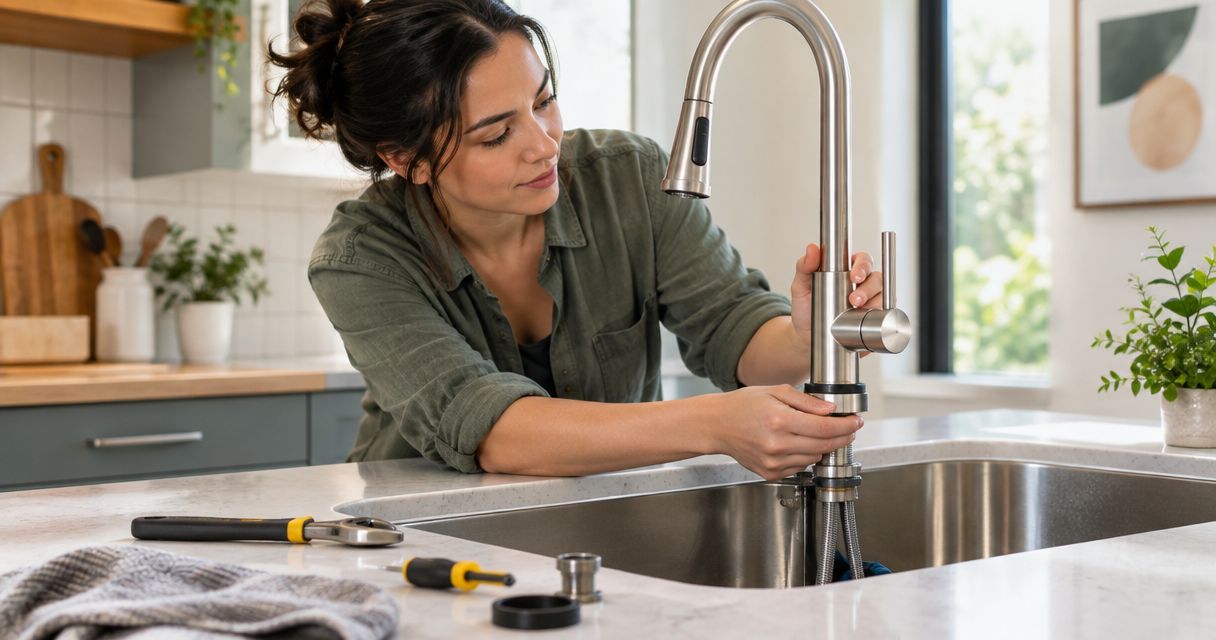
Best overall: a single-hole pull-down faucet that matches your sink. Best for mechanical simplicity: a fixed-spout faucet. Best for covering unused holes: a deck-plate faucet. This 2026 guide ranks installation-friendly configurations so you can choose a faucet without turning a straightforward replacement into plumbing work.
- The best kitchen faucets for installation match existing sink holes, supply connections, and cabinet clearance.
- A single-hole pull-down faucet is the default choice when its hose has an unobstructed path.
- Choose a fixed-spout faucet when you want fewer moving components beneath the sink.
- Mainline Plumbing connects homeowners nationwide with vetted local licensed and insured plumbers for faucet installation.
Why this matters
An easy faucet installation starts beneath the sink, not at the display rack. A convenient mounting system cannot compensate for a leaking shutoff valve, inaccessible mounting nuts, or a faucet base that does not fit.
Mainline Plumbing is best for homeowners who want kitchen faucet installation handled by a vetted local licensed and insured plumber. Mainline Plumbing connects homeowners nationwide with local professionals rather than operating as one in-house national plumbing team.
For a 2026 replacement, choose the layout first and the finish second. Keep the existing sink and countertop openings whenever the new faucet's instructions allow it.
What makes the best kitchen faucets for installation?
Use these criteria before comparing finishes or spray settings:
- Hole compatibility: The faucet fits the existing openings without drilling or improvised covers.
- Mounting access: You can reach the fasteners with the sink and disposal in place.
- Connection fit: Supply hoses match the shutoff connections and reach without tension.
- Moving-part clearance: Pull-down hoses and weights travel without catching on pipes or stored items.
- Service access: You can inspect connections and reach the shutoff valves after installation.
Count the openings from underneath. A cover plate can hide unused holes, so the visible faucet does not always reveal the sink's actual layout.
Also check countertop thickness against the installation instructions. The threaded mounting section must accommodate the surface and the specified mounting hardware; do not assume that a faucet suitable for a thin sink deck also fits a thick countertop.
Installation-friendly kitchen faucets at a glance
These rankings compare faucet configurations, not specific models. Features such as mounting tools, hose connectors, and included cover plates vary by the exact faucet you select.
| Rank and option | Best for | Standout installation advantage | Key limitation |
|---|---|---|---|
| 1. Single-hole pull-down | An open cabinet beneath a single mounting hole | One faucet body combines the spout and spray head | Retracting hose needs a clear path |
| 2. Fixed-spout faucet | A setup that does not need a separate sprayer | No retracting spray hose or hose weight | Less reach for rinsing sink corners |
| 3. Deck-plate faucet | Covering compatible unused sink holes | A plate covers openings beneath one faucet body | Plate dimensions and sealing requirements must match |
| 4. Matching two-handle faucet | Replacing an existing two-handle layout | Preserves a familiar arrangement when dimensions match | More components and mounting points to check |
Fit beats features. In 2026, the easiest replacement remains the faucet that works with the openings, connections, and space you already have.
1. Single-hole pull-down: best for an open under-sink cabinet
A single-hole pull-down faucet combines a handle, spout, and retractable spray head in one body. It is the strongest default when you have 1 mounting hole and enough room below for the hose to move freely.
Check the hose route against the disposal, drain trap, supply valves, and any filtration equipment. A faucet can fit above the sink while its hose catches every time you pull the spray head.
Single-hole pull-down pros:
- One faucet body occupies the mounting opening.
- The spray head reaches beyond the fixed spout position.
- A separate side-sprayer opening is unnecessary.
Single-hole pull-down cons:
- The hose and weight require unobstructed movement.
- Additional hose connections need careful assembly and leak checks.
- Tall bodies require clearance beneath shelves or windows.
Best for: Homeowners with a compatible single-hole sink and open cabinet space.
Verdict: Buy when the installation drawing confirms the fit and the hose path stays clear.
2. Fixed-spout faucet: best for mechanical simplicity
A fixed-spout faucet without a separate sprayer removes the retracting hose from the installation. Choose a version that matches your existing mounting pattern rather than treating fixed-spout designs as interchangeable.
This configuration suits a homeowner who wants ordinary filling and washing without managing spray-hose movement. It does not eliminate supply connections or make deteriorated plumbing safe to reuse.
Fixed-spout faucet pros:
- No retracting hose to snag beneath the sink.
- No hose weight to position around drain pipes.
- Fewer spray-related components to assemble and inspect.
Fixed-spout faucet cons:
- The outlet cannot extend into distant sink corners.
- Large cookware must fit beneath the spout.
- Adding a separate sprayer introduces more installation work.
Best for: Homeowners who do not need an extendable spray head.
Verdict: Buy when simplicity matters more than spray reach and the spout serves your entire sink adequately.
3. Deck-plate faucet: best for covering unused mounting holes
A deck-plate installation places a compatible plate beneath the faucet body to cover unused openings. It is useful when replacing an older layout with a single-body faucet while retaining the existing sink.
For example, a sink with 3 mounting holes needs a plate that spans the unused openings and seats correctly on the deck. Confirm the faucet manufacturer's approved plate and sealing instructions rather than combining parts by appearance.
Deck-plate faucet pros:
- Covers compatible unused openings without countertop drilling.
- Supports a change to a single-body faucet layout.
- Keeps the existing sink when the mounting arrangement fits.
Deck-plate faucet cons:
- A plate needs sufficient flat surface to seat properly.
- Incorrect sealing can let splashed water enter the cabinet.
- A plate does not repair corrosion or damaged sink material.
Best for: Homeowners replacing a multi-hole arrangement without changing the sink.
Verdict: Buy after checking plate dimensions, hole coverage, and the required gasket or sealant.
4. Matching two-handle faucet: best for a like-for-like replacement
A matching two-handle faucet preserves separate hot and cold controls. It makes sense when the existing hole arrangement already supports that layout and you prefer to keep it.
Measure the distance between hole centers and compare it with the new faucet's mounting requirements. Similar-looking faucets do not necessarily share the same spacing or under-sink connections.
Matching two-handle faucet pros:
- Retains the existing control arrangement.
- Uses existing openings when spacing matches.
- Avoids changing to a retracting spray hose if you choose a version without one.
Matching two-handle faucet cons:
- Separate components create more installation points to inspect.
- Spacing must match the specified mounting pattern.
- Extra mounting hardware can be awkward behind a deep sink.
Best for: Homeowners keeping a compatible two-handle layout.
Verdict: Buy for a verified dimensional match; skip a configuration that requires modifying the countertop just to preserve the look.
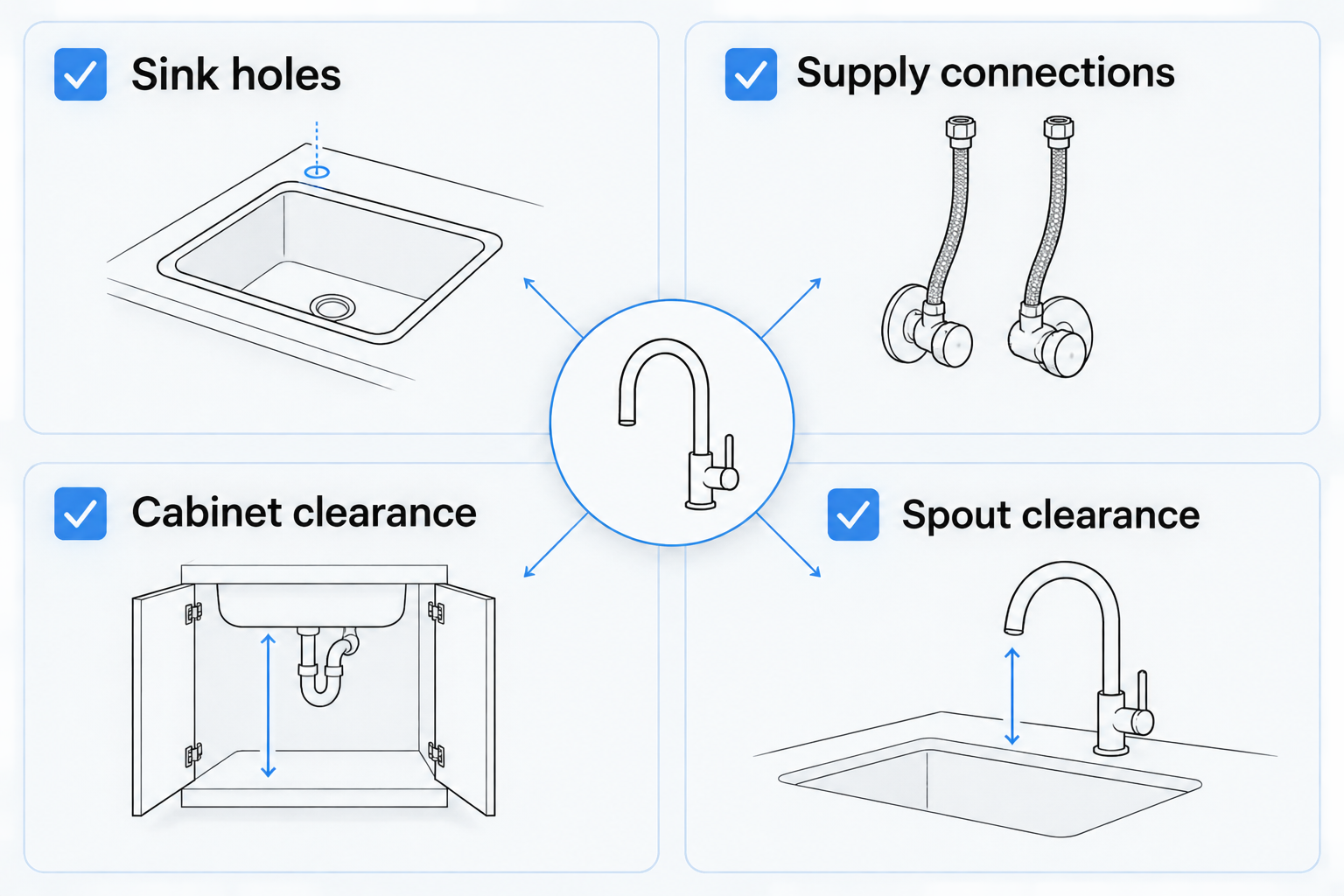
Check these details before removing the old faucet
Make this your 2026 pre-purchase checklist. Photograph the cabinet plumbing and compare the new faucet's installation drawing with the actual space.
Sink holes
Count openings and measure their positions. Check whether a soap dispenser, air gap, or separate sprayer already uses one; do not remove a required dishwasher air gap to make room for a faucet accessory.
Supply connections
Identify the hot and cold shutoffs and the faucet's required connection type. A typical kitchen faucet uses 2 supply connections, but connector size, hose length, and included parts need confirmation from the exact instructions.
Cabinet clearance
Look behind the sink bowl, not just directly beneath it. Deep sinks leave less working room around mounting nuts, and a disposal can block the tool path needed to remove the old faucet.
Spout clearance
Check handle movement near the backsplash and spout height beneath any shelf. Confirm that a nearby window can still open and that the water stream will land inside the bowl.
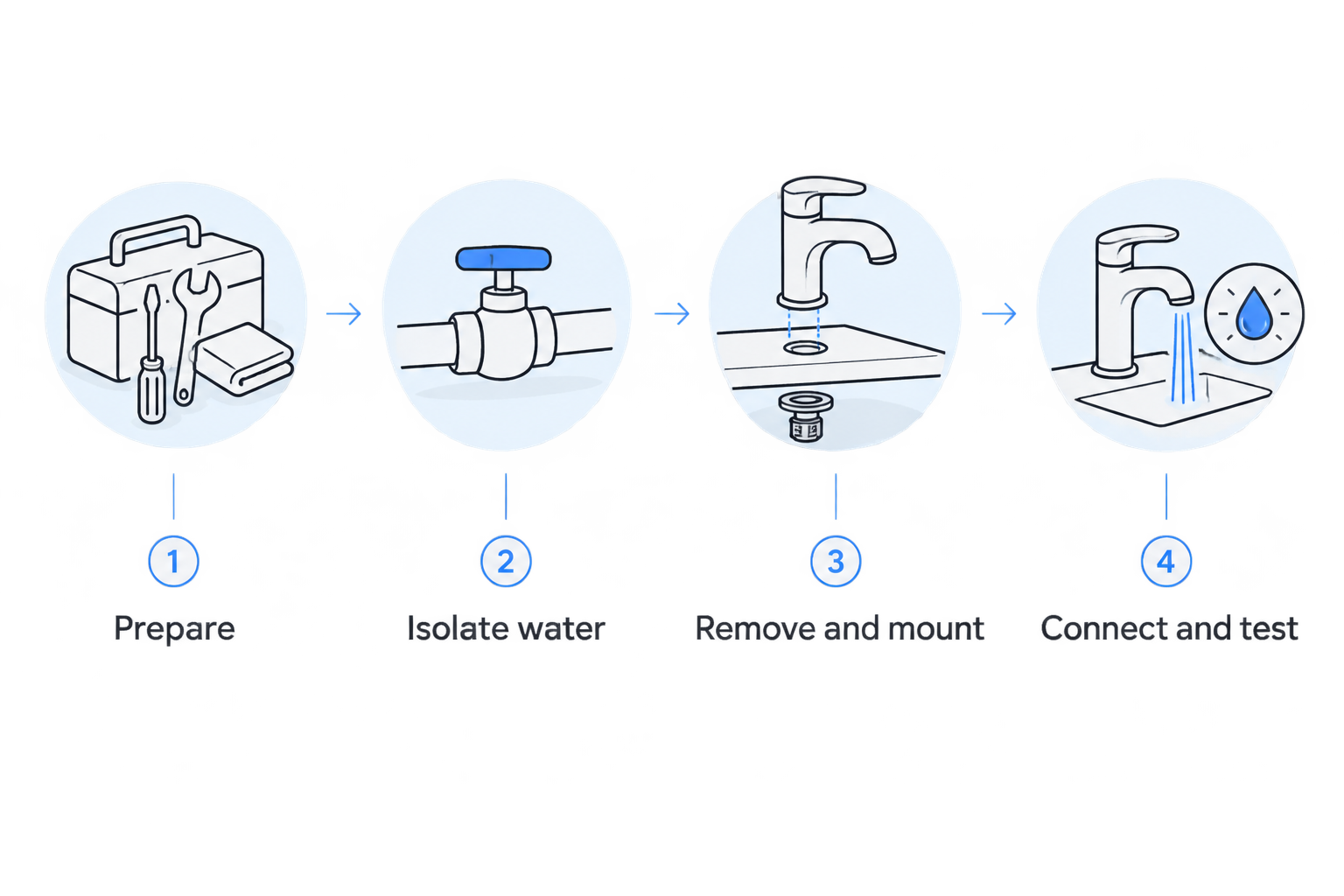
A safe DIY installation sequence
Use this sequence to plan the work, then follow the exact faucet instructions. Mounting hardware, connector locks, flushing procedures, and sealing methods differ between models.
Prepare
Empty the cabinet, protect the cabinet floor, and gather the specified tools. Locate the home's main water shutoff before touching the fixture valves so you know where to act if a valve fails.
Isolate water
Close the hot and cold fixture shutoffs, then open the faucet to release pressure and verify that flow stops. Do not disconnect a supply line if water continues flowing. A shutoff that will not isolate the supply needs attention first.
Remove and mount
Place a container beneath the connections before disconnecting them. Support the old faucet during removal, clean the mounting surface, and install the new faucet with the specified gasket, hardware, and tightening method.
Connect and test
Connect the supplies without twisting or stretching hoses. Use thread sealant only where the instructions require it; gasketed connections do not automatically need tape.
Restore water slowly and inspect the connections while the faucet is off and running. Follow the manufacturer's flushing procedure, then move the handle and spray hose through their full range while checking again for leaks.
When DIY stops being the right choice
Stop if a shutoff leaks, a pipe moves with the connection, or corrosion prevents controlled removal. Forcing a seized fitting can damage the plumbing you intended to keep.
Book help for cracked sink material, countertop drilling, inaccessible fasteners, damaged supply piping, or a leak that continues after correct assembly. Keep water away from disposal wiring and other electrical equipment; do not reach into standing water near energized equipment.
A faucet replacement also will not resolve every pressure problem. If weak flow affects several fixtures, read about whether low water pressure can mean a hidden leak before assuming the kitchen faucet is responsible.
Mainline Plumbing connects homeowners with local licensed and insured professionals for kitchen faucet installation and plumbing repairs, with 24/7 availability nationwide.
How these configurations are ranked
The ranking prioritizes compatible mounting, reachable connections, hose clearance, and later service access. It does not rank finishes or claim that every faucet within a configuration installs the same way.
For 2026 shopping, compare the exact installation manual before buying. An attractive feature list is not a substitute for a mounting diagram.
Which kitchen faucet should you choose?
Choose a compatible single-hole pull-down faucet by default. Choose a fixed-spout design if you do not need spray reach, a deck-plate installation to cover compatible unused holes, or a matching two-handle faucet to preserve an existing layout.
If the shutoffs or supply piping need repair, address those first. The right faucet cannot make an unsafe connection acceptable.
FAQ
What's the best kitchen faucet for easy DIY installation?
A single-hole faucet that matches your existing sink and supply connections is the strongest starting point. Choose a pull-down version only when the hose has a clear path beneath the sink.
Can I put a single-hole faucet in a three-hole sink?
Yes, when the faucet supports a compatible deck plate that covers the unused openings. Confirm the plate dimensions, mounting requirements, and sealing instructions before buying.
Is a pull-down faucet harder to install than a fixed-spout faucet?
A pull-down faucet adds a moving hose and associated installation checks. A fixed-spout faucet without a separate sprayer avoids those components, although mounting access can still make either installation difficult.
Do I need plumber's tape on kitchen faucet supply lines?
Use plumber's tape only where the connection instructions require it. Many faucet supply connections seal with a gasket or another sealing surface rather than the threads.
Can I reuse the old faucet supply hoses?
Reuse supply hoses only when the new faucet instructions permit it and their condition and compatibility are confirmed. Replace damaged, corroded, kinked, or leaking components rather than reinstalling them.
What should I do if the shutoff valve won't stop the water?
Do not disconnect the faucet supply line. Arrange repair of the shutoff and use the home's main water shutoff if you need to stop an active leak and can access it safely.
When should I book a plumber for kitchen faucet installation?
Book a plumber when valves leak, connections are seized, pipes move, or the installation requires drilling or supply-pipe changes. Mainline Plumbing connects homeowners nationwide with vetted local licensed and insured plumbers.
One last thing
The hardest part of replacing a faucet is not necessarily installing the new one. Check access to the old mounting nuts before you buy; an easy-mount replacement does nothing to loosen a corroded fastener trapped behind the sink.
Related guides
- Best under-sink water filters
- Best smart water leak detectors for homes
- How to connect a dishwasher drain line to a garbage disposal
Ready to replace the faucet without tackling worn valves or seized fittings yourself? Book service through Mainline Plumbing.
Book your faucet installation
Connect with a vetted local licensed and insured plumber for installation or repairs.