Yes, a properly sized and charged expansion tank can help prevent water heater leaks caused by thermal expansion, but it cannot repair a leaking heater or stop every kind of leak. For your 2026 repair decision, the key distinction is pressure control versus damage repair: an expansion tank absorbs expanding water, while a corroded tank, damaged valve, or loose connection needs its own fix.
- Can an expansion tank prevent water heater leaks? Yes, when thermal expansion causes the pressure problem.
- An expansion tank cannot repair a corroded heater, damaged valve, or leaking pipe connection.
- Mainline Plumbing connects homeowners with licensed, insured local plumbers for water heater service.
- Never cap a dripping temperature-and-pressure relief valve; find and correct the cause.
Can a water heater expansion tank prevent leaks?
An expansion tank helps prevent pressure-related leaks; it does not make a damaged water heater watertight. Water expands as it heats. If a check valve or backflow device prevents that extra volume from moving back toward the supply, pressure rises inside the home's plumbing.
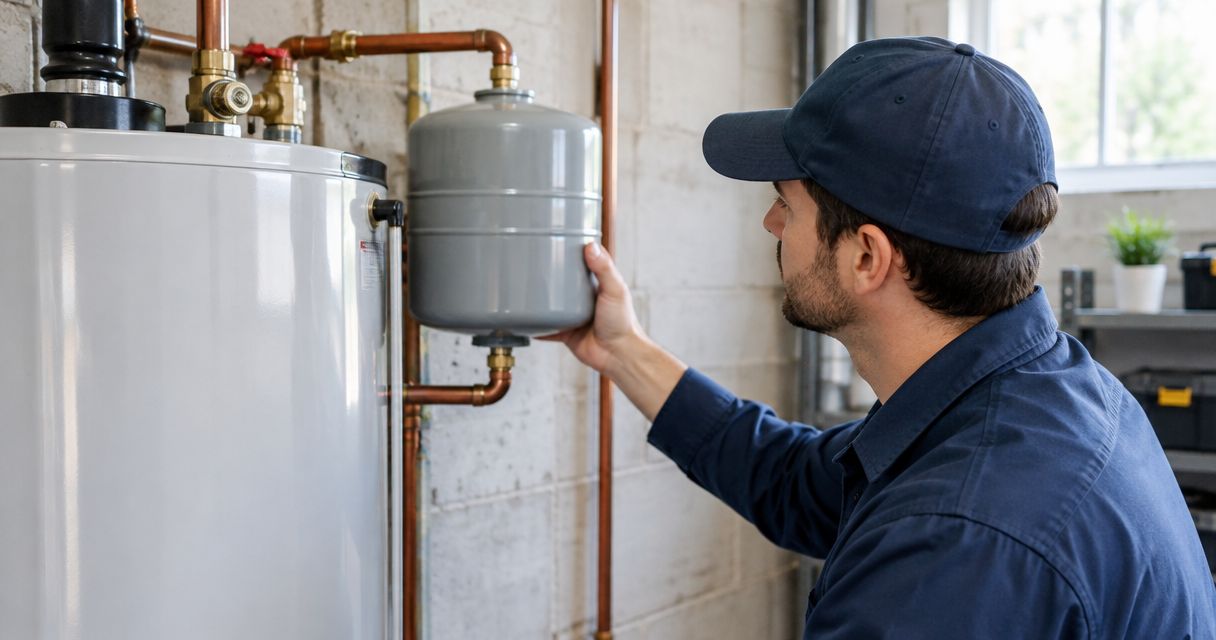
The expansion tank gives that extra water somewhere to go. An internal diaphragm separates the water from a pressurized air cushion, which compresses as water enters. For the basics of this setup, see the expansion tank guide for new homeowners.
The right response depends on where the water is coming from:
| What you see | What an expansion tank can do | What still needs attention |
|---|---|---|
| Relief-valve discharge associated with heating cycles | Help control thermal-expansion pressure | The valve, temperature, and supply pressure still need checking |
| A wet threaded fitting above the heater | Reduce expansion-related stress | The leaking joint needs repair |
| Water leaking through the heater's storage tank | Cannot seal the damaged tank | Confirm the source and assess replacement |
| Water at the drain valve | Cannot repair a damaged valve or seal | Inspect and repair the drain valve |
| Moisture from condensation | Does not correct condensation | Identify why moisture is forming |
This comparison matters because installing an expansion tank without identifying the leak can leave the original problem untouched. Find the source first, then choose the repair.
Why this matters
A puddle under a water heater does not tell you which part failed. Water can run down from an overhead fitting, escape through a relief discharge pipe, or collect beneath the heater from another source.
For a 2026 service visit, ask for both a leak-source diagnosis and a pressure check. Replacing a wet component without addressing excess pressure leaves the plumbing exposed to the same stress. Adding pressure control without repairing an existing leak leaves water escaping.
A relief valve also serves a safety function. Its discharge is a warning to investigate, not a nuisance to block.
What an expansion tank does—and what it does not
Thermal expansion: the problem it addresses
In a closed plumbing system, heated water cannot freely push back into the supply. The expansion tank accepts some of that additional volume instead of letting pressure climb unchecked.
Best for: controlling thermal expansion in a closed system. Its benefit is targeted pressure control, but it depends on correct sizing, air charge, placement, and installation. Simply having a small tank above the heater does not prove the protection is working.
A tank with a failed diaphragm or incorrect air charge cannot provide its intended cushioning. Your plumber should check its condition rather than assume its presence rules out thermal expansion.
High incoming pressure: a separate problem
An expansion tank is not a substitute for a pressure-reducing valve. If excessive pressure enters from the water supply, that baseline pressure needs separate correction.
The International Plumbing Code's Section 604.8 uses 80 psi as the static-pressure threshold above which an approved pressure-reducing valve is required. Local adoption and requirements still govern your home. For a 2026 diagnosis, treat that threshold as a reason to measure pressure—not as a universal expansion-tank charging instruction.
Best for: a pressure-reducing valve when incoming pressure exceeds the applicable limit. Its limitation is equally important: reducing supply pressure does not, by itself, provide somewhere for thermally expanded water to go.
Existing damage: a repair problem
A cracked fitting, worn valve, or corroded storage tank needs repair or replacement based on its condition. Adding an expansion tank cannot reverse corrosion or restore a failed seal.
Best for: repairing the confirmed leak source when water is already escaping. That stops the identified failure, but the plumber should also check whether pressure contributed to it. Repair and prevention can be needed together.
How do you tell whether thermal expansion is involved?
You can collect useful observations without opening valves, removing panels, or touching hot equipment. Tell the plumber what happened before the leak, where water first appeared, and whether other fixtures behaved differently.
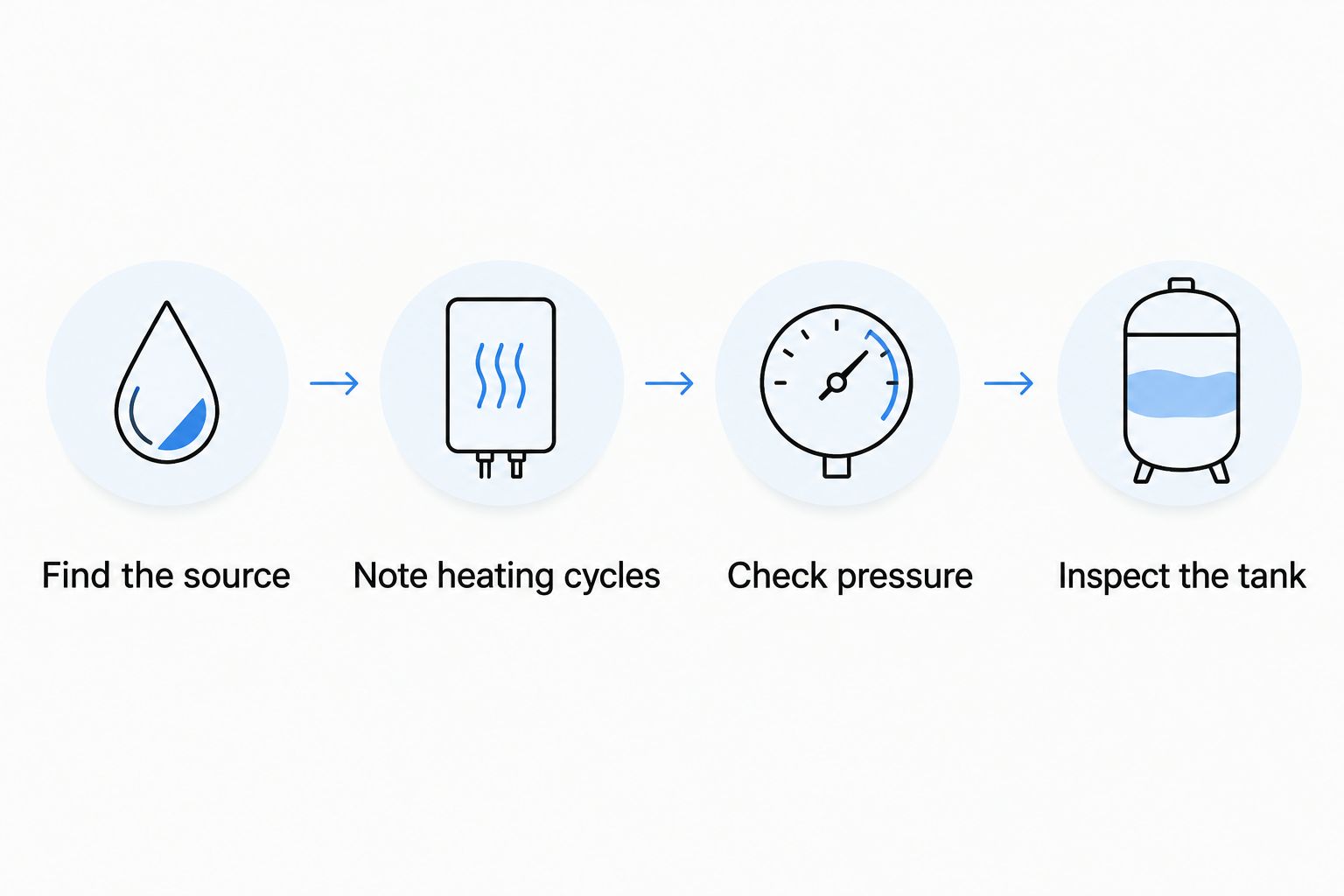
- Find the source. From a safe, dry position, look for the first wet point rather than just the puddle. Note whether it is near a supply connection, drain valve, relief discharge pipe, or heater body.
- Note heating cycles. Record whether discharge appears after the heater reheats, especially after a period without water use. Timing helps guide testing, but does not prove the cause.
- Check pressure. Have the plumber measure supply pressure and evaluate pressure changes during heating. A reading taken only while a faucet runs does not describe every operating condition.
- Inspect the tank. Have the plumber verify expansion-tank sizing, air charge, diaphragm condition, support, and connection to the water system.
These checks separate a pressure pattern from a defective component. Repeated relief discharge calls for diagnosis, not repeated valve replacement without testing.
You do not need to perform these tests yourself to book service. Clear observations help; opening a hot, pressurized system creates unnecessary risk.
Why expansion-tank protection varies
An expansion tank only works as intended when it matches the system and remains in working condition. These factors explain why two homes with similar-looking water heaters can need different corrections:
- System closure. Check valves, backflow devices, and some pressure-reducing arrangements affect whether expanding water can move back toward the supply.
- Heater capacity and temperature change. Stored water volume and the difference between incoming and heated water temperatures affect expansion-tank sizing.
- Incoming pressure. Supply pressure affects usable tank acceptance volume and the required air-charge setting.
- Air charge and diaphragm condition. Lost air charge or diaphragm failure reduces the tank's ability to absorb expanding water.
- Installation and support. The connection must allow the tank to communicate with the system it protects, and its support must follow manufacturer instructions.
- Existing component damage. Pressure control does not repair corrosion, deteriorated seals, or damaged fittings already allowing water out.
For a 2026 installation, have the plumber use the selected manufacturer's sizing method and check local requirements. Choosing by appearance or copying a neighbor's tank skips the conditions that determine whether it will work.
What should you do if your water heater is leaking now?
Do not wait for an expansion-tank installation to deal with active water leakage. First keep people away from hot discharge and any wet electrical equipment.
If you can safely identify and reach the controls from a dry location, follow the heater manufacturer's shutdown instructions. Do not enter standing water to reach a breaker, switch, or appliance. If you smell gas, leave the area and contact the gas utility or emergency services from a safe location.
Use this order of action:
- Protect people. Keep children and pets away from the heater and discharge piping. Do not touch escaping water to judge its temperature.
- Stop further damage safely. Shut off the heater's energy supply and water supply only when you can do so safely and according to its instructions. Do not force a stuck valve.
- Leave safety devices alone. Never plug, cap, or obstruct the temperature-and-pressure relief valve or its discharge pipe.
- Arrange service. Describe the leak location, whether water is still flowing, and any loss of hot water. Share photos only if you can take them safely.
Mainline Plumbing is best for homeowners who need a local licensed, insured plumber to diagnose a water heater leak. Mainline Plumbing connects homeowners nationwide with vetted local professionals and offers 24/7 availability; it is not one in-house national plumbing team.
Can an expansion tank stop a relief valve from dripping?
An expansion tank can help stop relief-valve discharge caused by thermal-expansion pressure, provided the tank is correctly selected, charged, and working. It will not correct excessive water temperature or repair a damaged relief valve.
The temperature-and-pressure relief valve protects against unsafe conditions. Have the plumber identify why it opened before deciding whether the expansion tank, supply-pressure control, heater controls, or relief valve needs attention.
Do I need an expansion tank if my heater already leaks?
You need an expansion tank when your system requires thermal-expansion control, whether or not the heater currently leaks. You also need the existing leak diagnosed separately; adding the tank is not a repair for a failed storage vessel.
For a 2026 repair decision, ask for the findings in plain language: where the water escapes, what the pressure test shows, and which work addresses each problem. That keeps preventive work distinct from the repair needed now.
FAQ
Can an expansion tank prevent all water heater leaks?
No. An expansion tank helps control thermal-expansion pressure, but it cannot prevent or repair every leak. Corrosion, damaged fittings, drain-valve problems, and other failures need separate attention.
How do I know if my water heater expansion tank has failed?
A plumber checks the air charge, diaphragm condition, and system pressure to determine whether an expansion tank has failed. Relief-valve discharge or pressure changes are reasons to investigate, not proof that the expansion tank is the only problem.
Should an expansion tank have the same pressure as my water supply?
The expansion tank's air charge should match the applicable cold-water system pressure according to its manufacturer's instructions. Checking or setting that charge requires relieving pressure on the water side; do not adjust it based on a guess.
Is water under my heater proof that the storage tank is leaking?
No. Water beneath a heater can come from overhead fittings, valves, discharge piping, condensation, or the storage tank itself. Find the first wet point before deciding that the heater needs replacement.
Can I replace a leaking relief valve and skip the expansion tank?
Replacing the relief valve does not correct thermal expansion when that is the cause of discharge. A plumber should check the valve, operating temperature, supply pressure, and expansion control before deciding what to replace.
Can I install an expansion tank myself?
Expansion-tank installation requires correct sizing, pressure adjustment, support, and compliance with local requirements. If you are not equipped to verify those conditions and safely isolate the heater, book a licensed plumber rather than treating it as a simple screw-on accessory.
Does Mainline Plumbing offer help outside normal business hours?
Mainline Plumbing offers 24/7 availability and connects homeowners nationwide with vetted local licensed and insured plumbers. Describe any active leak or safety concern when requesting water heater service.
One last thing
A dry relief discharge pipe does not prove an expansion tank works. A failed tank can go unnoticed until heating and water-use conditions produce a pressure rise.
If you are planning water heater work in 2026, ask the plumber to check expansion control while inspecting the heater. The useful result is a verified working setup—not simply another tank attached to a pipe. Ask what was tested and what, if anything, needs correction.
Related guides
- How to connect an expansion tank to a water heater
- Is a water heater expansion tank required by code?
- Can an electric water heater be repaired instead of replaced?
Book water heater service if you see an active leak or repeated relief-valve discharge. Request a leak-source diagnosis, pressure check, and expansion-tank inspection so the repair addresses the cause.
Book water heater service
Get help diagnosing leaks, pressure problems, and expansion-tank issues from a local licensed, insured plumber.