Yes. Hard water can damage your water heater when dissolved minerals form scale on heating surfaces and collect inside the system. That buildup interferes with heat transfer, contributes to component problems, and restricts flow in tankless units; flushing removes some deposits, but it does not repair a leaking tank or prevent new scale.
- Hard water damage water heater warning signs include rumbling, reduced hot water, and recurring scale buildup.
- Tank and tankless water heaters both need maintenance matched to water hardness and manufacturer instructions.
- Flushing addresses accumulated deposits; water softening addresses incoming hardness. Neither repairs a failed tank.
- Mainline Plumbing connects homeowners nationwide with vetted local licensed and insured plumbers for water heater service.
Why this matters
Treat mineral buildup before deciding you need a replacement. Noise or disappointing hot water does not identify the failed part, and replacing a heater without addressing hard water leaves the replacement exposed to the same conditions.
For your 2026 maintenance plan, separate three questions: Is the water hard? Is the heater affected? Is the problem maintenance-related or an actual failure? Mainline Plumbing connects homeowners with local professionals who handle water heater repair and installation; the service is a nationwide connection network, not one in-house national plumbing crew.
Can hard water damage your water heater?
Hard water can damage storage-tank and tankless water heaters, but the buildup affects them differently. Heating encourages calcium carbonate to come out of solution and form deposits. Those deposits accumulate where water gets hot, including heating elements, tank bottoms, and heat exchanger passages.
| Water heater type | Where buildup collects | What you might notice | Important limitation |
|---|---|---|---|
| Gas storage tank | Tank bottom and heated surfaces | Rumbling, popping, slower recovery | Noise alone does not prove the tank needs replacement |
| Electric storage tank | Heating elements and tank bottom | Reduced hot water, element problems, sediment | Thermostat and electrical faults can cause similar symptoms |
| Tankless | Heat exchanger passages | Restricted hot-water flow, temperature changes, service alerts | Descaling does not fix every flow or ignition problem |
Scale is not the same thing as corrosion. Scale is mineral buildup; corrosion is deterioration of metal. They can exist together, but a plumber needs to identify which problem is present before recommending work.
A heater that still produces hot water can still need maintenance. Waiting for complete failure is not a useful way to judge whether mineral deposits are affecting the system.
Storage-tank heaters: sediment and coated heating surfaces
In a storage heater, loose material settles toward the bottom. On a gas model, accumulated sediment interferes with heat moving from the heated tank surface into the water. Popping or rumbling sometimes accompanies that buildup.
Electric models have heating elements inside the tank. Scale can coat those elements and interfere with heat transfer, contributing to overheating and element failure. An element problem does not automatically mean the entire heater has failed.
Look for changes rather than one isolated sound:
- Hot water runs out sooner under the same household routine.
- Recovery after showers takes noticeably longer.
- New popping or rumbling occurs during heating.
- Sediment appears during manufacturer-approved maintenance.
These signs justify an inspection, not a diagnosis from across the room. A broken dip tube, failed element, thermostat problem, or changing household demand can produce overlapping symptoms.
Tankless heaters: scale inside narrow water passages
Tankless heaters are not protected from hard water simply because they have no storage tank. Their heat exchangers heat moving water, and scale can form inside the passages carrying it. Restrictions affect flow and heat transfer.
Temperature swings and service alerts deserve attention, but neither confirms scale by itself. A clogged inlet screen, fixture restriction, or another operating fault also needs consideration. Give the plumber the exact alert shown on the display rather than resetting the unit repeatedly.
For tankless maintenance in 2026, use the instructions for your specific model. The approved cleaning solution, service connections, procedure, and maintenance interval matter. Do not substitute a generic online routine for the manufacturer's directions.
Why hard water damage varies
Two homes with hard water do not necessarily develop identical heater problems. These factors shape the maintenance needs:
- Mineral concentration. Water with more dissolved hardness minerals supplies more material that can form scale.
- Water temperature. Higher temperatures encourage calcium carbonate deposits; do not change settings without considering sanitation and scalding guidance.
- Hot-water use. More water passing through the heater brings more dissolved minerals into the system.
- Heater design. Tank bottoms, electric elements, and tankless heat exchangers collect deposits in different places.
- Maintenance history. Loose sediment and established scale do not respond identically to the same cleaning procedure.
- Existing water treatment. Correctly selected and maintained softening equipment reduces incoming calcium and magnesium.
Set the service schedule from your water conditions and heater manual, not a universal calendar reminder. A maintenance interval that suits one household is not proof that another heater can wait just as long.
How do you know whether your water is hard?
Test the water rather than judging it only by spots on faucets. A utility water-quality report is a useful starting point, but a test at your home checks the water actually reaching the heater. Private-well owners need their own water testing.
The U.S. Geological Survey classifies water hardness by calcium carbonate concentration: 0–60 mg/L is soft, 61–120 mg/L is moderately hard, 121–180 mg/L is hard, and more than 180 mg/L is very hard. These are water classifications, not thresholds that predict an exact heater lifespan.
White crust around fixtures, soap scum, and scale in a kettle support the case for testing. They do not reveal how much material is inside your heater. Likewise, clear-looking water can contain dissolved hardness minerals.
Keep a dated copy of your 2026 test results with the heater's model information. If you already have a softener, test treated water too; owning treatment equipment does not establish that it is working correctly.
What should you do if you suspect scale buildup?
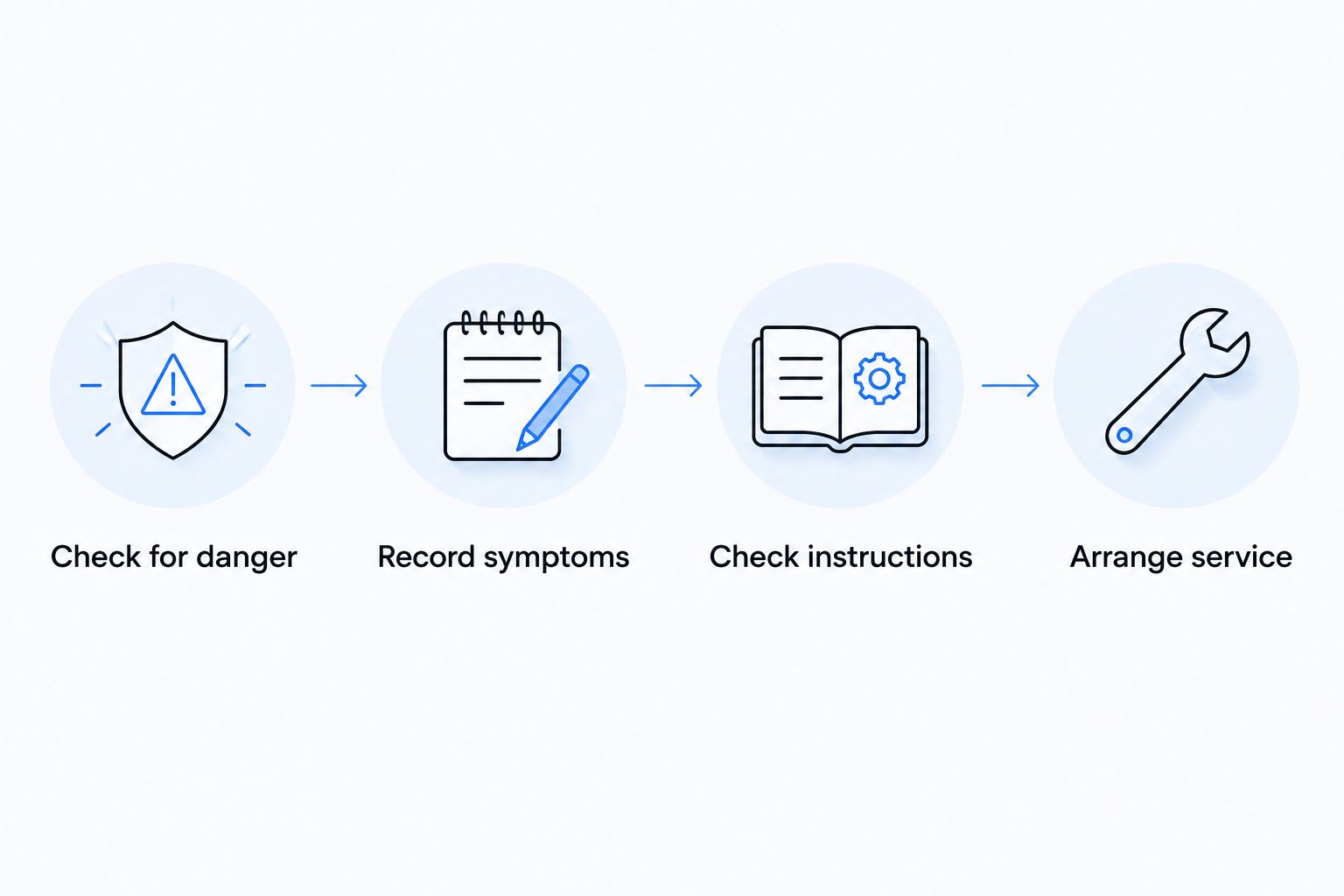
Start with observations that do not require opening the heater or handling hot water. This sequence helps you give a plumber useful information without turning a maintenance concern into a burn or electrical hazard.
- Check for danger. Look from a safe position for active leakage, wet electrical equipment, or discharge from the safety relief pipe. A gas smell requires leaving the area and contacting the gas utility or emergency services from outside.
- Record symptoms. Note when noise starts, whether hot-water flow changed, and whether every fixture is affected. Photograph any displayed error message.
- Check instructions. Find the model number, maintenance directions, and previous service records. Do not remove electrical covers or burner components to investigate.
- Arrange service. Ask for water testing and a heater diagnosis before approving cleaning, component replacement, or a new unit.
If water is actively escaping, avoid standing water near electrical equipment. Shut off the heater's energy supply and cold-water inlet only when you can do so safely and know the correct controls. Never cap a relief pipe or attempt to stop its discharge by plugging it.
Does flushing fix hard water damage?
Flushing is maintenance, not a universal repair. A tank flush removes drainable water and some loose sediment. It does not reliably remove all hardened scale, restore a failed heating element, or seal a corroded tank.
Tankless descaling is a different procedure. It circulates an approved cleaning solution through the heat exchanger according to the manufacturer's instructions. The unit needs suitable service connections and proper isolation during the work.
| Approach | Best for | Main benefit | Limitation |
|---|---|---|---|
| Tank flushing | Loose sediment in a serviceable storage heater | Removes material that drains out | Does not remove every hardened deposit |
| Tankless descaling | Scale in a serviceable heat exchanger | Cleans internal heating passages | Requires model-specific procedures and suitable connections |
| Water softening | Reducing incoming calcium and magnesium | Addresses the source of hardness | Requires correct sizing and ongoing maintenance |
| Component repair | A confirmed repairable fault | Replaces the failed part | Does not independently correct hard water |
| Heater replacement | A failed tank or otherwise unsuitable unit | Replaces equipment that cannot be sensibly repaired | Leaves the water problem unchanged unless addressed separately |
Before attempting maintenance yourself, read whether you can flush a water heater yourself. Hot water, stored pressure, electrical power, and gas controls make this more than opening a drain valve.
Will a water softener protect your heater?
A conventional ion-exchange softener reduces calcium and magnesium in incoming water. That directly addresses hardness and reduces the minerals available to form new scale. It does not instantly remove established deposits or repair existing heater damage.
Water softening is best for homeowners with confirmed hardness who want to address the incoming water. The trade-off is another system to size, maintain, and check. Installation also needs to suit the home's plumbing and applicable local requirements.
An ordinary sediment filter is not a substitute for softening. Sediment filters capture particles; dissolved hardness minerals pass through typical sediment-filter media. Ask what a proposed treatment actually removes rather than accepting a general claim that it fixes water quality.
Before choosing treatment in 2026, confirm compatibility with your heater's water-quality requirements. Keep the recommendations and maintenance instructions together so treatment and heater servicing work as one plan.
Should you repair or replace a scaled water heater?
Repair is appropriate when the problem is a serviceable component and the rest of the heater remains suitable for use. Cleaning plus an element repair, for example, addresses a different situation from water escaping through a failed tank shell. The diagnosis comes first.
Replacement is the appropriate direction for a leaking tank shell. Water on the floor still needs tracing: a connection, valve, or nearby pipe can leak without the tank itself failing. Do not approve replacement based only on a puddle's location.
Ask the plumber to explain:
- Where the failure is and what evidence identifies it.
- Whether cleaning will improve the condition being diagnosed.
- Which components need repair and which remain serviceable.
- What water-treatment or maintenance change prevents repeating the problem.
For a repair decision in 2026, compare the written scope rather than accepting a blanket claim that hard water always means replacement. Mainline Plumbing is best for homeowners seeking a connection to a vetted local licensed and insured plumber for water heater diagnosis.
FAQ
Can hard water ruin a water heater?
Yes, hard water can contribute to water heater damage through scale buildup on heating surfaces and inside water passages. The presence of hard water alone does not prove that your heater needs replacement.
What does hard water damage sound like in a water heater?
Popping or rumbling in a storage heater can accompany sediment buildup during heating. Noise alone does not confirm scale or identify which repair is needed.
How often should I flush a water heater with hard water?
Follow your heater manufacturer's maintenance instructions and adjust the service plan to measured hardness and operating conditions. A plumber can assess whether the heater needs flushing, descaling, or another repair.
Is a tankless water heater better for hard water?
A tankless heater is not immune to hard water because scale can form inside its heat exchanger. Choose equipment around household needs and water-quality requirements, not the assumption that tankless eliminates maintenance.
Will a water softener remove scale already inside my heater?
A water softener reduces incoming hardness but is not a substitute for cleaning existing deposits. Have the heater assessed separately for flushing, descaling, or component repair.
Is a leaking water heater just a hard water problem?
A leaking water heater needs a leak diagnosis, not an assumption about hard water. The source can be a connection, valve, pipe, or failed tank, and each requires a different response.
Can Mainline Plumbing help with a water heater affected by hard water?
Mainline Plumbing connects homeowners nationwide with vetted local licensed and insured plumbers for water heater service. The service offers 24/7 availability; the local professional assesses the heater and recommends the next step.
One last thing
Keep one sample of evidence, not a bucket of drained water. A photo of an error code, a water-hardness test result, and a short description of when symptoms occur are more useful for arranging service than trying to diagnose deposits by their appearance. Never open a hot or pressurized heater to collect a sample.
Related guides
- Can an electric water heater be repaired instead of replaced?
- How to connect a water softener to a tankless water heater
- Is a tankless water heater worth it?
Book water heater service if you have recurring rumbling, reduced hot water, or suspected scale. For an active leak, request urgent help and stay clear of hot water and electrical hazards.
Book water heater service
Connect with a vetted local licensed and insured plumber to assess scale, leaks, or loss of hot water.