The cost to replace main sewer line piping in 2026 requires a property-specific estimate based on the damaged section, burial depth, access, and replacement method. Ask for the complete installed scope, including permits, excavation, connections, and surface restoration—not just the pipe work. Before approving replacement, have a plumber confirm whether the line needs replacement, a localized repair, or cleaning.
- The cost to replace main sewer line piping depends on the confirmed damage, access, replacement method, and restoration scope.
- A sewer camera inspection helps distinguish a blockage from damage that requires repair or replacement.
- Trenchless sewer work limits continuous digging, but pipe condition and access determine whether it fits.
- Mainline Plumbing connects homeowners nationwide with vetted local licensed and insured plumbers for sewer service.
Why this matters
A sewer replacement estimate should solve a documented problem. Recurring backups deserve investigation, but a backup alone does not prove the entire underground line has failed.
Start with the evidence. Understanding when you need a sewer camera inspection helps you ask for a diagnosis before committing to excavation. If sewage is already entering your home, stop using connected plumbing fixtures and arrange urgent service instead of continuing to test the drains.
How much does it cost to replace a main sewer line in 2026?
Your replacement estimate should cover a defined length of pipe, a specified installation method, and a clearly stated restoration plan. Without those details, you cannot tell whether competing estimates describe the same job.
For a useful 2026 estimate, ask the plumber to separate the work into these categories. An item does not have to appear as a separate charge, but its inclusion or exclusion should be clear.
| Estimate component | What the written scope should explain | What to check |
|---|---|---|
| Diagnosis and locating | What failed and where the damaged section lies | Whether inspection, locating, and any necessary cleaning are included |
| Pipe work | Which section will be replaced and how | Full replacement versus a localized repair |
| Excavation and access | Where digging or access pits are required | Work beneath driveways, landscaping, or structures |
| Permits and inspections | Who handles local approvals | Whether required approvals are included |
| Connections and testing | How the new section connects and is checked | Responsibility for existing branches and connection points |
| Site restoration | What happens after the pipe work | Backfill, pavement, lawn, and landscaping responsibilities |
Ask where the estimate starts and ends. A proposal that stops at backfilling is not the same scope as a proposal that also replaces a concrete walkway.
Also ask what happens if excavation reveals a condition the inspection could not establish. Require approval before additional work begins, with the change described in writing. That protects your ability to decide rather than discover an expanded scope after the work is complete.
Open-trench replacement: best for direct access to damaged pipe
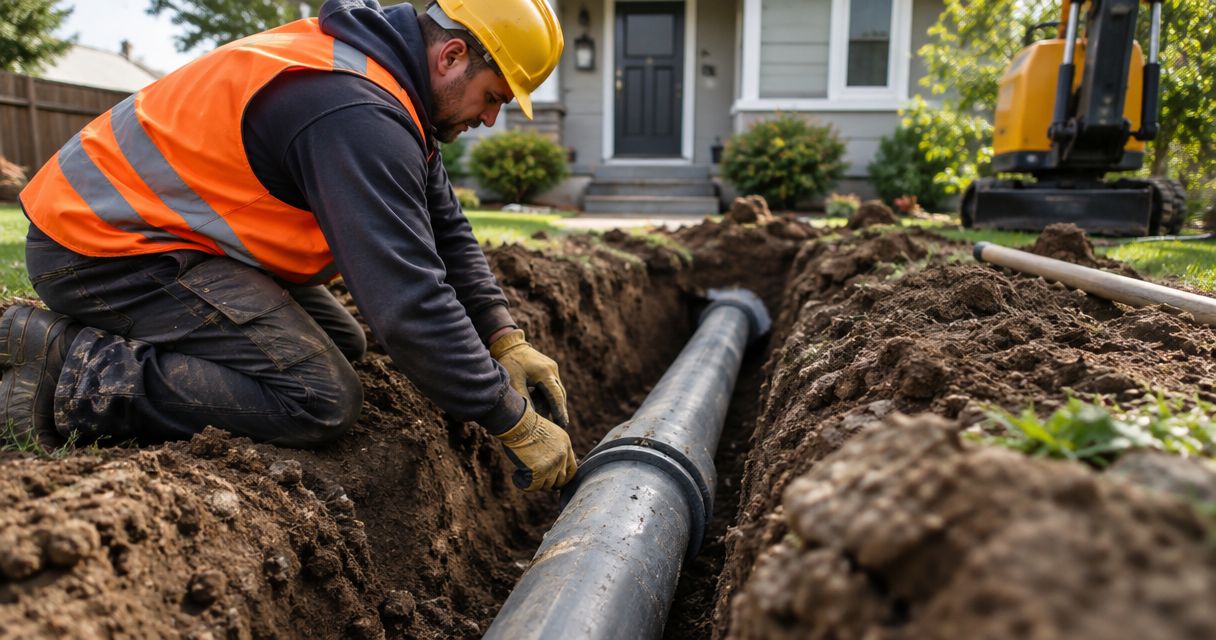
Open-trench replacement exposes the affected pipe through excavation. It gives the plumber direct access to remove damaged sections, install new piping, and address alignment problems where digging is feasible.
Best for: Pipe damage or alignment problems that require direct access. The advantage is access to the problem itself; the drawback is disruption along the excavation route.
Ask the contractor to mark the proposed trench route before you approve the job. Identify anything above it, including paving, fences, garden beds, steps, and retaining features. Your written scope should explain what gets removed and who restores it.
Do not treat backfilling as a promise that the property will look finished. Ask separately about soil settlement, lawn repair, and hard-surface replacement.
Pipe bursting: best for suitable replacement routes
Pipe bursting replaces an existing sewer pipe by breaking it outward while pulling a new pipe through its route. It generally uses access excavations rather than exposing the entire run.
Best for: Existing sewer routes that a qualified plumber confirms are suitable for bursting. Reduced continuous excavation is the benefit; required access pits and site restrictions remain drawbacks.
Ask how the plumber has assessed the route, nearby utilities, existing connections, and access needs. A trenchless label does not establish that the method fits your property.
If the diagnosis includes a low section that holds water, ask specifically how the proposed method corrects that condition. Replacing pipe material and correcting the pipe's slope are different tasks.
Pipe lining: best for suitable pipes that can be rehabilitated
Pipe lining creates a new interior lining within an existing pipe. It is rehabilitation rather than removal and replacement of the entire original pipe, so the proposal should describe it accurately.
Best for: Pipes whose condition, shape, and access allow lining after professional assessment. The benefit is less continuous excavation; the limitation is that lining does not correct every structural or alignment problem.
Ask what preparation is necessary, how branch connections will be handled, and how the completed work will be checked. A collapsed section or unsuitable alignment can require a different approach.
For a closer comparison, review trenchless sewer repair methods. Choose the method that addresses the diagnosed defect, not simply the one described as less disruptive.
How do the sewer repair options compare?
These options solve different problems. Use the inspection findings to narrow the choice before comparing installation proposals.
| Option | Best for | Main advantage | Main limitation |
|---|---|---|---|
| Drain cleaning | A removable blockage in otherwise serviceable pipe | Clears an obstruction without replacing pipe | Does not repair broken or displaced pipe |
| Localized repair | Damage confined to an accessible section | Addresses a defined defect without replacing unaffected sections | Leaves the remaining existing pipe in place |
| Open-trench replacement | Work requiring direct access or alignment correction | Exposes the damaged section for replacement | Disturbs the excavation route |
| Pipe bursting | Replacement along a suitable existing route | Avoids a continuous open trench | Requires access and a suitable route |
| Pipe lining | Rehabilitation of a suitable existing pipe | Limits excavation along the pipe run | Does not resolve every collapse or slope problem |
The right sewer repair is the one that corrects the documented defect. Ask the plumber to explain both why the recommended option fits and why the alternatives do not.
Why the cost to replace a main sewer line varies
For a 2026 sewer replacement estimate, these site conditions define the work. Ask the plumber to connect each proposed task to something observed or confirmed at your property.
- Pipe length: A localized failure and a damaged run require different amounts of pipe work. Confirm the start and end points rather than accepting an undefined promise to replace the line.
- Burial depth: Deeper work changes excavation, access, and worker-protection requirements. Ask how depth was established and what remains to be verified.
- Surface access: Lawn, concrete, driveways, and structures create different removal and restoration needs. Identify the surfaces affected before work starts.
- Pipe condition: Roots, cracks, displaced joints, collapse, and poor slope do not all call for the same solution. Ask which defect the proposed work corrects.
- Replacement method: Open excavation, bursting, and lining involve different equipment, preparation, and access. Suitability comes before convenience.
- Local requirements: Permits, inspections, utility coordination, and work near public infrastructure affect the scope. Confirm who handles each requirement.
An unexplained difference between estimates is a reason to compare scope, not assume one contractor is wrong. Ask each contractor to identify exclusions in plain language.
What should you do before approving sewer replacement?
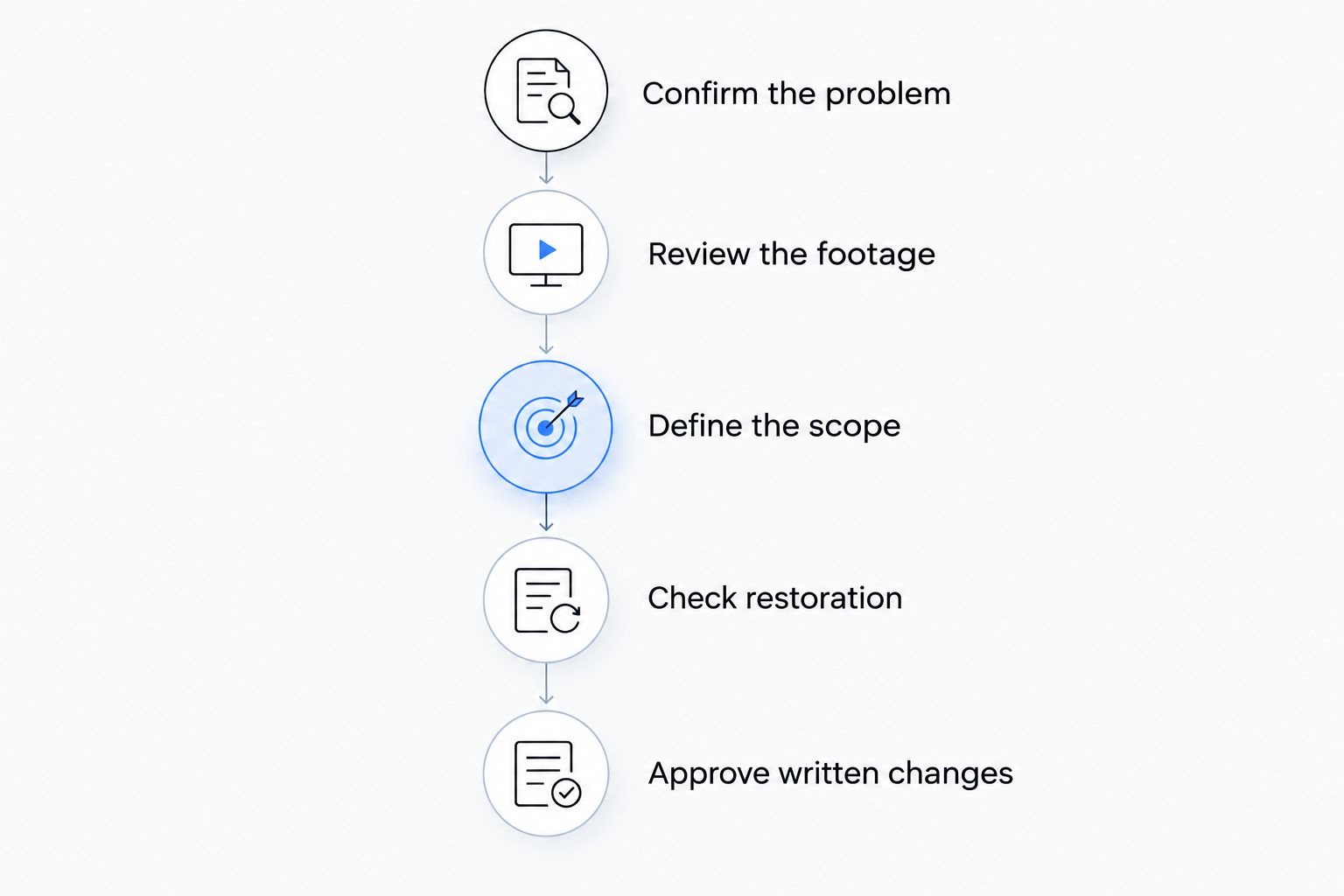
Use this sequence to move from a drain problem to an informed decision. If sewage is backing up, arrange urgent help first; do not postpone containment while collecting routine proposals.
- Confirm the problem. Describe which fixtures are affected, when backups happen, and whether cleaning has helped before. Let the plumber determine what inspection or clearing is necessary.
- Review the footage. Ask to see the relevant camera recording and have the defect explained. A camera shows the interior condition; locating helps establish where the problem sits underground.
- Define the scope. Get the proposed repair boundaries, method, connections, and exclusions in writing. Ask why a localized repair or cleaning would not solve the problem if full replacement is recommended.
- Check restoration. Identify every disturbed surface and the party responsible for finishing it. Clarify whether restoration is included or requires another contractor.
- Approve written changes. Establish how unexpected conditions will be documented and authorized. Keep the original proposal, change approvals, inspection records, and completion documentation together.
Ask about plumbing use during the work, too. Your household needs to know when toilets, sinks, showers, and laundry must stay off and who confirms that normal use can resume.
Does a sewer backup mean the entire line needs replacement?
A sewer backup alone does not establish that the entire line needs replacement. A blockage can interrupt drainage even when the pipe remains serviceable; damaged pipe can also cause recurring obstructions.
The distinction matters. Cleaning addresses material inside the line, while repair or replacement addresses a physical defect. Ask for evidence connecting the recommended work to the cause of the backup.
If sewage enters the home, keep children and pets away from affected areas and avoid contact with contaminated water. Do not enter standing water near electrical equipment. Arrange urgent plumbing service and appropriate cleanup.
Is trenchless sewer replacement always the better choice?
Trenchless sewer replacement is appropriate only when the pipe route and site conditions support it. Reduced digging is useful, but it does not outweigh leaving the underlying problem unresolved.
Ask what the proposed method will correct and what it will leave unchanged. Get the access-pit locations and restoration responsibilities in writing, just as you would for an open-trench project.
Who pays when the damaged sewer pipe is near the street?
Responsibility depends on local rules and the location of the damaged section. Do not assume that pipe outside your property boundary automatically belongs to the sewer utility.
Ask the local sewer authority where homeowner responsibility ends and whether work affects a public connection or right-of-way. For a 2026 project, confirm current requirements before authorizing work near public infrastructure.
FAQ
How do I get an accurate estimate for main sewer line replacement?
Get a property-specific inspection and a written proposal defining the damaged section, installation method, access, and restoration. Compare proposals only after confirming that they cover the same work.
Can a plumber repair part of my sewer line instead of replacing everything?
A localized repair is an option when damage is confined to a section and the remaining pipe is suitable to keep. Ask the plumber to explain the condition of both the damaged section and the pipe that would remain.
Is trenchless sewer replacement better than digging up the yard?
Trenchless sewer replacement limits continuous excavation when the route and pipe conditions are suitable. Open excavation remains appropriate when direct access or alignment correction is needed.
Does homeowners insurance cover sewer line replacement?
Coverage depends on your policy, endorsements, and the cause of damage. Ask your insurer what documentation it needs, and do not assume routine deterioration or root damage is covered.
Can I keep using water when my main sewer line is backing up?
Stop using fixtures that discharge into the affected line when sewage is backing up. Arrange urgent service rather than flushing toilets or running water to test whether the blockage has cleared.
What should I ask about a sewer replacement warranty?
Ask what the written warranty covers, who provides it, and what exclusions or maintenance conditions apply. Keep the warranty with the installation scope, completion records, and inspection documentation.
Can Mainline Plumbing help me find a local sewer plumber?
Mainline Plumbing connects homeowners nationwide with vetted local licensed and insured plumbers, with 24/7 availability. Confirm the diagnosis, written scope, and service arrangements with the assigned local professional.
One last thing
A clear restoration plan is part of a clear sewer replacement proposal. Before you sign, ask what your yard, walkway, or driveway will look like when the plumbing contractor's work ends—and who handles anything unfinished.
For your 2026 project, keep the camera recording and written diagnosis even after the repair is complete. Those records explain what was found, what was authorized, and which section was addressed.
Related guides
- How do you know if your main sewer line is clogged?
- How to use a sewer camera inspection for an insurance claim
Book a local sewer assessment
Mainline Plumbing is best for homeowners seeking a connection to vetted local licensed and insured plumbers for residential sewer service. Mainline Plumbing connects homeowners nationwide; it is not one in-house national plumbing crew. Ask the assigned local professional to explain the findings, proposed method, and restoration scope before you approve work.
Book a local sewer assessment
Connect with a vetted local licensed and insured plumber. Available 24/7 nationwide.